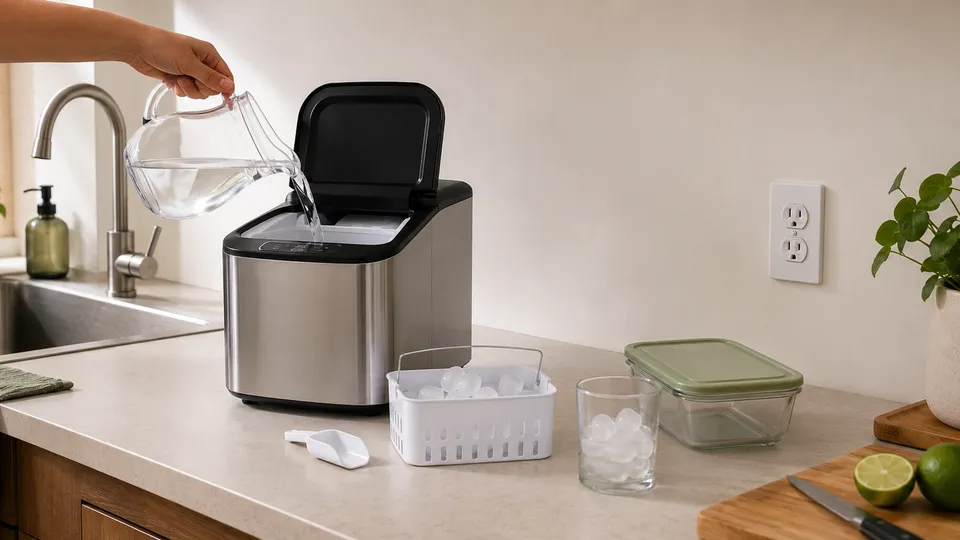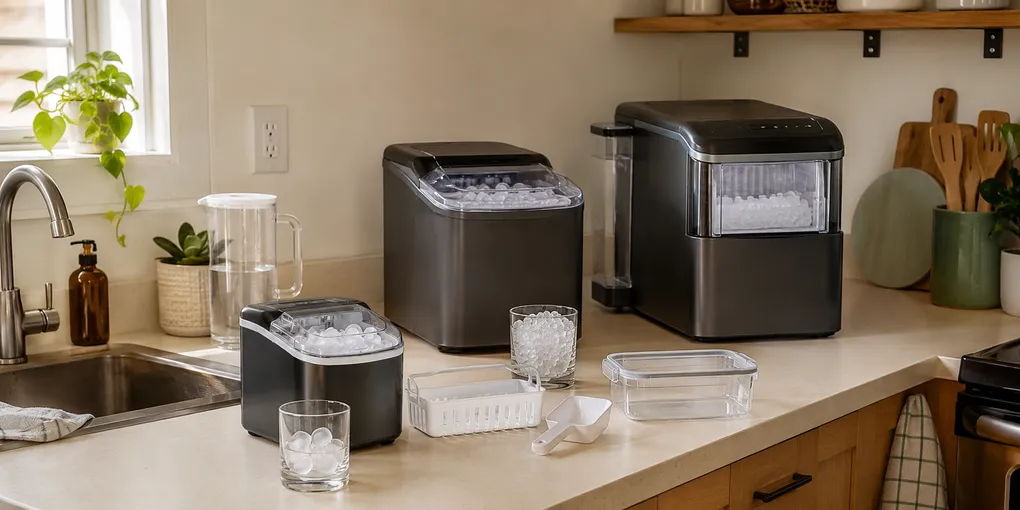
A countertop ice maker can make sense in a small apartment when you use ice often enough to justify a permanent counter spot. It does not make sense simply because it is smaller than a refrigerator ice maker. You still need a place to fill it, let it breathe, scoop ice, clean it, and deal with melting ice that is not being used.
That is why the best choice is not automatically the machine with the largest daily-output number. For an apartment kitchen, the useful questions are more practical:
- Will the machine fit at its full depth, with its lid and water-fill access usable?
- Do you want ordinary bullet ice or chewable nugget ice enough to accept more cleaning and counter commitment?
- Are you comfortable refilling a reservoir and moving fresh ice to the freezer?
- Can the machine sit near a grounded wall outlet without a cord crossing the sink or a cooking area?
This guide compares three clearly different roles: the smallest practical bullet-ice machine, a compact daily nugget-ice option, and a premium nugget machine for someone who will use it frequently. Specifications below come from the manufacturers’ current product pages or manuals; verify the exact model, electrical label, and clearance instructions before ordering because product revisions can change them.
Quick Picks
| Pick | Best for | Officially listed highlights | Watch before buying |
|---|---|---|---|
| Igloo IGLICEBSC26 | The smallest regular-ice role | 26 lb per 24 hours; 1.5 qt water reservoir; 12.6 in W x 8.98 in D x 11.69 in H; 120 W | The 1.5 lb basket is not freezer storage. |
| Euhomy Pearl L1 | Daily nugget ice without stepping up to a premium side-tank setup | 35 lb per 24 hours; 1.1 L tank; first ice stated as 7 to 10 minutes; self-cleaning function | Confirm the current IM-15S-AZ-HM manual’s outer dimensions, rated input, and clearance at checkout. |
| GE Profile Opal 2.0 Ultra | A frequent nugget-ice routine with room and budget for it | 38 lb per day; 3 lb bin; 10.5 in W x 17.5 in D x 16.5 in H without side tank; 360 W | Its depth, 4-inch listed clearance, upkeep, and optional side tank make it a deliberate counter commitment. |
Start With the Apartment Constraints
Measure the working footprint, not just the empty rectangle
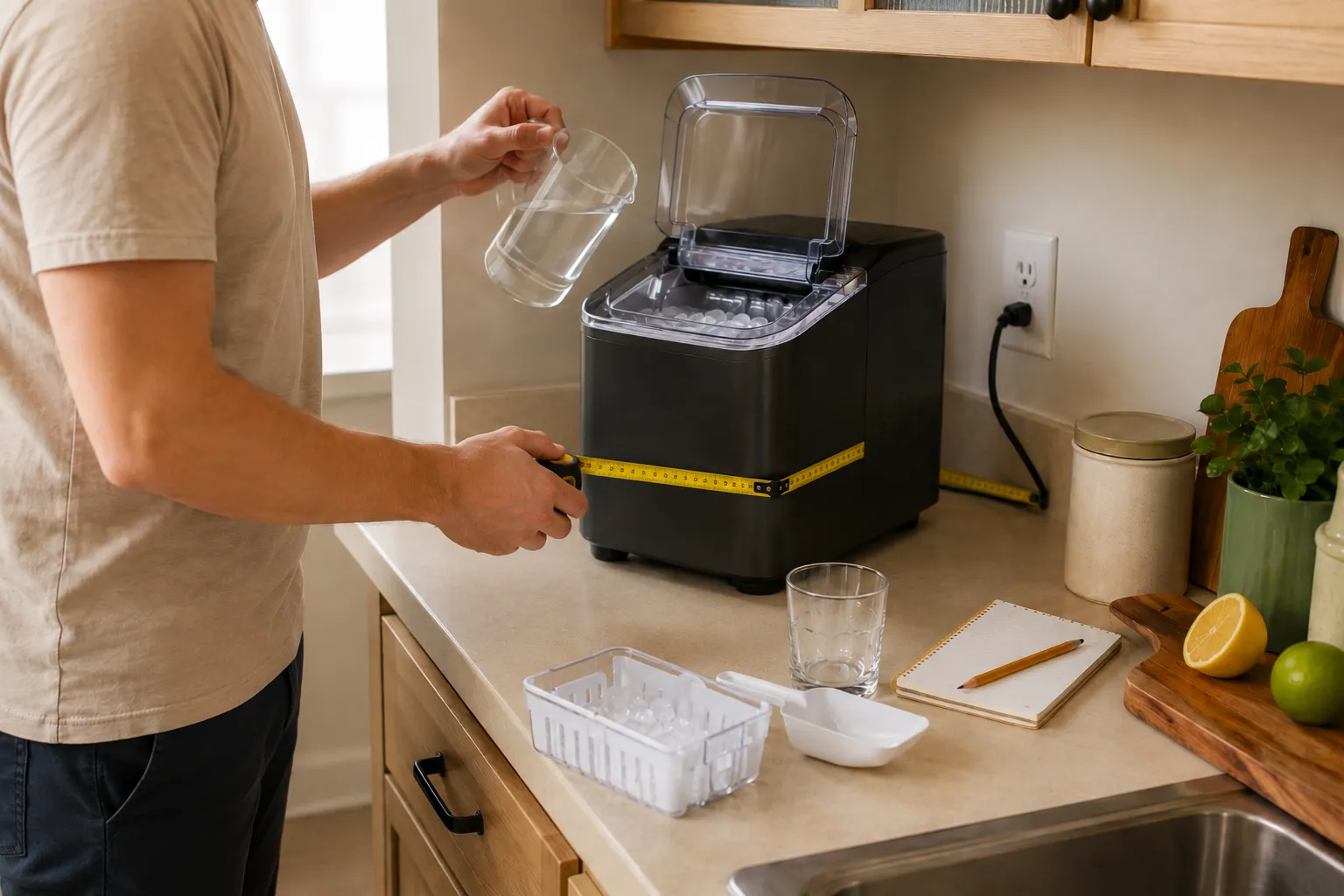
For a countertop ice maker, width is often the easy number. Depth is what can turn an apparently compact appliance into an awkward one. Measure from the wall to the front of the counter, then leave room to reach the lid, add water, remove the ice basket, and place a cup or scoop in front of it.
For example, the compact Igloo is listed at just under 9 inches deep, while the GE Opal is listed at 17.5 inches deep before accounting for usable space around it. GE also lists 4 inches of clearance at the sides and rear. That clearance is specific to the Opal’s documentation, not a universal number to apply to every ice maker. Read the manual for whichever model you are considering.
Upper cabinets matter too. A machine can fit under a cabinet while still making its water lid inconvenient to open. If you cannot fill and clean it without moving it every time, it is unlikely to earn a permanent counter space.
A countertop ice maker is not a freezer
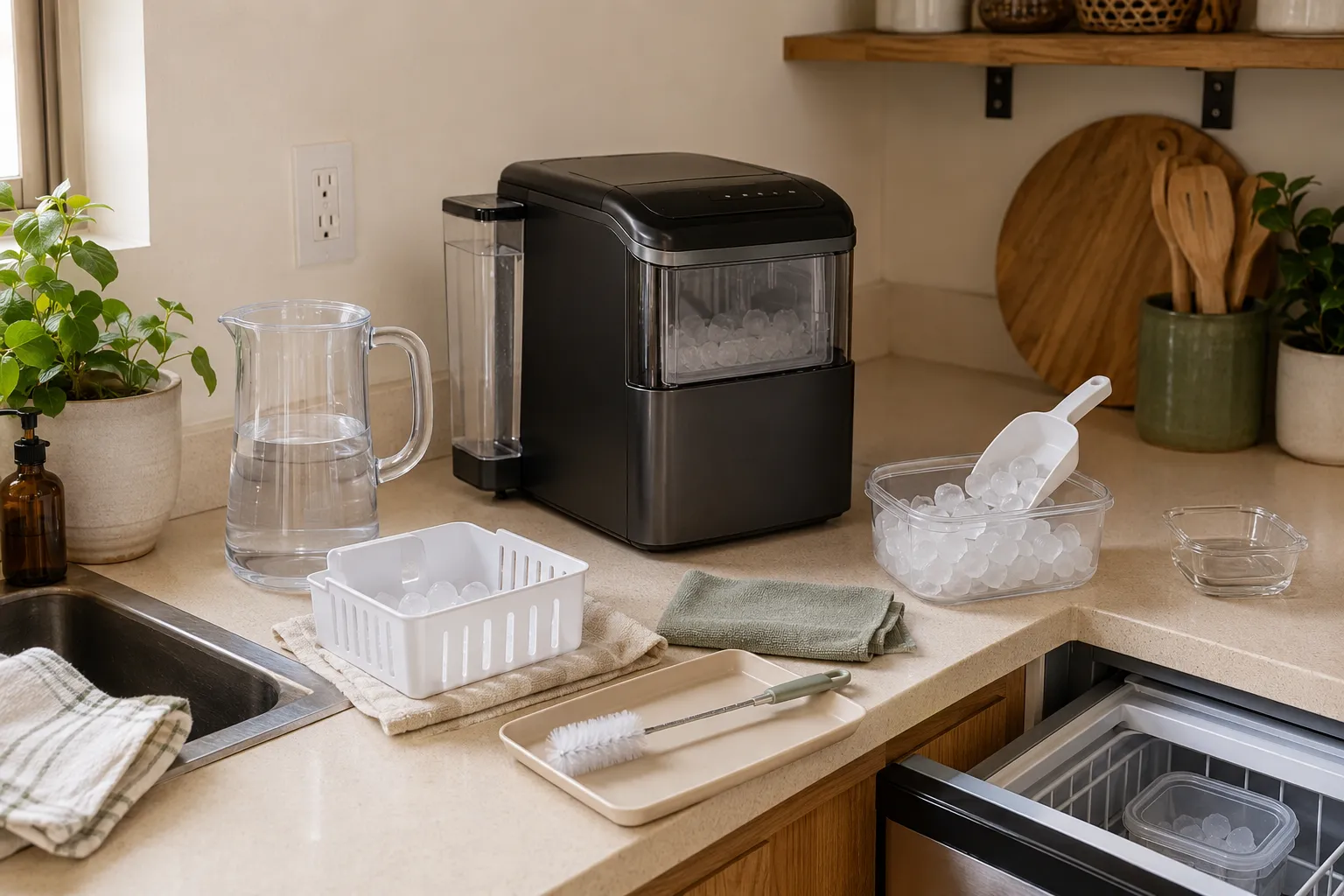
The insulated basket holds finished ice temporarily. It does not freeze and store it indefinitely. If you make a batch for later, move that ice to your freezer. When ice begins to melt inside the basket, the water generally returns to the reservoir and is made into new ice; that is convenient for the machine but not the same as long-term storage.
This changes the best choice for a one-person apartment. A modest machine that you run before guests or during a heat wave may be more useful than a high-output nugget machine that occupies the counter every day but is used only occasionally.
Plan for water, cleanup, and power before the first batch
These three choices use internal water reservoirs rather than a permanent water-line setup. That makes them renter-friendly in one sense: there is no faucet adapter or plumbing connection to plan. It also means manual refilling is part of the routine.
If you are deciding between a manual-fill countertop model and a model that may need installation, read whether countertop ice makers need a water line before treating every ice maker as the same appliance category.
Use a stable, level counter close to a grounded wall outlet. Keep the cord clear of water, hot cooking surfaces, and the sink. Do not assume that a power strip or an extension cord is an acceptable substitute for a correctly located outlet; follow the manufacturer instructions and your lease or building rules.
Cleaning is not optional. Mineral scale, stale standing water, and a neglected basket will make an ice maker less pleasant to use. Pick a machine only if you are willing to empty, wipe, and run its recommended cleaning cycle on the schedule in its manual.
Best Compact Bullet-Ice Option: Igloo IGLICEBSC26
The Igloo IGLICEBSC26 is the strongest fit when a small physical footprint matters more than having a specific ice texture. Its official manual lists a 12.6-inch width, 8.98-inch depth, and 11.69-inch height, which gives it a much easier starting footprint than many countertop nugget machines. The same manual lists a 1.5-quart reservoir, a 1.5-pound basket, production of up to 26 pounds in 24 hours, and a 120 W electrical rating.
That role is straightforward: it is a compact, refillable bullet-ice maker for someone who wants normal ice in a small kitchen, not a substitute for a large freezer or an always-ready bar setup.
What works in an apartment:
- The shallow listed depth leaves more usable counter in a narrow kitchen.
- The reservoir format avoids a faucet hookup or plumbing modification.
- Its lower stated electrical draw is worth noting when planning limited kitchen outlets, although you should still use the outlet and cord arrangement specified in the manual.
What to keep in perspective:
- The basket capacity is small and the basket is not refrigerated storage.
- A listed daily output is a production ceiling, not a promise that you will have a full day’s ice waiting in the basket.
- Bullet ice and nugget ice are different experiences. Do not pay for a nugget machine if regular ice is all you actually need.
Best Daily Nugget-Ice Role: Euhomy Pearl L1
The Euhomy Pearl L1 is the middle role for someone who specifically wants nugget ice but does not need to begin with GE’s larger premium setup. Euhomy’s current product page lists 35 pounds of ice per 24 hours, a 1.1-liter water tank, a first-ice time of 7 to 10 minutes, and an automatic cleaning function.
Those are useful daily-routine signals: the tank must still be filled manually, and the automatic cleaning feature reduces steps only if you actually use it. Nugget ice is also a preference, not an objective upgrade. It suits people who enjoy softer, chewable ice in cold drinks; it does not solve a lack of freezer storage or counter space.
There is one deliberate boundary in this guide. Euhomy links the IM-15S-AZ-HM instruction manual from the current product page, but retailer listings can show inconsistent outer dimensions and electrical figures. Check the current official manual for the unit’s listed width, depth, height, rated voltage/wattage, clearance, and outlet instructions before treating it as a fit for a particular cabinet gap. A compact-looking photo is not a measurement.
This is a sensible short-list option when your counter has enough working depth, you expect to make nugget ice several times a week, and the manual confirms that the exact current model fits your outlet and layout.
Premium Nugget-Ice Option: GE Profile Opal 2.0 Ultra
The GE Profile Opal 2.0 Ultra is for a more committed nugget-ice routine, not for someone merely looking for the smallest appliance. GE lists production of up to 38 pounds per day, a 3-pound bin, and a first batch in 10 minutes or less. The base unit is listed at 10.5 inches wide, 17.5 inches deep, and 16.5 inches high; adding the side tank increases the listed width to 13.43 inches. GE also lists a 120 V, 2.5 A, 360 W electrical specification and 4 inches of side and rear clearance.
The important apartment tradeoff is depth. The Opal can be narrow without being easy to place. On a standard shallow counter, a 17.5-inch appliance plus usable front space and stated clearance can take over the work zone. It also has ongoing water, scale-management, and filter-related upkeep that belongs in the budget and routine.
The side tank can reduce refilling friction, but it widens the setup. It is useful only when the whole arrangement still leaves room to prep food and reach the sink. Treat it as an option for a household that makes ice often enough to maintain it, not as a default upgrade.
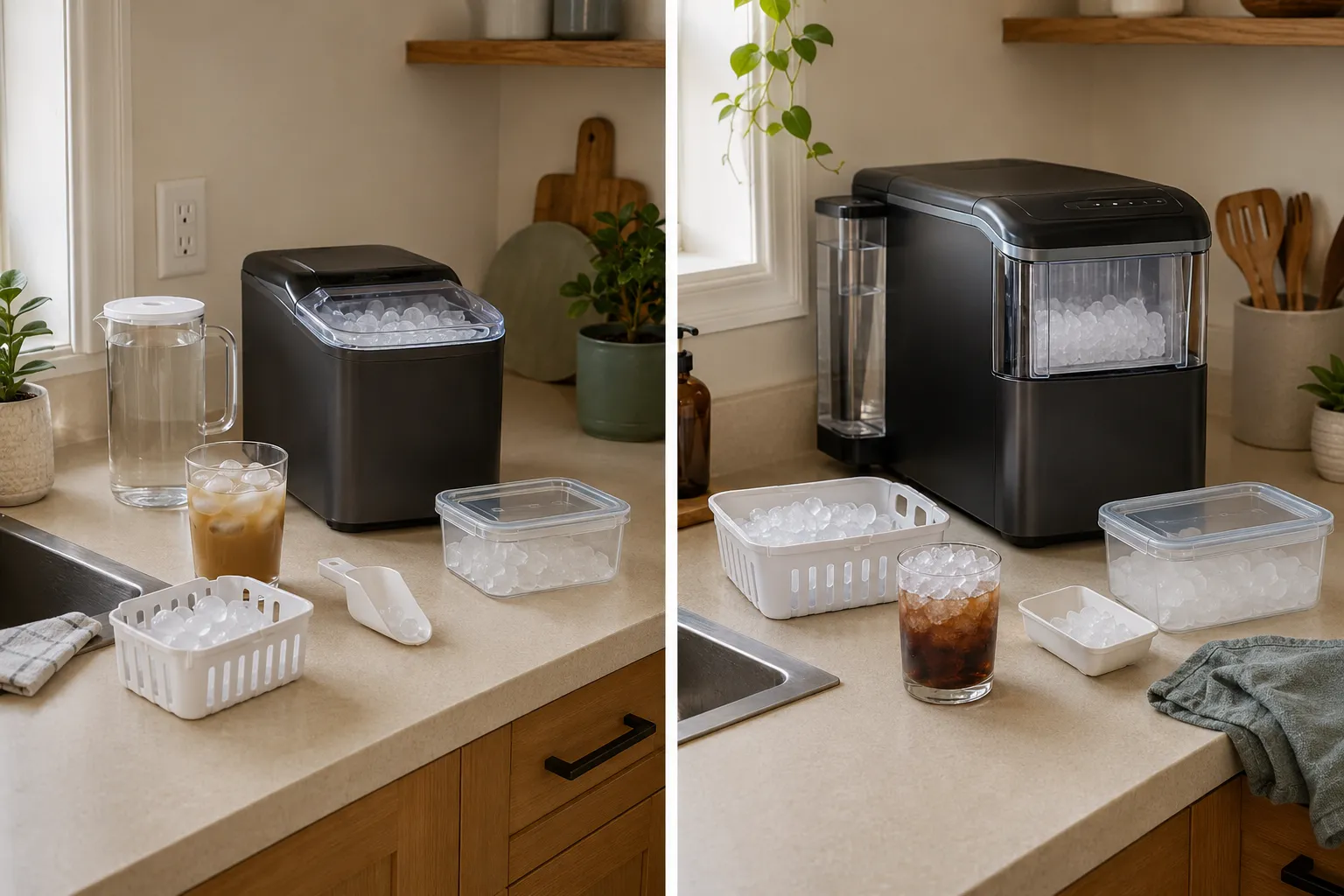
Bullet Ice vs. Nugget Ice: Choose the Routine First
There is no single “best” countertop ice texture.
| If your routine is mostly… | The more practical direction | Why |
|---|---|---|
| Water, iced coffee, or occasional mixed drinks | Compact bullet ice | The smaller, simpler machine may leave more counter space for the rest of the kitchen. |
| Cold drinks every day and a strong preference for chewable ice | Nugget ice | The texture preference can justify the larger purchase and cleaning routine. |
| Entertaining a few times a month | A compact reservoir model | You can make batches when needed and move finished ice to the freezer. |
| Wanting ice permanently ready with no refill or maintenance effort | None of these countertop models | A reservoir ice maker still needs water, cleaning, and basket management. |
Avoid treating the daily-output figure as the deciding number. First decide whether you would notice and value the ice type frequently. Then check the actual footprint and ownership routine.
How to Pick the Right One for Your Kitchen
Use this short decision path before buying:
- Measure depth, height, and working space. Include the wall, upper cabinet, lid access, a scoop, and the space in front of the machine.
- Pick the ice texture you will actually use. Regular bullet ice often solves the need with less counter commitment; nugget ice is a preference worth paying for only when it is truly part of your routine.
- Check the manual for the exact model. Confirm voltage, watts or amps, outlet guidance, clearance, water capacity, cleaning instructions, and the current dimensions. Do not rely on a marketplace title or a product photo.
- Plan the water and freezer workflow. Decide where you will fill it, where you will set down the basket, and whether you have freezer space for ice you want to keep.
- Count cleaning as ownership time. If you would not regularly empty, wipe, and run a cleaning cycle, spend the counter space on a simpler appliance.
For a wider framework on choosing appliances around a small kitchen’s actual counter, storage, outlet, and cleaning constraints, see what to look for before buying small appliances for a first apartment.
FAQ
Do countertop ice makers need a water line?
Not necessarily. The three models in this guide use refillable internal reservoirs according to their product information, so their routine is manual filling rather than a permanent water-line connection. Confirm the manual for the exact model before purchase because product variants can differ.
Can I leave ice in a countertop ice maker overnight?
Treat the basket as temporary holding space, not a freezer. If you want to keep finished ice for later, move it to a freezer. Check your model’s manual for its specific handling and cleaning instructions.
Are countertop nugget ice makers good for a small apartment?
They can be, if nugget ice is a genuine daily preference and the counter has enough depth, clearance, and outlet access. They are not automatically the better small-apartment choice: a smaller bullet-ice maker may suit an occasional user better.
How often should I clean a countertop ice maker?
Follow the schedule and method in the exact product manual, especially if you have hard water or use the machine frequently. Emptying unused water and keeping the basket and interior clean are basic parts of the routine; an auto-clean function does not remove the need to follow the manufacturer directions.
Final Thoughts
For most small apartments, the right countertop ice maker is the smallest one that matches a real drinking habit. The Igloo is the compact regular-ice choice when depth is tight. The Euhomy Pearl L1 is a nugget-ice option to evaluate carefully against its current official manual. The GE Opal 2.0 Ultra fits a frequent-user, premium nugget-ice routine only when its deeper footprint, clearance, and upkeep are genuinely acceptable.
Measure first, read the exact model manual second, and let your real routine decide whether the appliance earns its counter space.