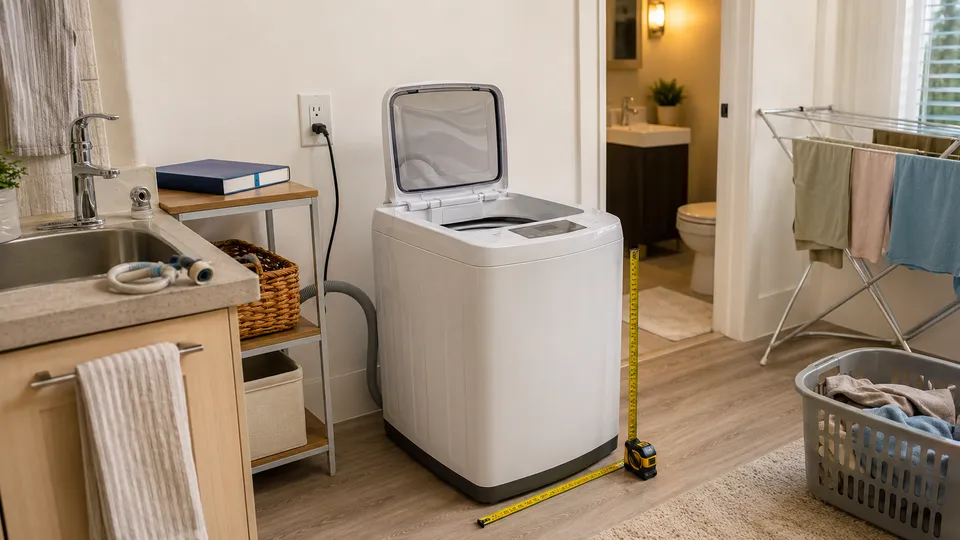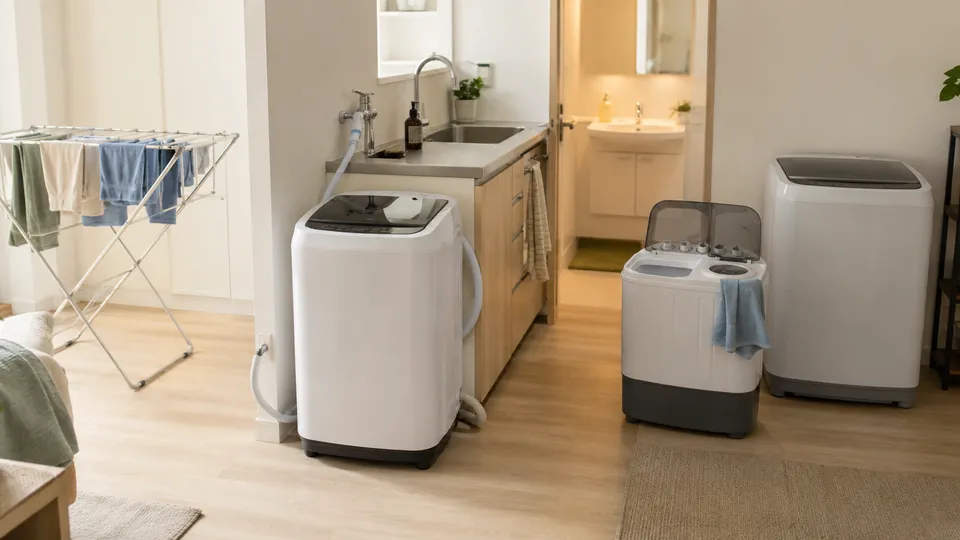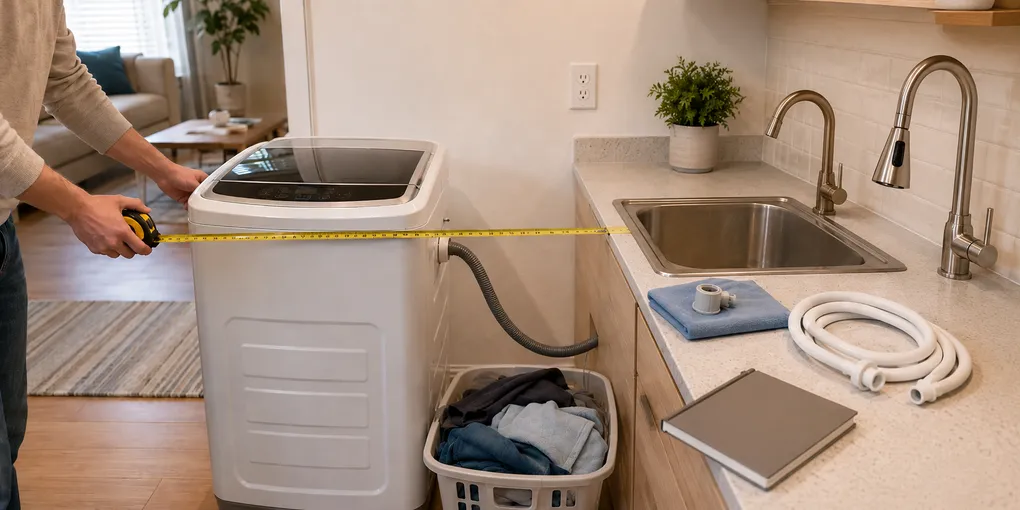
A portable washing machine may connect temporarily to a sink faucet, but the word “portable” does not mean it fits every faucet. Before you choose an automatic washer with a quick-connect hose, you need to know whether the exact washer manual supports the exact faucet in your apartment.
A fixed faucet with a removable aerator can be a promising starting point. A pull-down or pull-out faucet is not automatically incompatible, but it is not automatically compatible either. A generic listing for a “universal” adapter cannot settle that question.
This guide is a buying decision guide, not a plumbing-modification guide. It does not approve a connection, override a lease, or suggest adapting a faucet beyond the instructions for the exact washer and faucet.
Quick Answer: Is Your Faucet Worth Investigating?
| Faucet situation | What to do before buying an automatic portable washer |
|---|---|
| Fixed faucet with a removable aerator | Compare the washer’s supplied-adapter instructions with the faucet’s aerator and threads. This is the clearest situation to investigate. |
| Pull-down or pull-out faucet | Treat compatibility as unconfirmed. Check the washer maker and faucet maker rather than assuming an adapter will work. |
| Filtered, touchless, concealed-aerator, or unusual faucet | Stop before ordering. The fitting, controls, and manufacturer instructions may differ from a standard exposed faucet. |
| No documented faucet match | Consider a manual-fill twin-tub washer instead of turning an uncertain adapter into the plan. |
The faucet is only one part of the decision. You still need permission, a secure drain route, a suitable outlet, stable floor space, and a drying plan. Start with can you use a portable washing machine in an apartment if you have not checked the complete setup.
What “Compatible” Actually Means
Compatibility is not a visual guess. A faucet connection is only a reasonable candidate when all of these are true:
- The washer’s current manual describes a connection method for that kind of faucet.
- The faucet has the removable aerator, threads, and physical clearance that the washer’s supplied fitting requires.
- The hose can lock into place and remain supported for the full cycle.
- The machine’s drain hose can reach an approved drain point without being stretched, kinked, or left where it can move free.
- The rental permits the appliance and its temporary water connection.
One manufacturer illustrates why the exact wording matters. GE’s portable-washer instructions describe a one-faucet “unicouple” connection that combines water inlet and drainage. GE says the sink faucet must have a removable aerator, then instructs the owner to install the supplied adapter, lock the hose collar onto it, and give the connection a small tug to confirm it is locked. The same instructions require a nearby GFCI outlet and level feet before use. Read GE’s current portable-washer setup instructions.
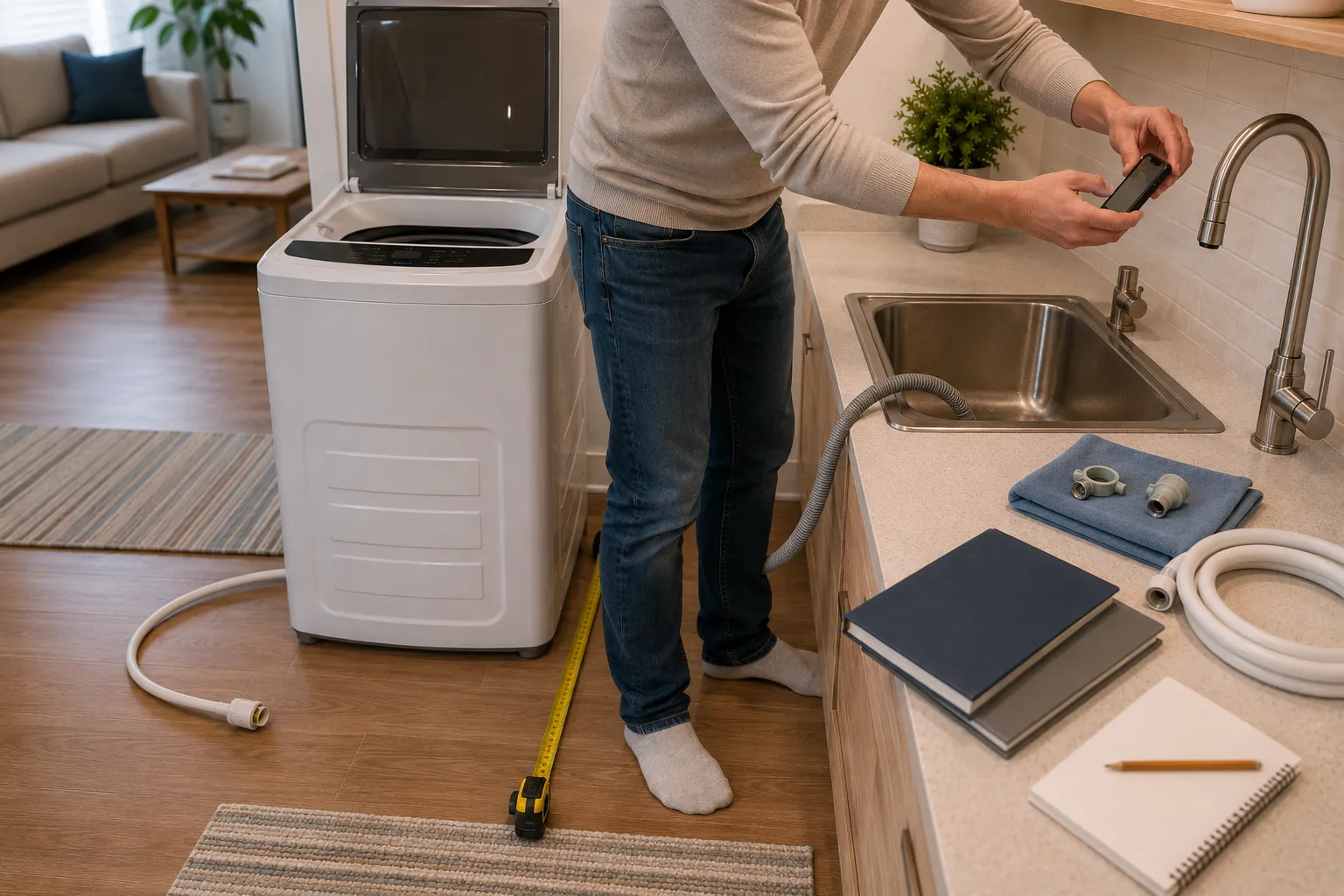
That is useful evidence for a compatible GE-style setup. It is not a universal rule for every portable washer, faucet, adapter, or apartment.
Fixed Faucets With a Removable Aerator: The Best Starting Point
A fixed faucet has a rigid spout. When its aerator can be removed and the washer manual calls for that method, you have a concrete compatibility path to investigate.
For the GE one-faucet setup, the instructions call for these model-specific steps:
- Remove the original aerator from the sink faucet.
- Thread the supplied faucet adapter onto the faucet head.
- Push down the unicouple locking collar, lift it onto the adapter, and release the collar.
- Confirm the connection is locked with a small tug.
GE also notes that its adapter has inside and outside threads and includes extra O-rings for different faucet types. That does not mean an unrelated adapter fits every thread. It means the included parts are part of that machine’s documented system.
Before ordering, take clear photos of the faucet tip with and without the aerator if it can be removed. Save the washer model number and manual link with those photos. If the instructions do not clearly match the faucet, ask the washer manufacturer before spending money on fittings.
Pull-Down and Pull-Out Faucets: Stop and Confirm
A pull-down or pull-out faucet has a moving spray head and flexible hose. Its end fitting, aerator design, and support while a hose is attached can differ from a fixed spout.
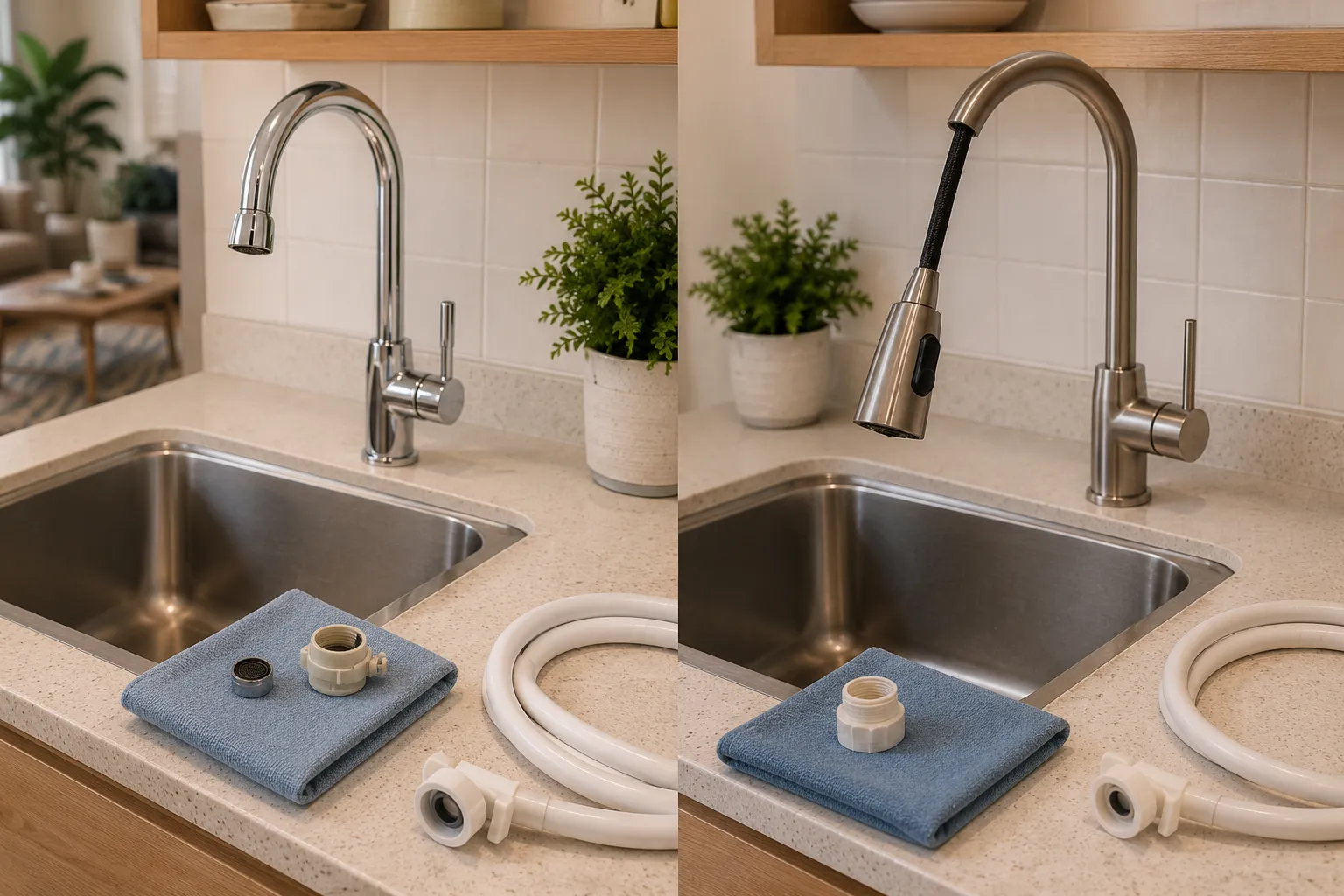
The GE portable-washer instructions above confirm a removable-aerator sink-faucet path. They do not say that every retractable spray-head faucet is supported. That gap matters. Do not convert “the instructions mention a sink faucet” into “my pull-down faucet is compatible.”
Use this as a stop-and-confirm checklist:
- Identify the faucet’s exact brand and model, not just its finish or general shape.
- Find the faucet maker’s current aerator and accessory documentation.
- Find the exact washer manual’s stated connection method and supplied fittings.
- Ask the washer maker whether the documented connection applies to that faucet model.
- Ask the landlord or manager when the rental rules are unclear about temporary water-using appliances.
If one answer remains uncertain, do not make a generic adapter the deciding purchase. A low-cost part is not useful if it leaves the hose unsupported, conflicts with the faucet instructions, or creates a setup your rental does not permit.
Why a “Universal” Adapter Is Not a Compatibility Result
An adapter listing can tell you what thread or hose end a part claims to fit. It cannot tell you whether the washer manufacturer approves the water connection, whether a pull-down head remains stable, whether the drain route is safe, or whether the lease allows the appliance.
Avoid building the purchase decision around claims such as “fits most faucets” or photos of a different washer. The correct order is:
- Confirm the washer’s required connection.
- Identify the faucet’s actual construction.
- Confirm the two together with the relevant manufacturers.
- Then confirm drainage, electrical access, floor stability, and rental permission.
This order may feel slower than buying an adapter first, but it prevents the most common waste: owning a washer that cannot be connected where you live.
Manual-Fill Twin-Tub Washers: The Faucet-Free Alternative
When the faucet is the uncertain part of the apartment, a manual-fill twin-tub washer can be more realistic than forcing an automatic connection. This is not a shortcut; it is a different laundry routine.
For example, ROVSUN’s 11 lb. twin-tub washer describes a process in which you load clothing, fill the tub with water, set the wash timer, drain the water, and then move clothes to the separate spinner. The official listing states a 7 lb. wash tub and 4 lb. spinner, with wash timing up to 15 minutes and spin timing up to five minutes. It lists the unit at 110 V / 60 Hz, around 22 lb., with dimensions of 14 L x 21.6 W x 23.6 H in. See ROVSUN’s product page and linked manual.
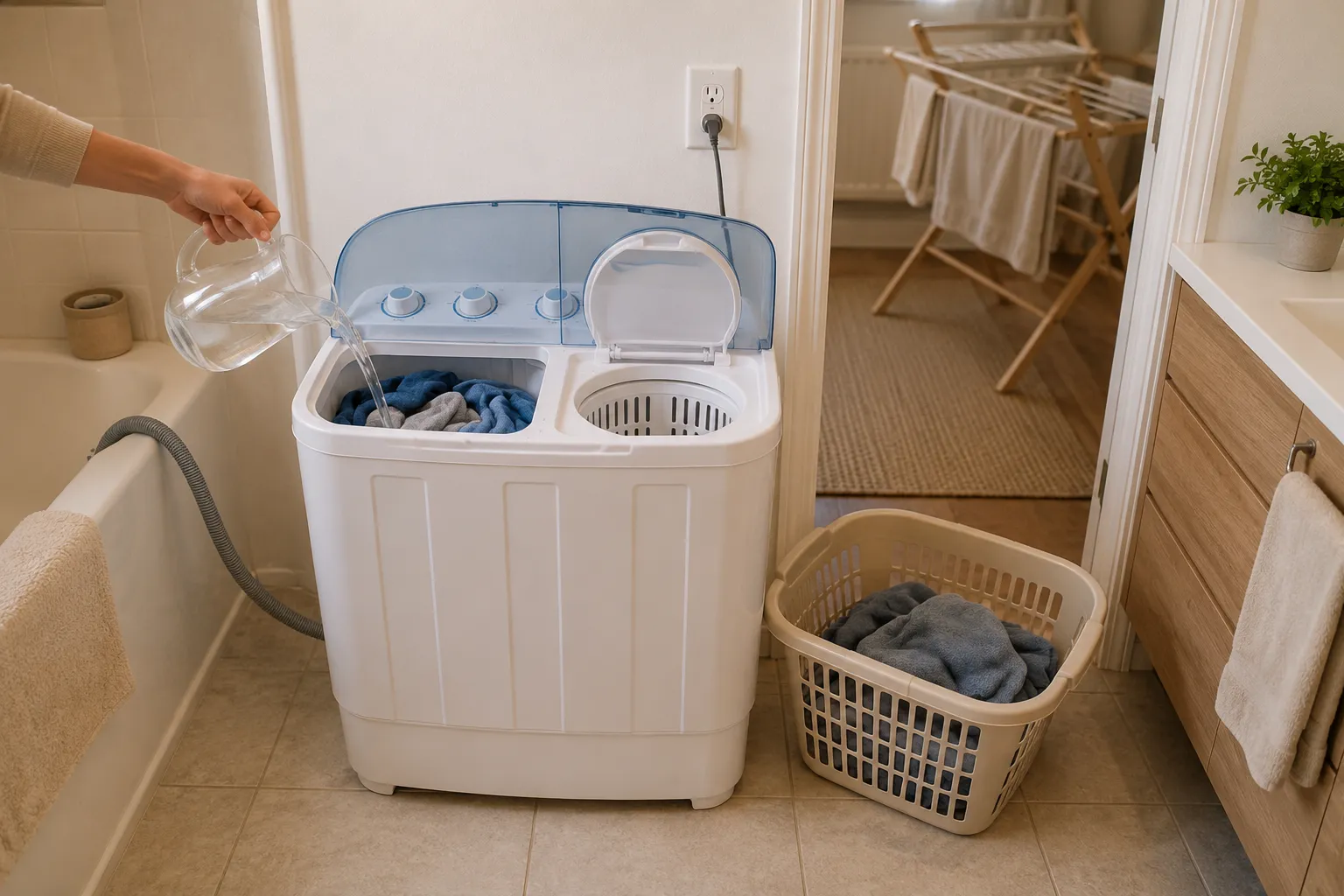
The advantage is that the washing routine does not depend on a faucet adapter. The tradeoffs are manual filling, user-managed drainage, moving wet clothes to the spinner, and a separate drying plan. A spinner removes water; it does not provide heated drying.
For a comparison of automatic, twin-tub, larger-capacity, and dryer-pairing roles, read the best portable washing machines for apartments.
Four Things a Faucet Adapter Cannot Solve
Even a documented faucet connection does not complete an apartment laundry setup.
| Check | Why it still matters |
|---|---|
| Lease and building rules | A temporary hose can still be prohibited or require written permission. |
| Drain route | The machine needs an approved destination that stays available and secure for the entire cycle. |
| Outlet and floor | The machine needs the electrical setup in its manual and a level, stable place where it will not block a walkway. |
| Drying | A spin cycle is not a complete drying plan. You still need room for a rack or the documented requirements of a separate dryer. |
Do not buy an automatic portable washer because the faucet is probably workable, then solve these four questions after it arrives. The apartment has to support the whole routine.
Before You Order: A Five-Minute Documentation Check
Gather these items before you compare models or adapters:
- The washer’s exact model number and current manual.
- A photo of the faucet tip and aerator, plus the faucet brand and model if known.
- A photo of the proposed washer location, sink or tub, outlet, and drain route.
- The measurement from the machine location to the drain point.
- The relevant lease or building-rule language about in-unit laundry and water-using appliances.
This gives a manufacturer or property manager enough concrete information to answer. It is more useful than asking whether portable washers “usually fit” an apartment faucet.
FAQ
Can a portable washing machine connect to a bathroom faucet?
Possibly, but only when the exact washer manual documents a suitable connection and the bathroom faucet meets those requirements. Do not assume a bathroom faucet works merely because it has an aerator.
Will a portable washer work with a pull-down faucet?
Do not assume so. A pull-down or pull-out faucet needs model-specific confirmation from the washer and faucet manufacturers. A generic adapter listing is not enough evidence.
Do I need a faucet adapter for a portable washing machine?
Some automatic portable washers include a model-specific adapter or unicouple fitting. Use the supplied parts and the current manual as the starting point. Do not choose a replacement or “universal” adapter before you know what the washer and faucet documentation require.
Is a manual-fill washer better for a rental?
It can be a better fit when there is no documented faucet connection, but it still needs permission where required, a secure drain plan, a proper outlet, stable floor space, and a way to dry clothes. It trades faucet compatibility for more manual work.
Final Take
A fixed faucet with a removable aerator is the clearest automatic-washer setup to investigate. A pull-down or pull-out faucet is not a reason to guess, buy a generic adapter, or force a connection. Verify the exact equipment first.
When that verification is not available, a manual-fill twin-tub machine may be the better category to compare. The right choice is the laundry workflow your apartment can actually support, not the adapter that looks closest in a product photo.