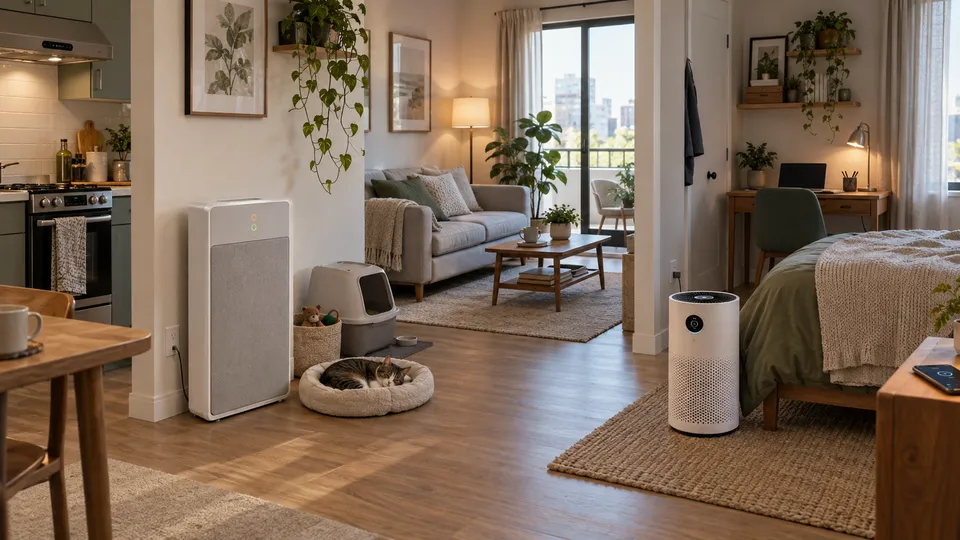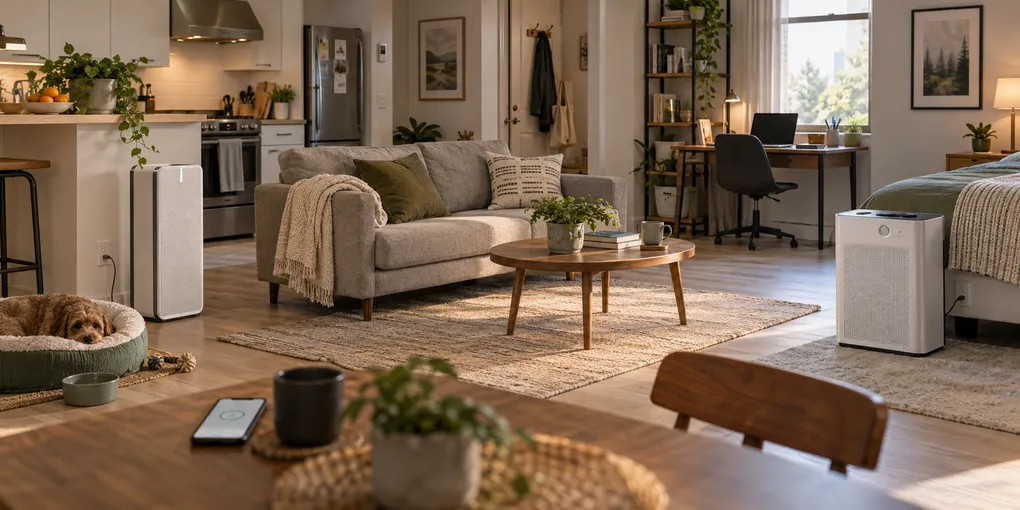
The Winix 5510 and Coway Airmega Mighty AP-1512HH are closely matched air purifiers for bedrooms, studios, and defined apartment living areas. Both have verified airflow for a medium room, a washable pre-filter, an odor-filter stage, automatic operation, and a manually controlled ionizing feature.
The important differences are less obvious. The Winix is narrower and shallower, has slightly higher published CADR figures, uses a separate carbon-pellet filter, and adds Wi-Fi controls. The Coway is shorter and lighter, uses a particle sensor rather than the Winix odor-gas sensor, and provides simple physical controls with a timer and Eco mode.
This comparison uses current U.S. documentation for the exact Winix 5510 and Coway AP-1512HH. It does not substitute specifications from the Winix 5500-2, Coway MightyS AP-1512HHS, or the newer Coway Mighty2.
If you are still choosing among several product roles rather than these two exact models, start with our guide to the best air purifiers for apartments and studios.
Quick Answer
Choose the Winix 5510 if recurring pet odor, cooking carryover, app control, or a clearly documented carbon-pellet filter matters most. It has the higher smoke CADR, a shallower footprint, a lower rated wattage, and a filter arrangement that gives odor support a clearer role.
Choose the Coway Airmega Mighty AP-1512HH if you prefer straightforward physical controls, a particle-sensing Auto mode, a shorter and lighter body, a built-in 1/4/8-hour timer, or an Eco mode that can stop the fan when its sensor no longer detects pollution.
For most pet-owning or kitchen-adjacent apartments, the Winix is the stronger starting point. For a bedroom or office where simple controls and particle-based automatic operation matter more than Wi-Fi, the Coway remains a practical choice.
Winix 5510 vs. Coway AP-1512HH at a Glance
| Decision point | Winix 5510 | Coway Airmega Mighty AP-1512HH |
|---|---|---|
| AHAM room size at 4.8 ACH | 392 sq ft | 361 sq ft |
| CADR: dust / pollen / smoke | 252 / 247 / 253 | 246 / 240 / 233 |
| Dimensions | 13.59 W x 8.27 D x 22.17 H in | 16.8 W x 9.6 D x 18.3 H in |
| Weight | 13.3 lb | 12.3 lb |
| Filtration | Washable fine-mesh pre-filter, AOC carbon-pellet filter, True HEPA filter, PlasmaWave | Washable pre-filter, deodorization filter, HEPA filter, bipolar ionizer |
| Main automatic sensor | Odorous-gas sensor | Dust/particle sensor |
| Published noise | 23.5 dB minimum; no official maximum listed | 24-53 dB(A) |
| Rated power | 65W | 77W |
| Controls | Physical controls, Wi-Fi, Winix app, Alexa | Physical controls only |
| Timer | Through the Winix app | 1, 4, or 8 hours on the control panel |
| Special automatic mode | Light-triggered Sleep mode | Eco mode can stop the fan after 30 minutes without detected pollution |
| Filter schedule | AOC carbon and HEPA approximately 12 months | Deodorization filter approximately 6 months; HEPA approximately 1 year |
| Warranty | Two years | One year for internal/functional parts; three years for applicable motor/electronic parts |
Current specifications come from the Winix 5510 product page, the Winix 5510/5520 manual, the Coway Airmega Mighty AP-1512HH product page, and the current Coway AP-1512HH manual. Prices are not used as a permanent advantage because promotions and retailer bundles change.
What Actually Differs?
These purifiers are close enough in airflow that the better purchase usually comes down to four practical differences:
- The Winix gives its carbon filter a larger role. Winix describes a separate AOC filter made with carbon pellets. Coway supplies a separate deodorization filter but does not publish comparable carbon quantity or odor-capacity data.
- They react to different signals. The Winix manual describes an odorous-gas sensor. The Coway manual describes a dust sensor and allows its sensitivity to be adjusted.
- Their bodies use floor space differently. The Winix is narrower and shallower but taller. The Coway is wider and deeper but almost four inches shorter.
- The control philosophy is different. Winix adds an app and Alexa support. Coway keeps the routine on the control panel with a physical timer and Eco mode.
Neither product is automatically better because it has one extra feature. The useful question is whether your apartment problem is mostly particles, recurring odor, bedroom placement, or day-to-day control.
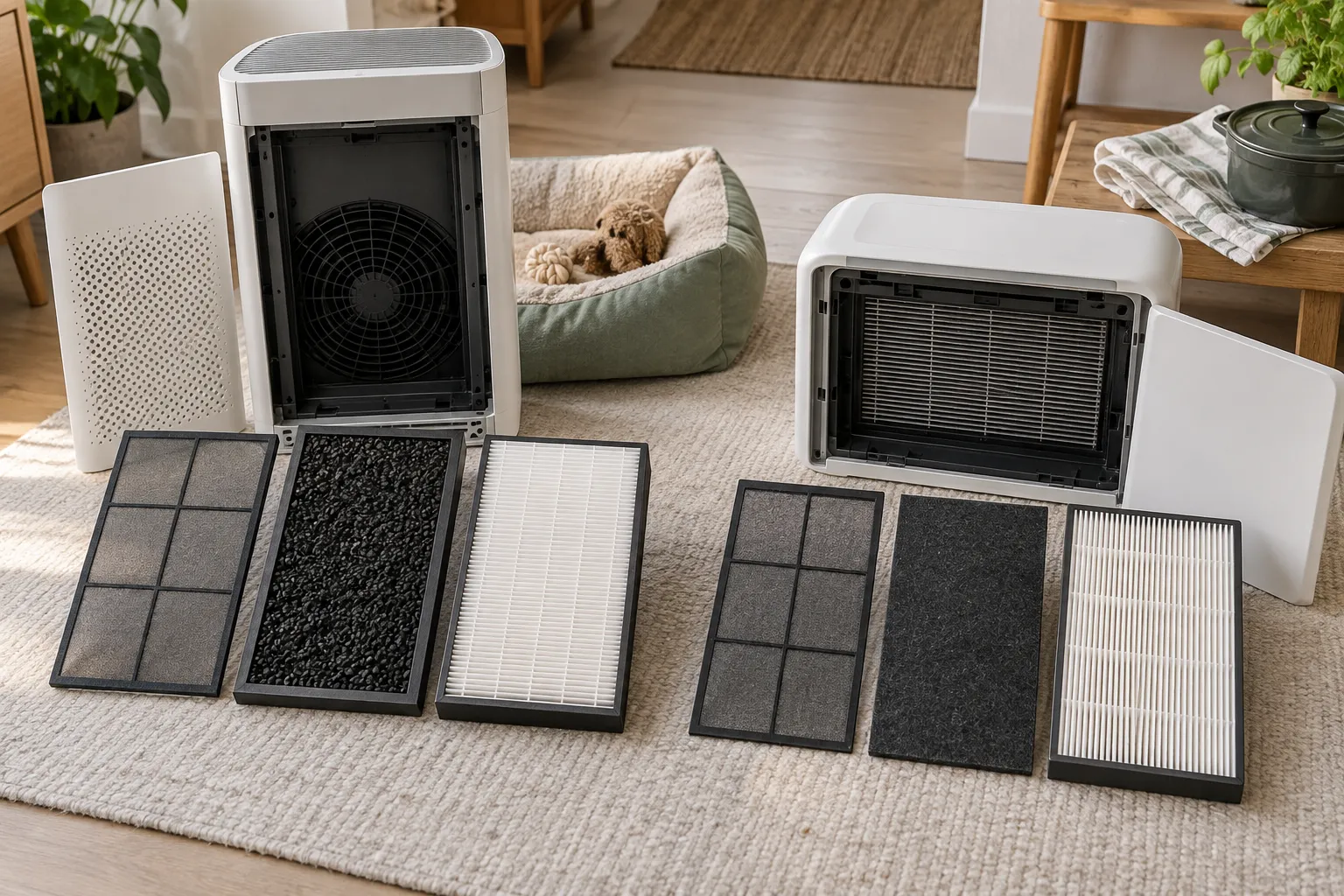
CADR and Realistic Apartment Room Size
The fairest comparison uses the room size stated at 4.8 air changes per hour, not the much larger one-air-change marketing number.
Winix lists the 5510 as AHAM Verifide for 392 square feet at 4.8 air changes per hour. Its current CADR table gives 252 for dust, 247 for pollen, and 253 for smoke.
Coway lists the AP-1512HH for 361 square feet at 4.8 air changes per hour. Its current product page gives CADR figures of 246 for dust, 240 for pollen, and 233 for smoke.
The Winix therefore has the larger published smoke advantage: 253 versus 233, or roughly 8.6 percent. Its dust and pollen advantages are much smaller. This is a measurable difference, but not enough to turn the two machines into different room-size classes.
Both are most realistic for one enclosed bedroom, office, studio zone, or defined living area. Neither should be selected for every closed room in an apartment just because the manufacturer also lists a large one-hour coverage figure.
Carbon Filters and Everyday Apartment Odors
The Winix 5510 has the clearer standard filter arrangement for pet odor, cooking carryover, and other recurring household smells. Winix describes its AOC filter as using carbon pellets and positions it for odors from cooking, pets, and smoke.
The Coway includes a separate deodorization filter, and its standard replacement pack includes two deodorization filters plus one HEPA filter. Coway recommends replacing the deodorization filter approximately every six months. It also sells compatible filter variants aimed at pet, allergen, and smoke priorities.
Those descriptions do not prove a specific odor-removal percentage or show how long either filter will last in a particular apartment. Neither manufacturer publishes directly comparable carbon weight or breakthrough-test data on the cited pages.
For frequent cooking smells, source control still comes first. Use the range hood or exhaust fan, contain the source, and ventilate safely when outdoor conditions allow. An air purifier can support that routine only after the affected air reaches its intake. Our guide to air purifiers for cooking smells in small apartments explains the limitations in more detail.
Odor-Gas Sensor vs. Particle Sensor
The sensor difference is more important than the colored air-quality lights suggest.
The Winix manual says its smart sensor detects the amount of odorous gas in the environment. In Auto mode, the fan adjusts according to the detected gas level. This makes its automatic behavior relevant when a pet area, cooking event, or household odor changes the room.
The Coway manual says Auto mode adjusts speeds 1 through 3 according to its dust sensor. The sensor ships at standard sensitivity, and the manual provides a procedure for changing it to sensitive or insensitive when the displayed pollution level does not match the room conditions.
Neither indicator is a complete indoor-air monitor. Neither machine measures carbon dioxide, and neither should be used as a carbon-monoxide safety device. The sensors are best treated as automatic-control inputs rather than laboratory instruments.
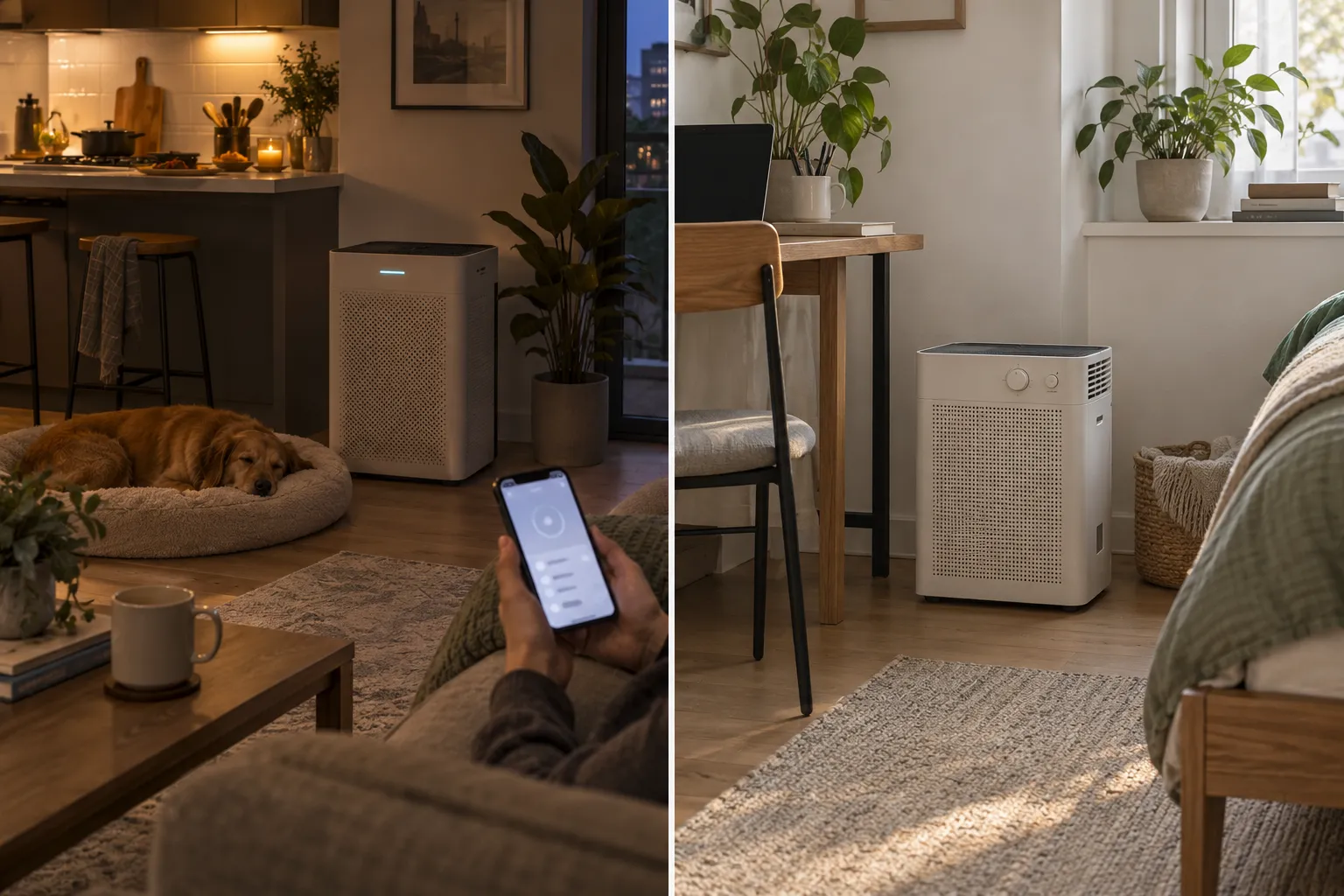
Apartment Footprint and Required Clearance
The Winix occupies less width and depth but more height. At 13.59 inches wide and 8.27 inches deep, it can fit a shallow strip of floor beside a cabinet, desk, or wall more easily than the Coway. Its 22.17-inch height matters under shelves or beside low windows.
The Coway is 16.8 inches wide and 9.6 inches deep but only 18.3 inches high. That shorter body may fit better under a window or low visual line, although its wider face requires more open floor space.
The manuals also require working clearance:
- Winix calls for approximately 12-18 inches from walls for maximum airflow and recommends a hard, flat indoor surface.
- Coway calls for at least 20 cm, or about 7.9 inches, from walls or adjacent objects and 30-60 cm, or about 11.8-23.6 inches, above the machine.
- Both need an unobstructed intake and outlet, safe cord routing, and access to remove the front panel and filters.
Measure the operating footprint, not only the appliance body. A purifier pushed behind a sofa or into a tight corner will not use its airflow effectively.
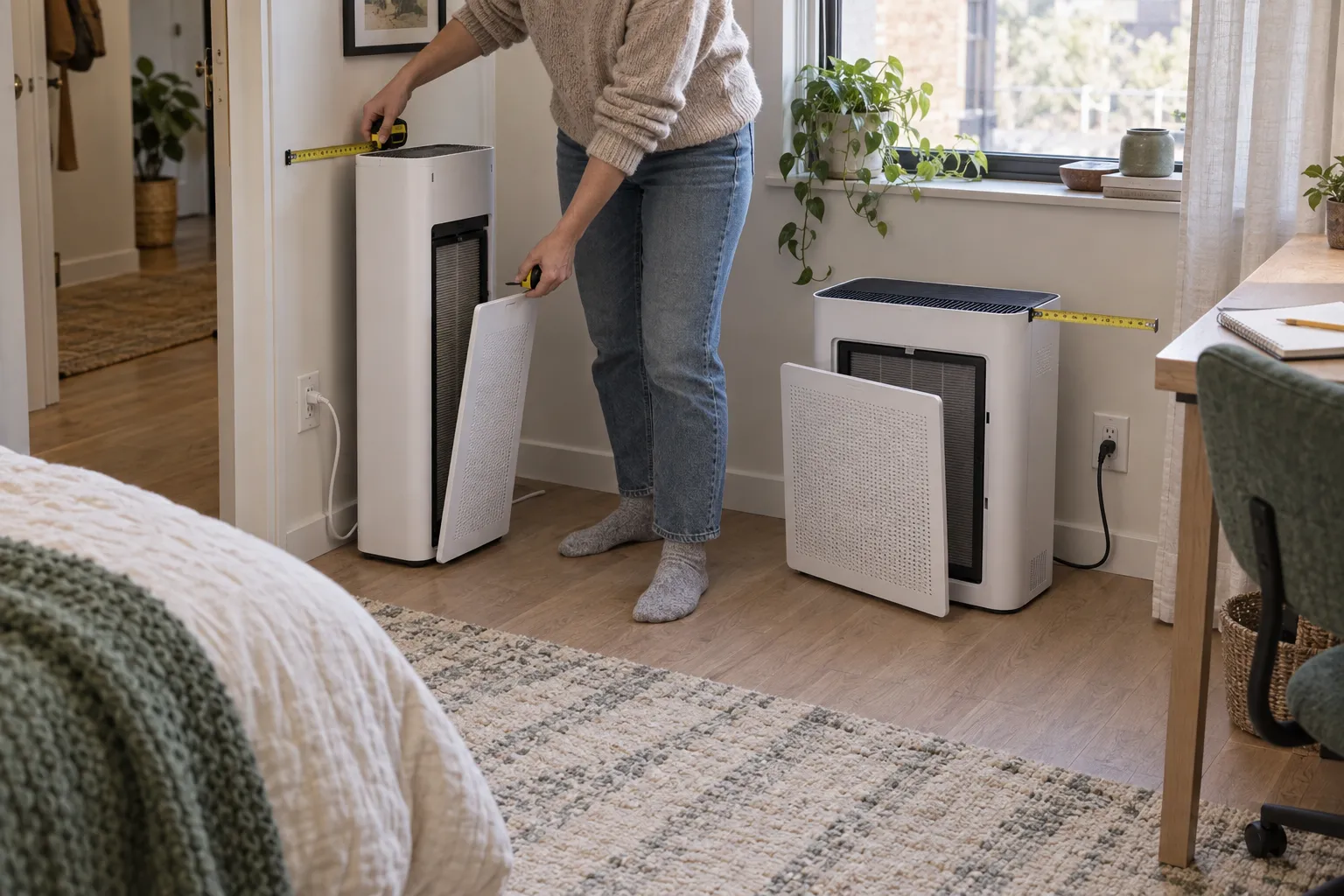
Smart App vs. Simple Physical Controls
Choose the Winix if remote control is part of how you will use the purifier. The 5510 supports the Winix Smart app, Wi-Fi, and Alexa. The current product page places its timer function in the app rather than identifying a physical timer button.
Choose the Coway if you prefer to control everything directly from the machine. It provides Auto, speeds 1 through 3, Eco, and a physical 1/4/8-hour timer. It does not require an app or account for its core operation.
Coway’s Eco mode stops the fan when no pollution has been detected for 30 minutes and restarts operation when the sensor detects pollution again. That is different from simply running the lowest speed continuously.
The Winix has a light sensor that can automatically enter Sleep mode when the room darkens, dim the LEDs, and reduce the fan below its normal Low setting. When light returns, the machine goes back to Auto mode.
Bedroom Noise and Nighttime Behavior
The published minimum noise figures are effectively tied: 23.5 dB for the Winix and 24 dB(A) for the Coway. A half-decibel difference from separate manufacturer tests is not a meaningful buying advantage.
Coway publishes a complete range of 24-53 dB(A). Winix does not publish an official maximum noise figure for the 5510 on the current product page or manual, so this comparison does not borrow a maximum from another Winix model.
The Winix has the more clearly documented automatic nighttime routine. Its light-triggered Sleep mode dims the air-quality light and selects a fan speed below Low. PlasmaWave is disabled in Sleep mode by default, though the manual says it can be turned back on.
Coway’s current product page uses the phrase “sleep mode,” but its current manual and control sequence document Auto, speeds 1-3, and Eco rather than a separate selectable Sleep control. For a bedroom, use the documented lower fan settings and timer instead of assuming a dedicated Sleep button exists.
Filter Maintenance and Replacement
Both machines use front-access filter stacks, but the replacement schedules differ.
Winix 5510 Maintenance
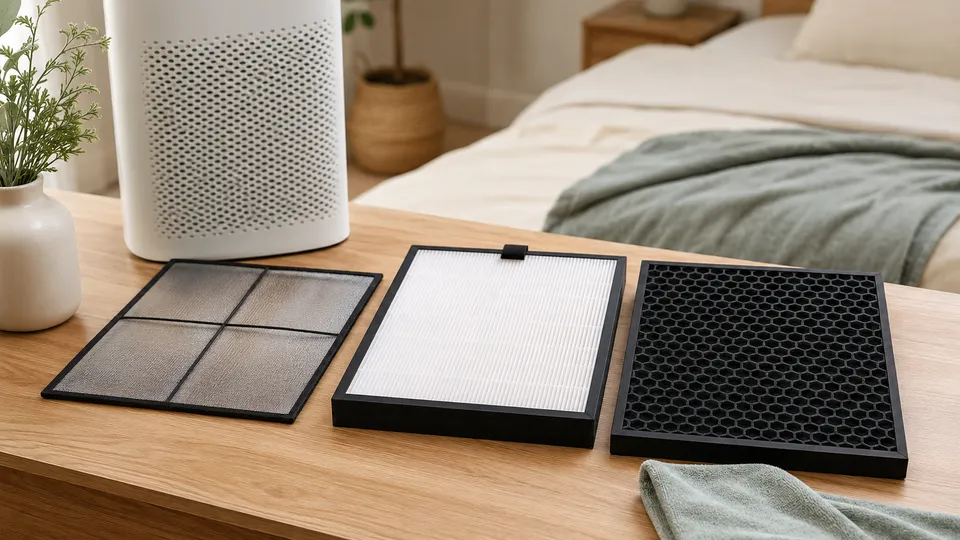
The 5510 manual recommends cleaning the fine-mesh pre-filter approximately every 14 days. Use a vacuum or soft brush. If it is excessively dirty, the manual permits rinsing it with room-temperature water, followed by at least 24 hours of drying.
The AOC carbon filter and True HEPA filter cannot be washed. Winix estimates approximately 12 months for both and directs owners to replace them when the filter indicator illuminates. The specified replacement is Filter Q, SKU 1712-0123-00.
Do not copy washable-carbon guidance from the older Winix 5500-2. It does not apply to the current 5510 manual.
Coway AP-1512HH Maintenance
Coway recommends cleaning the reusable pre-filter every 2-4 weeks with a vacuum or water, then reinstalling it only after it is completely dry.
The deodorization filter and HEPA filter cannot be washed or reused. The current manual recommends replacing the deodorization filter approximately every six months and the HEPA filter approximately once a year. Coway notes that these intervals are based on eight hours of use at maximum speed and can change with the operating environment.
The Coway air-quality sensor should be cleaned approximately every two months. Dust on the sensor lens can affect the pollution indicator and Auto mode response.
PlasmaWave and Coway Ionizer Controls
Both products include an optional electronic air-treatment stage, and both manuals provide a way to turn it off.
- The Winix control panel has a PlasmaWave button that enables or disables the feature.
- The Coway control panel has an ionizer on/off button.
The official manuals do not clearly establish that either off setting persists through every unplugging or power-cycle scenario. The article therefore does not promise a permanent disable state. If avoiding the feature matters, check the indicator after restarting the unit.
Power Consumption and Warranty
The Winix has the lower nameplate power figure at 65W, compared with 77W for the Coway. Actual electricity use will depend on fan speed, Auto or Eco behavior, operating hours, and local electricity rates. The difference in rated maximum power is real, but it is not an annual cost estimate.
Winix provides a two-year limited warranty for the 5510 in the United States and Canada and requires proof of purchase.
Coway’s current warranty table is more detailed. It gives all Airmega models one year of coverage for internal or functional parts. The AP-1512HH falls under the table’s three-year motor and electronic-parts category for other Airmega models. Coverage applies to the original retail purchaser and requires an authorized seller, proof of purchase, and evidence of the issue.
Keep the receipt and verify the exact model on the listing. A retailer bundle, used unit, AP-1512HHS, or Mighty2 is not automatically covered by the same documentation.
Which One Should You Buy?
Choose the Winix 5510 if:
- Pet smells, cooking carryover, or recurring household odor is central to the purchase
- You want a separately documented carbon-pellet filter
- Slightly higher published CADR figures matter
- A narrow, shallow body fits the available floor area
- App control, Alexa, and automatic light-triggered Sleep mode are useful
- Replacing the carbon and HEPA filters on the same approximate annual schedule is simpler for you
Choose the Coway Airmega Mighty AP-1512HH if:
- You prefer simple controls without an app or account
- A dust-sensing Auto mode fits the main problem better than odor-gas response
- You want a physical 1/4/8-hour timer and Eco mode
- A shorter and slightly lighter appliance fits the room better
- You are comfortable replacing the deodorization filter more frequently than the HEPA filter
- A complete official 24-53 dB(A) noise range matters to the decision
What This Comparison Does Not Claim
This is a manufacturer-document comparison, not a hands-on laboratory test. It does not claim that either purifier cures allergies, prevents illness, removes all VOCs, or eliminates every household odor.
An air purifier treats only the air that passes through it. It does not remove settled dust or pet hair from bedding and carpet, fix a moisture or mold source, replace kitchen ventilation, stop smoke at an apartment boundary, or reduce carbon dioxide.
For the underlying filter distinction, read HEPA vs. activated carbon filters for bedroom air purifiers.
FAQ
Is the Winix 5510 better than the Coway AP-1512HH for odors?
The Winix is the stronger starting point for recurring household odor because its standard configuration includes a separately documented AOC carbon-pellet filter and an odor-gas sensor. That does not prove a guaranteed odor-removal rate, and source control remains necessary.
Is the Coway AP-1512HH better for dust and pollen?
The Coway’s Auto mode responds to a dust sensor, which may suit a particle-first routine. Its published CADR figures are slightly lower than the Winix figures, however. Both have enough verified airflow for a medium enclosed room when correctly placed and maintained.
Which purifier is quieter for a bedroom?
Their published minimum figures are nearly identical: 23.5 dB for the Winix and 24 dB(A) for the Coway. Coway publishes a 53 dB(A) maximum, while Winix does not publish a directly comparable maximum for the 5510. The official data does not support declaring an overall noise winner.
Can PlasmaWave and the Coway ionizer be turned off?
Yes. Both current manuals document an on/off control for the respective feature. Because the manuals do not clearly promise that the choice persists through every power cycle, verify the indicator after restarting the machine.
Which model is easier to maintain?
The Winix uses one approximate 12-month schedule for both its AOC carbon and HEPA filters. The Coway separates the schedule: roughly six months for the deodorization filter and one year for the HEPA filter. The easier routine depends on whether you prefer one annual filter set or more frequent odor-filter replacement.
Can either purifier clean an entire apartment?
Only when the apartment is effectively one open zone and the chosen air-change rate is appropriate. In an apartment with closed bedrooms, size each machine for the room where it will run or plan separate units for separate rooms.
Is the Coway MightyS AP-1512HHS the same product?
No. The AP-1512HHS is a different smart model with different documentation and replacement-filter requirements. This comparison covers the non-Wi-Fi AP-1512HH only.
Final Verdict
For most apartments dealing with pets, cooking carryover, or recurring everyday odor, start with the Winix 5510. Its standard carbon-pellet filter, odor-gas sensor, slightly stronger published airflow, shallower body, and app controls give it the more versatile apartment role.
Choose the Coway Airmega Mighty AP-1512HH when you want a simpler physical-control experience, particle-sensing Auto mode, Eco behavior, a built-in timer, and a shorter body. It remains a strong one-room purifier even though it gives up some smart features and published smoke CADR.
The better purchase is not determined by the largest square-foot claim. Choose the machine whose sensor, filter schedule, control style, and physical shape match the room where it will actually operate.