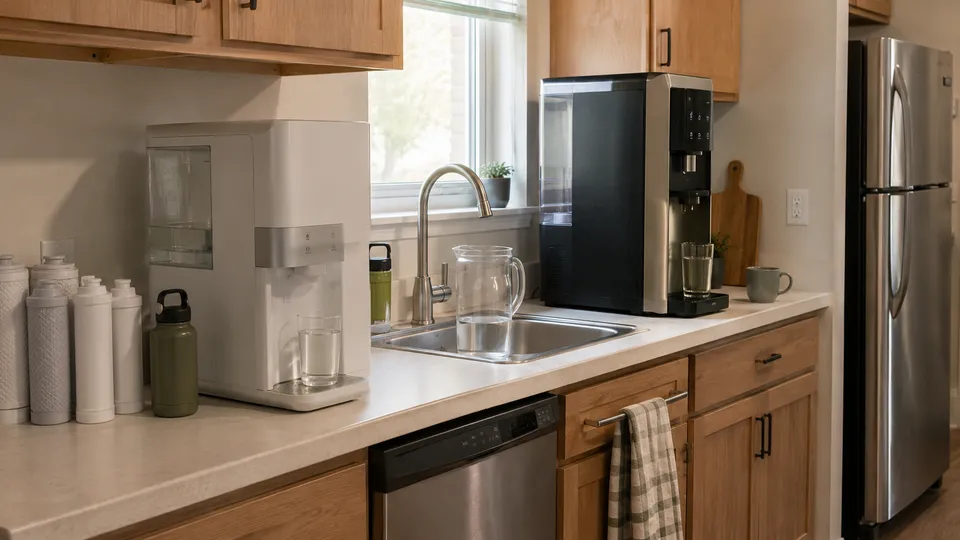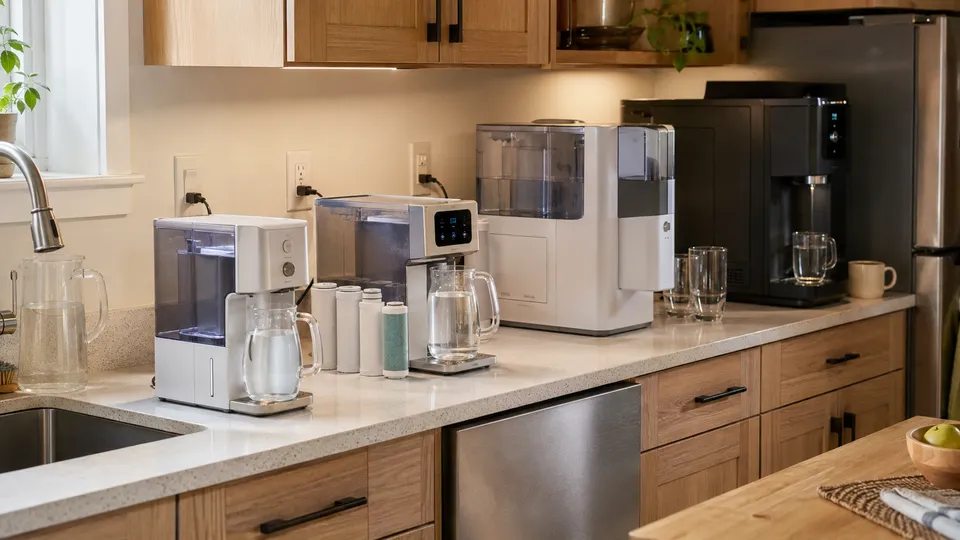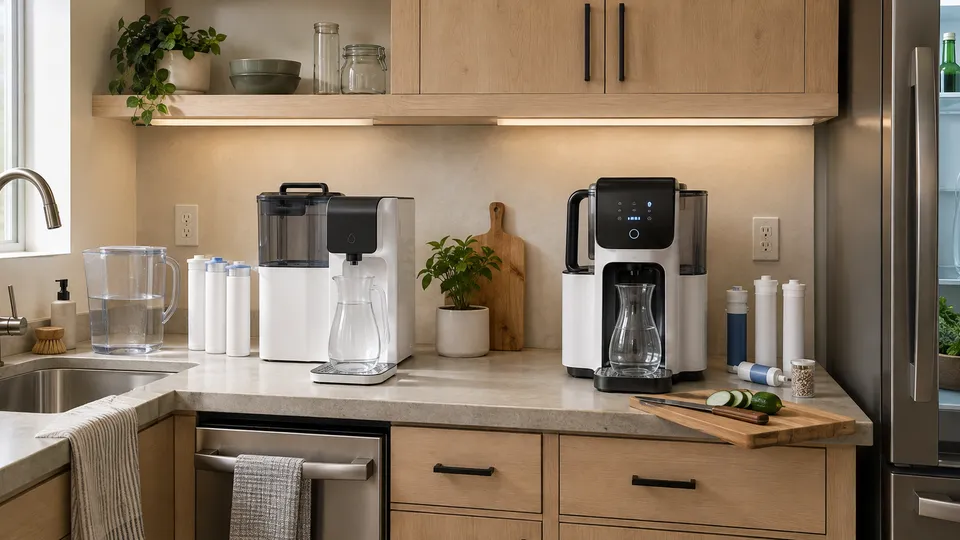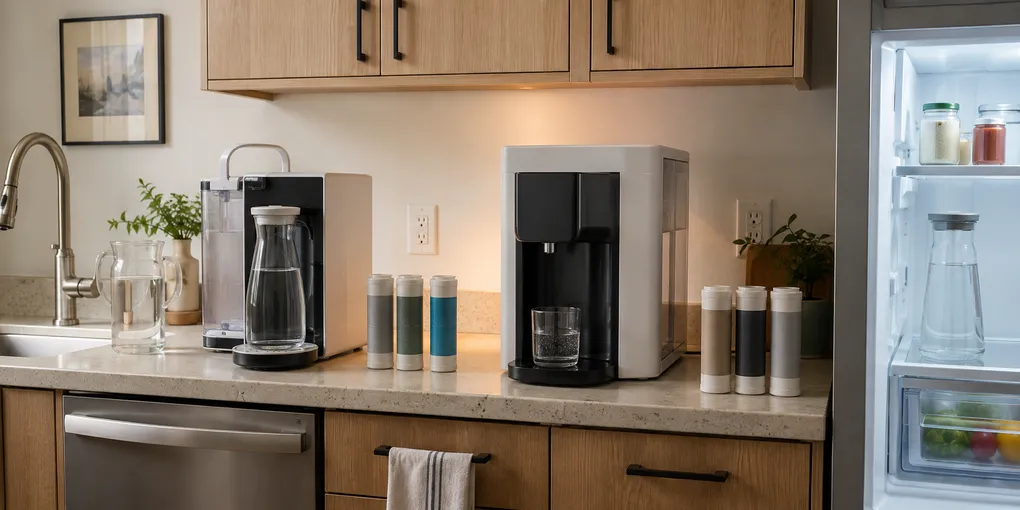
The AquaTru Carafe and AquaTru Classic are countertop reverse-osmosis (RO) systems that avoid a permanent water-line installation. They share AquaTru’s stated four-stage filtration approach, plug into a standard 120V AC outlet, and use a manual-fill routine. The better apartment choice is therefore not about which one has “more” filtration. It is about the water you handle every day, the container material you prefer, and how much of your counter you can give up permanently.
The Carafe centers the routine on a removable 64 oz borosilicate-glass carafe and a 2.5 L source-water tank. The Classic uses built-in Tritan plastic tanks, with 1 gal of source-water storage and 0.75 gal of clean-water storage. Both need refilling, electricity, cleaning, and their own replacement filters.
This comparison covers the current base AquaTru Carafe with VOC Carbon Filter and current base AquaTru Classic with VOC Carbon Filter. It does not treat Carafe Smart, Classic Smart, mineral-boost filter options, older listings, or bundles as interchangeable versions. Product facts below are taken from current manufacturer product and support pages, not hands-on testing or laboratory tests.
For the broader category decision, see best countertop reverse osmosis systems for apartments. For a comparison between the Carafe and another glass-carafe countertop RO system, read AquaTru Carafe vs. Bluevua ROPOT for apartments.
Quick Answer
Choose the AquaTru Carafe if you want to pour and store filtered water in a removable 64 oz borosilicate-glass carafe, have a smaller daily water routine, and prefer the lighter 9 lb body. It is the more natural fit when refrigerator storage and a glass serving vessel matter as much as the filtering appliance itself.
Choose the AquaTru Classic if you want more built-in water storage and can leave a 16 lb, 14 x 12 x 14 in machine in one dedicated counter location. Its 1 gal source tank and 0.75 gal clean-water tank can mean fewer refill cycles, but the appliance is less convenient to move or store away.
Neither is a zero-maintenance option. They both use manual filling, a nearby outlet, removable water components, filter changes, and maker-specific cleaning instructions. Neither model’s filters are interchangeable with the other.
Verified Base-Model Facts
| Item | AquaTru Carafe | AquaTru Classic |
|---|---|---|
| Exact version compared | Carafe with VOC Carbon Filter | Classic with VOC Carbon Filter |
| Clean-water vessel | 64 oz borosilicate-glass carafe | 0.75 gal built-in clean-water tank |
| Source-water storage | 2.5 L tap-water tank | 1 gal tap-water tank |
| Official size and weight | 13 in high, 14 in diameter, 7.5 in wide; 9 lb | 14 x 12 x 14 in; 16 lb |
| Storage material described by maker | Borosilicate glass carafe | Tritan plastic |
| Power and installation | 120V AC; no permanent plumbing described | 120V AC; no permanent plumbing described |
| Filtration and replacement intervals | Four stated stages; pre/carbon 6 months, RO 2 years, VOC carbon 1 year | Four stated stages; pre/carbon 6 months, RO 2 years, VOC carbon 1 year |
| Filter compatibility | Carafe-specific filters | Not interchangeable with Carafe filters |
| Current warranty and return terms | 1-year manufacturer warranty; 30-day money-back guarantee | 1-year manufacturer warranty; 30-day money-back guarantee |
The Carafe’s 14 in measurement is described by AquaTru as a diameter rather than a simple width or depth. Treat it as a measurement prompt, not a completed counter-fit calculation: use the current product diagram or owner manual to establish orientation, tank-removal room, and clearance beneath cabinets.
The Real Difference: Where Your Water Lives
The Carafe’s filtered water ends up in a removable glass vessel. AquaTru describes it as borosilicate glass, designed for pouring, and sized at 64 oz. You can take it from the counter to the refrigerator or table, then return it to the system when your routine requires more filtered water. That separation is useful for a renter who wants filtered water stored outside the machine and does not want the appliance to hold every serving container.
The Classic keeps more water inside the appliance. AquaTru support lists a 1 gal source-water tank and 0.75 gal clean-water tank, and describes the Classic’s plastic as Tritan. This may suit a household that fills several bottles, cooks with filtered water, or prefers not to remove a serving carafe for every pour. The tradeoff is a larger installed presence on the counter rather than a smaller appliance plus a carafe that can move to the refrigerator.
Glass versus Tritan is a preference and handling decision, not an automatic performance result. The Carafe’s glass vessel may matter to a shopper who specifically prefers glass for stored drinking water. The Classic’s built-in tanks may matter more to someone who values larger stored volumes and a simple push-button dispense routine. Neither material choice eliminates the need to clean the parts according to AquaTru’s current instructions.
Counter Space and Working Footprint
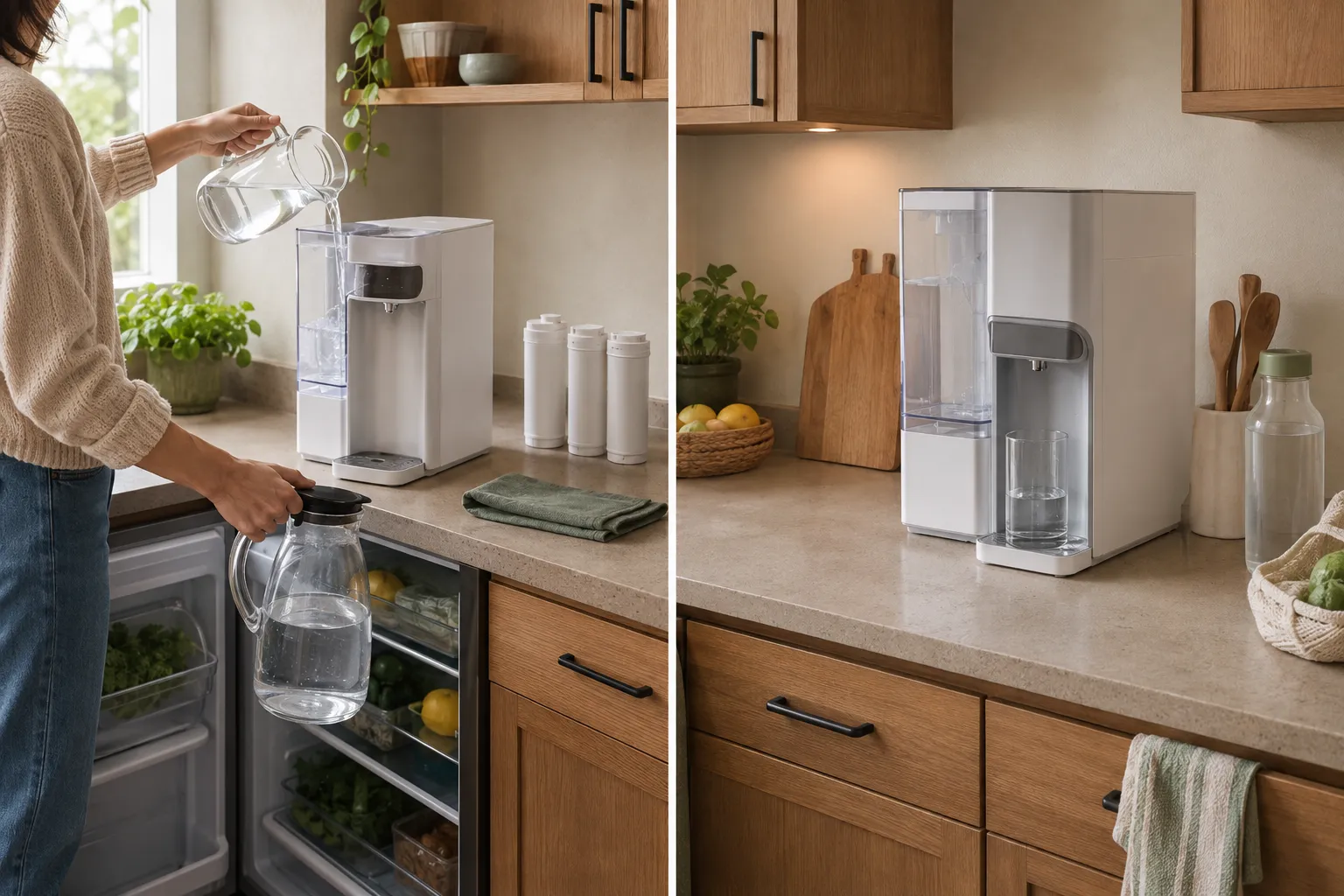
The Classic is easier to put into a conventional rectangular counter measurement. AquaTru currently lists it at 14 x 12 x 14 in and 16 lb. Do not assess it only by its width: leave room to access the source tank, the clean-water tank, filters, and the surrounding counter while the machine is in use.
The Carafe’s listed 9 lb body is lighter, but its working footprint includes more than the appliance. You need room to handle the 2.5 L source tank, remove the glass carafe, and set a full carafe down safely. A system that fits physically below an upper cabinet can still be awkward if the tank cannot be lifted out or the carafe cannot be poured without moving other appliances.
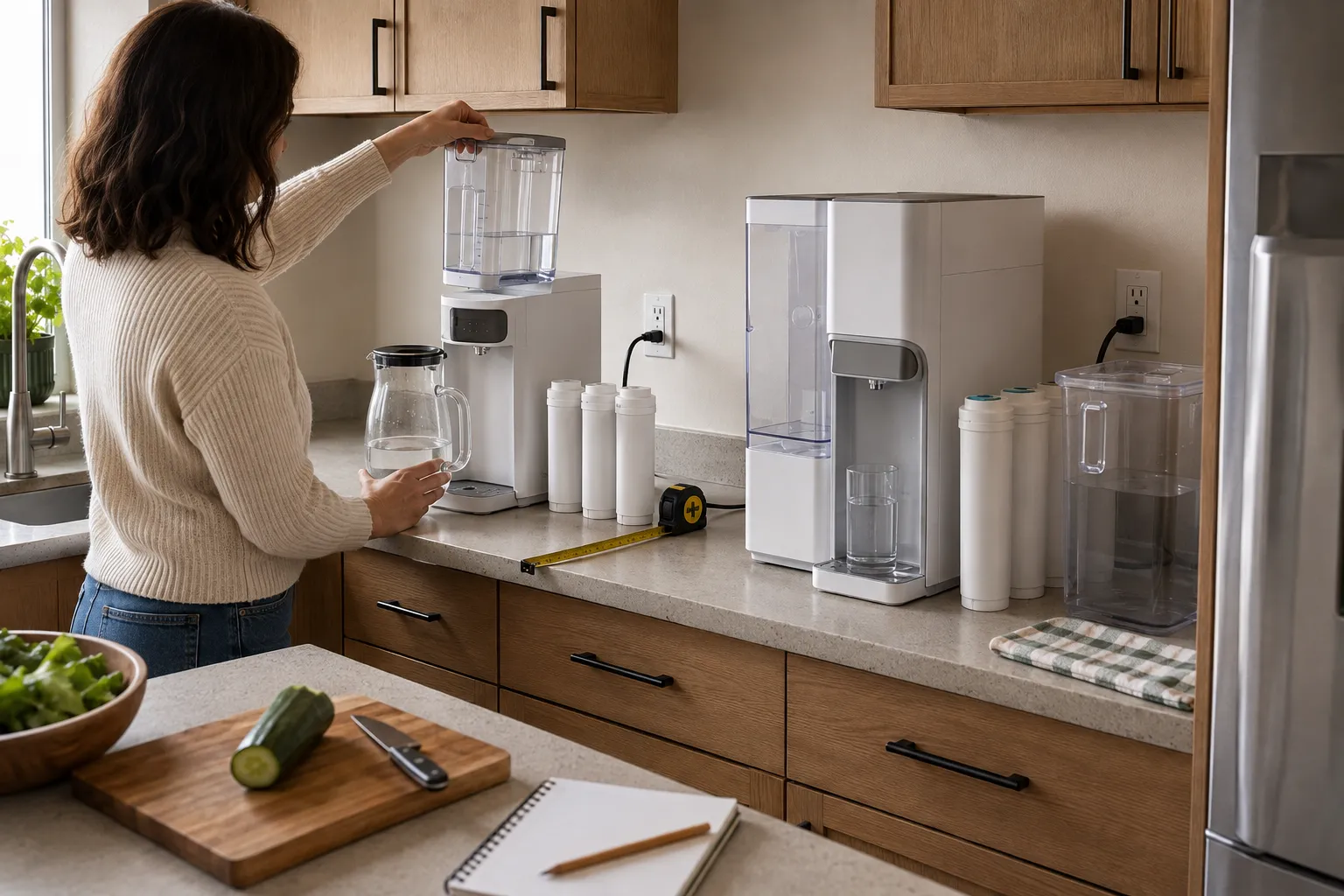
For either model, measure:
- Usable counter width and depth, including space in front of the unit.
- Clearance above the machine for filling and removing water components.
- The route between sink, machine, refrigerator, and drinking-water storage.
- A nearby
120Voutlet that does not require a cord across wet or food-prep areas. - Access for filter changes, cleaning, and drying removable parts.
If counter space is your first constraint rather than your product preference, compare these two against the wider set of countertop RO systems for apartments.
Same Broad Filtration Design, Different Replacement Filters
Both selected base models use AquaTru’s four stated stages: pre/carbon filtration, RO filtration, and VOC carbon filtration. The current product pages list the same broad replacement timing: six months for the pre/carbon filter, two years for the RO filter, and one year for the VOC carbon filter.
That similarity is easy to misread. AquaTru explicitly states that the Carafe uses filters made for the Carafe and that they are not interchangeable with AquaTru Classic filters. Do not order a replacement based only on a similar name, filter interval, or a retailer photo. Match the replacement to the exact product line and selected filter option.
For the Carafe, AquaTru support currently lists maker-stated capacities of about 300 gallons for the pre-filter, 600 gallons for the RO filter, and 300 gallons for the VOC carbon filter. The Classic product page describes its three filters as lasting 600-1200 gallons in total depending on stage, but this article does not turn that into a direct capacity comparison because the current pages do not present an equivalent stage-by-stage Classic table.
The responsible ownership rule is simpler: use the product’s current indicator and the exact current manufacturer guidance for your version. A published interval is a maintenance planning input, not a reason to override a model-specific alert or keep a due filter in service.
Daily Routine: Carafe Handling vs. Built-In Storage
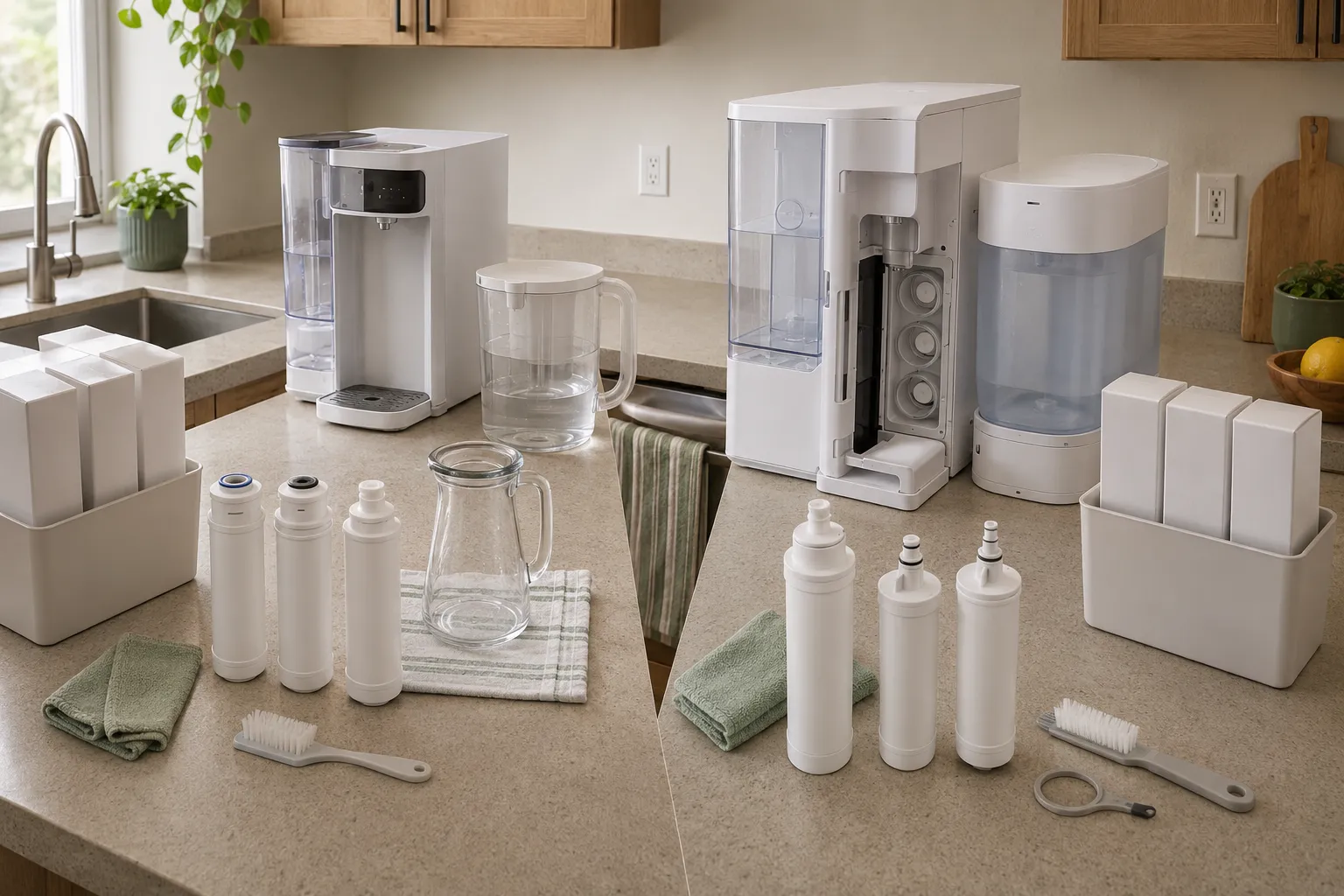
With the Carafe, your routine includes lifting or filling the 2.5 L tap-water tank, processing water, and carrying the 64 oz glass carafe where you want to use or refrigerate it. That can make the system feel more flexible in a small kitchen, but it also asks you to handle a breakable full carafe carefully and maintain a clear place to set it down.
With the Classic, more of the water stays in the appliance. You still fill the source tank and clean the system, but the listed 0.75 gal clean-water tank makes the workflow feel closer to drawing from a small countertop dispenser. It can reduce some refills for heavier daily use while making the appliance itself a long-term counter resident.
Neither model has a permanent water line. That is a rental-friendly boundary, but it does not remove the manual work. Before ordering, read the current owner manual for water handling, cleaning, storage, and any instructions for water left in the system after a cycle.
Which One Fits Your Apartment?
| Your priority | Better starting point | Why |
|---|---|---|
| You want a removable glass vessel that can go to the refrigerator | AquaTru Carafe | 64 oz borosilicate-glass carafe |
| You want more listed built-in source and clean-water storage | AquaTru Classic | 1 gal source tank and 0.75 gal clean-water tank |
| You need the lighter listed appliance body | AquaTru Carafe | 9 lb versus Classic’s 16 lb |
| You want a push-button dispenser and fixed appliance routine | AquaTru Classic | Built-in clean-water tank and one-touch dispensing described by AquaTru |
| You want filters to interchange between models | Neither | AquaTru says Carafe and Classic filters are not interchangeable |
| You do not want a powered manual-fill appliance | Neither | Both use a 120V AC outlet and a refill routine |
The right answer is usually not the model with the longer feature list. Choose the Carafe when the glass carafe and smaller handling routine make the appliance easier to live with. Choose the Classic when its extra storage fits your daily water use and your counter can support a fixed 16 lb machine.
Before You Order
- Confirm the cart shows the base Carafe or base Classic and the intended VOC Carbon Filter option.
- Measure the full workflow, including tank removal, carafe access, cabinet clearance, outlet reach, and room in front of the machine.
- Decide where filtered water will live between uses: a refrigerator carafe, a built-in tank, or another container.
- Check current replacement filter availability for the exact model. Do not assume Carafe and Classic filters fit each other.
- Review the current owner manual for cleaning, filter changes, storage, and water handling.
- Keep price out of the core decision. Current promotions and bundles change more quickly than counter fit and daily routine.
FAQ
Do AquaTru Carafe and Classic use the same filters?
No. AquaTru states that Carafe filters are designed for the Carafe and are not interchangeable with the Classic. The models can share a broad four-stage description and similar replacement intervals without sharing physical replacement filters.
Which model holds more water?
The Classic has the larger listed built-in storage: a 1 gal source-water tank and 0.75 gal clean-water tank. The Carafe uses a 2.5 L source tank and a 64 oz glass carafe. The better choice depends on whether you prefer larger integrated tanks or a removable glass serving vessel.
Is AquaTru Carafe smaller than AquaTru Classic?
The Carafe is lighter at a listed 9 lb, while the Classic is listed at 16 lb and 14 x 12 x 14 in. AquaTru describes the Carafe with a 13 in height, 14 in diameter, and 7.5 in width. Measure the working space needed for removable parts, not only these body figures.
Do either of these systems need plumbing?
The current product pages describe both as countertop systems that do not need permanent installation or plumbing. They do need a 120V AC outlet, manual water filling, cleaning, and replacement-filter maintenance.
Bottom Line
For a renter who values a removable glass 64 oz carafe, a lighter listed body, and a clear 2.5 L source-tank routine, the AquaTru Carafe is the more direct fit. For a renter who would benefit from 1 gal of source-water storage, 0.75 gal of built-in clean-water storage, and a stationary dispenser-style workflow, the AquaTru Classic is the stronger starting point.
They share a broad four-stage RO approach, but they are not interchangeable purchases. Measure the counter, decide where the filtered water will sit, and buy replacement filters for the exact model you choose.