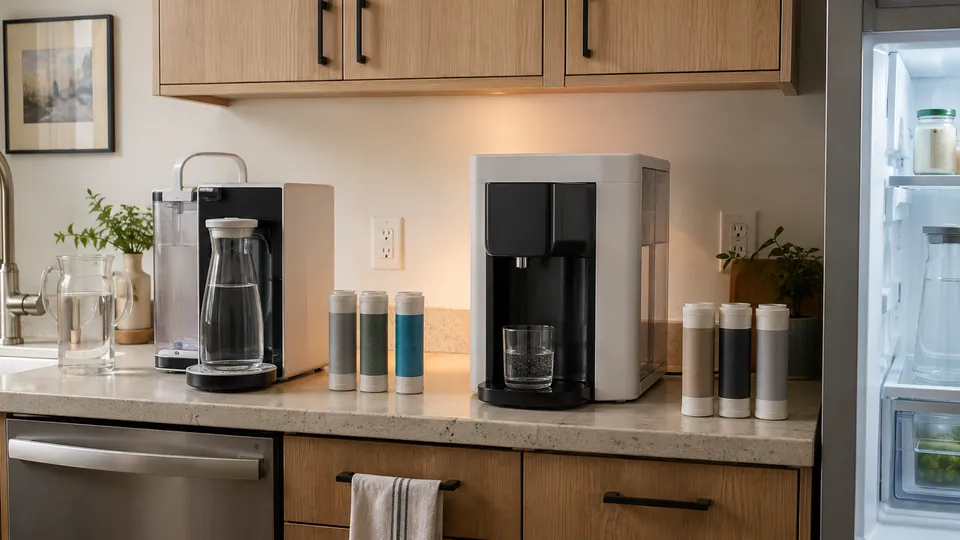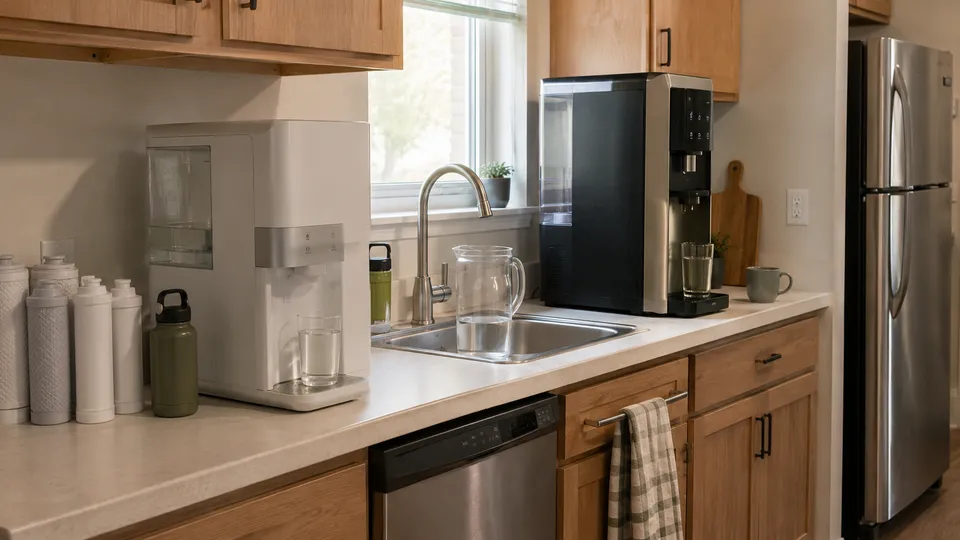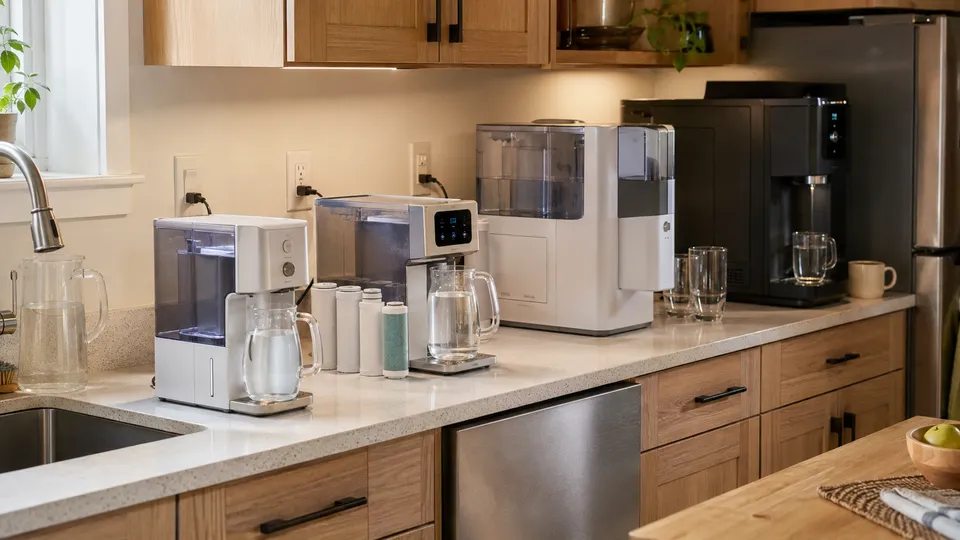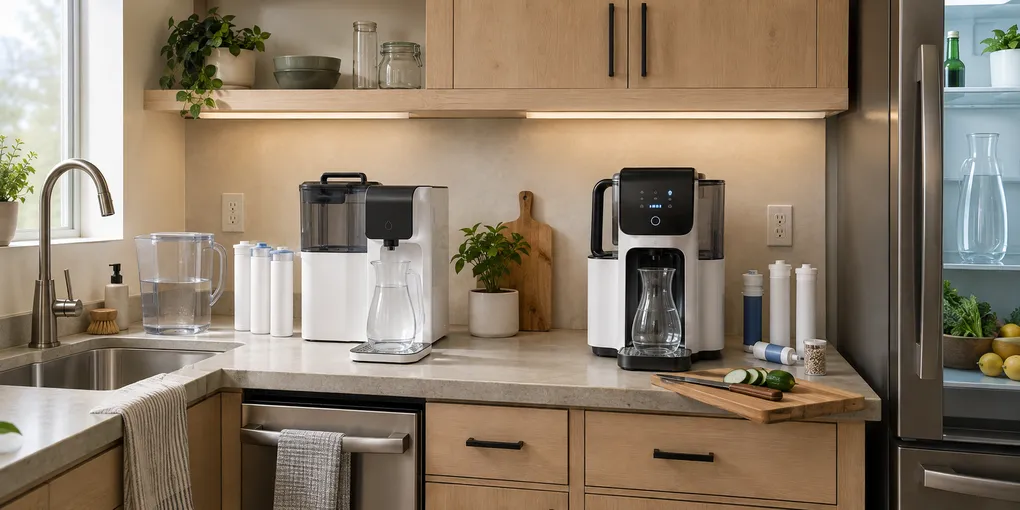
The AquaTru Carafe vs. Bluevua ROPOT decision comes down to documented certification and a predictable filter schedule versus remineralization and more visible status monitoring. Choose the AquaTru Carafe when you want more clearly published base-model specifications, a 64 oz glass carafe, named NSF/ANSI certification standards, and a documented filter-replacement schedule. Choose the Bluevua ROPOT when a real-time TDS display, filter-life monitoring, automatic rinsing, and added minerals matter more to your daily routine.
Both are manual-fill countertop reverse-osmosis (RO) systems for renters who want to avoid an under-sink installation. They plug into an outlet and dispense into a glass carafe rather than connecting permanently to a kitchen water line. Neither is automatically better because it says “RO”: counter clearance, refill workflow, carafe handling, and maintenance still determine which one fits an apartment.
This comparison is limited to the current base AquaTru Carafe with the VOC Carbon Filter option and the current base Bluevua ROPOT. It does not treat AquaTru Carafe Smart, an AquaTru mineral-boost filter, Bluevua ROPOT(UV), ROPOT-Lite, or an old RO100ROPOT listing as interchangeable versions. If you are keeping the Carafe but deciding whether its alternative should be AquaTru’s larger tank-first model, see AquaTru Carafe vs. AquaTru Classic. For a broader product-role comparison, read best countertop RO systems for apartments. For the wider choice between faucet-connected, refillable, and RO formats, start with our countertop water-filter guide for apartment renters.
The specifications below come from current manufacturer product pages and support documentation. This is not hands-on testing or a laboratory comparison. Prices, package contents, filter availability, and specifications can change, so check the exact current model page and manual before ordering.
AquaTru Carafe vs. Bluevua ROPOT: What Actually Differs?
Choose the AquaTru Carafe when you want the larger manufacturer-listed 64 oz glass carafe, a 2.5 L documented source-water tank, and a clearly stated three-part filter replacement schedule. Its official support documentation also publishes a listed 13 x 14 x 7.5 in body size and 9 lb weight, which gives you a concrete starting point for an apartment counter check.
Choose the Bluevua ROPOT when you prefer a five-stage system with a remineralization stage, real-time TDS display, and automatic rinsing. Bluevua lists a 60 oz glass carafe and a workflow of filling the tank, plugging the unit in, and pressing Start. Its current product page describes NSF and WQA certification, but use the maker’s current reports and documentation if you need to verify a particular standard or contaminant claim.
Do not choose either one merely because it avoids a water line. Both are countertop appliances that need counter space, electricity, manual filling, cleaning, filter changes, and a practical place to manage water left in the system. A no-plumbing setup is not a zero-maintenance setup.
Verified Base-Model Facts
| Item | AquaTru Carafe | Bluevua ROPOT |
|---|---|---|
| Best for | Shoppers who prioritize published dimensions, a larger listed carafe, named certification standards, and a clear filter schedule | Shoppers who prioritize remineralization, visible TDS and filter status, and automatic rinsing |
| Exact version compared | Carafe base model with VOC Carbon Filter | Current ROPOT base model, not UV or Lite |
| Clean-water vessel | 64 oz borosilicate glass carafe | Manufacturer lists a 60 oz borosilicate glass carafe, about seven glasses |
| Source-water storage | 2.5 L tap-water tank | Do not rely on an unverified retailer tank-capacity figure; confirm the current manual before purchase |
| Listed body size and weight | Official support lists 13 x 14 x 7.5 in; 9 lb | Not included here because the current official text reviewed did not provide a base-model value clearly enough to publish |
| Installation | No permanent plumbing or installation described | No installation required; fill, plug in, and start |
| Filtration stated by maker | Four stages: pre/carbon, RO, and VOC carbon stages | Five stages: sediment, CTO carbon, RO, post-carbon, and remineralization |
| Maintenance signals | Replacement schedule by filter stage | Real-time TDS display, filter-life tracking, and auto-rinse described on the product page |
| Warranty and returns | One-year manufacturer warranty; 30-day return guarantee | One-year warranty; 30-day return policy; 365-day support |
The omissions in the ROPOT column are deliberate. The current official page does not give every dimension, power, source-tank, concentrate-water, or replacement-interval detail in a form clear enough to treat as a stable specification. A comparison that invents a number is less useful than one that makes the verification gap obvious.
First, Check the Working Footprint
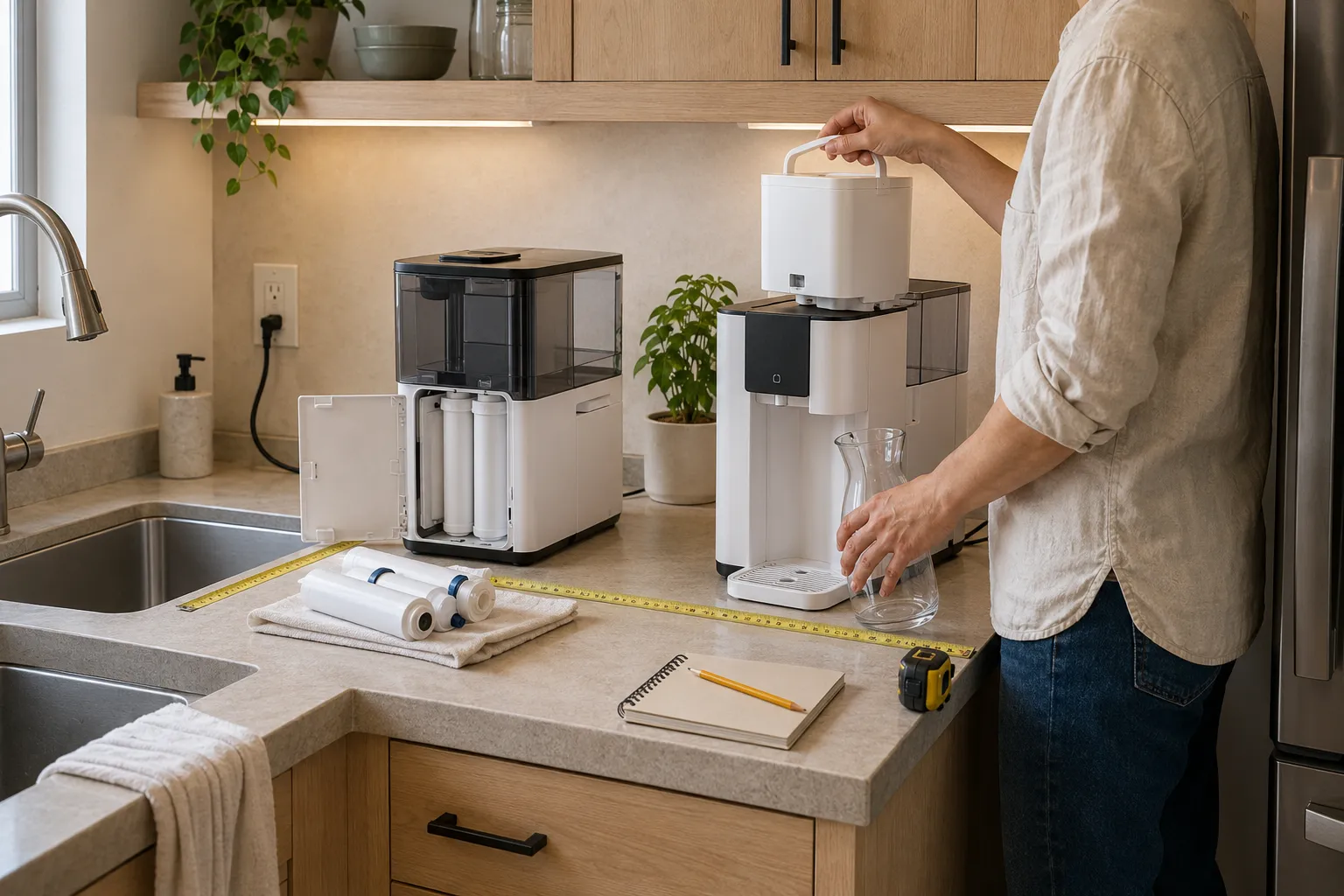
For a countertop RO system, the body measurement is only part of the space requirement. The working footprint also includes the room to lift or refill the source tank, remove and pour from the glass carafe, access filters, and wipe the counter after a spill.
The AquaTru Carafe’s official support page lists a 13 x 14 x 7.5 in size and a 9 lb unit weight. Treat those as a first measurement reference, then verify the practical orientation and clearance in the current manual before assigning it to a tight space below cabinets. A body that fits beneath a cabinet can still be inconvenient if you cannot lift the source tank comfortably.
Bluevua’s base ROPOT page confirms the manual-fill, plug-in routine and removable glass carafe, but this article does not publish an exact base-model body measurement because it was not clearly confirmed in the current manufacturer text reviewed. Before buying it for a narrow counter, get that figure from Bluevua’s current ROPOT manual and measure the full workflow, not just the cabinet gap.
For either system, check these five things before ordering:
- The counter’s usable width and depth, including the space in front of the machine.
- Clearance above the machine for filling and removing tanks.
- A stable, nearby outlet that does not require a stretched cord across the sink or prep area.
- A clear path from faucet to source tank and from carafe to refrigerator.
- A place to set the carafe down while loading, cleaning, or changing filters.
The Daily Water Routine Matters More Than “No Installation”
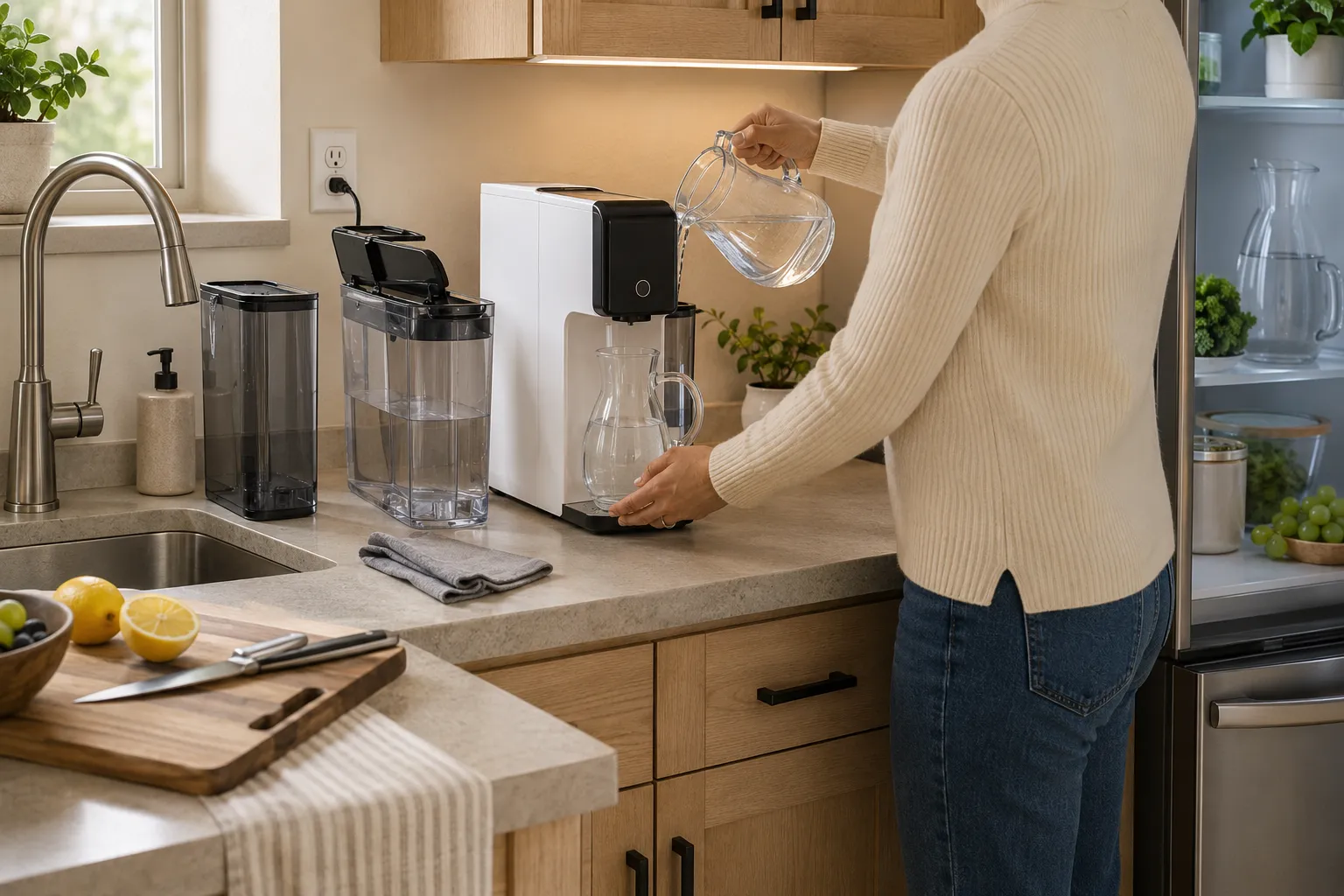
Both models are intended to avoid a permanent supply line. You bring tap water to the system, the unit filters it, and you pour from a glass carafe. That is useful in a rental with a pull-down faucet, a restrictive lease, or no interest in modifying the sink.
It also creates a repeatable apartment routine. You need to fill the source tank, wait for a filtering cycle, remove or use the carafe, and keep the surrounding counter dry. If the system is far from the sink, or your only counter is also your food-prep surface, that routine can become the real limitation.
AquaTru Carafe: Larger Listed Carafe and Documented Source Tank
AquaTru lists the Carafe’s glass vessel at 64 oz and its support documentation lists a 2.5 L tap-water tank. The brand describes the tap-water tank as having a handle for emptying and refilling. That makes the Carafe the more transparent option for a shopper planning the carrying and refill routine before buying.
The system does not need a permanent drain connection, but do not translate that into a claim that RO has no concentrated-water or cleanup responsibility. The official material reviewed does not give a model-specific pure-to-concentrate ratio that belongs in this article. Follow the current owner’s manual for tank-emptying, cleaning, and any water-disposal instructions rather than borrowing a ratio from AquaTru Classic or another countertop RO model.
Bluevua ROPOT: Fill, Start, Pour, Then Keep Up With Maintenance
Bluevua presents the ROPOT setup as: plug in the system, fill the tank, press Start, then pour from the glass carafe. This is the same broad rental-friendly category as AquaTru: no permanent plumbing, but a manual water routine.
The product page also highlights automatic rinsing, TDS display, and filter-life tracking. Those features can make ownership status easier to see, but they do not remove the need to refill, clean the removable parts, or follow the product-specific instructions for water left after processing. Bluevua’s current base-model page did not provide a clearly verifiable pure-to-concentrate ratio or source-tank capacity in the official text reviewed, so this article does not imply one.
Filters and Certification Claims: Read the Exact Version
Filter terminology is easy to overstate. The useful question is not which product has the longest list of stages; it is what the current base version says it includes, how you replace it, and what certification statement applies to that exact version.
AquaTru Carafe Filter Schedule
For the selected AquaTru Carafe configuration, the manufacturer lists:
| Filter stage | Maker-listed replacement interval |
|---|---|
| Pre/carbon filter | Six months |
| RO filter | Two years |
| VOC carbon filter | One year |
AquaTru’s current Carafe page also states certification to NSF/ANSI Standards 42, 53, 58, and 401 for the Carafe. Those are the maker’s current certification statements, not a guarantee that every water concern, local supply condition, or filter revision will be identical. Check the current product documentation if a particular substance or standard is central to your decision.
Bluevua ROPOT Filtration and Certification Statement
Bluevua describes the base ROPOT as a five-stage system: a 5 micrometer sediment stage, 0.5 micrometer CTO carbon stage, 0.0001 micrometer RO stage, 0.1 micrometer post-carbon stage, and a calcium-and-magnesium remineralization stage.
Bluevua’s product page describes the system as NSF and WQA certified. The article does not expand that into a list of specific standards or removal claims because the current official text reviewed did not provide a clear base-model certification table. Use Bluevua’s current reports page and the documentation for the exact ROPOT version before deciding based on a particular certification requirement.
Neither a stage count, TDS display, nor a broad certification label tells you what your local water needs. If you are responding to a known local contaminant issue, use the applicable water report and the manufacturer’s current certification documents rather than choosing from a generic “best filter” list.
Maintenance Is Part of the Product Choice
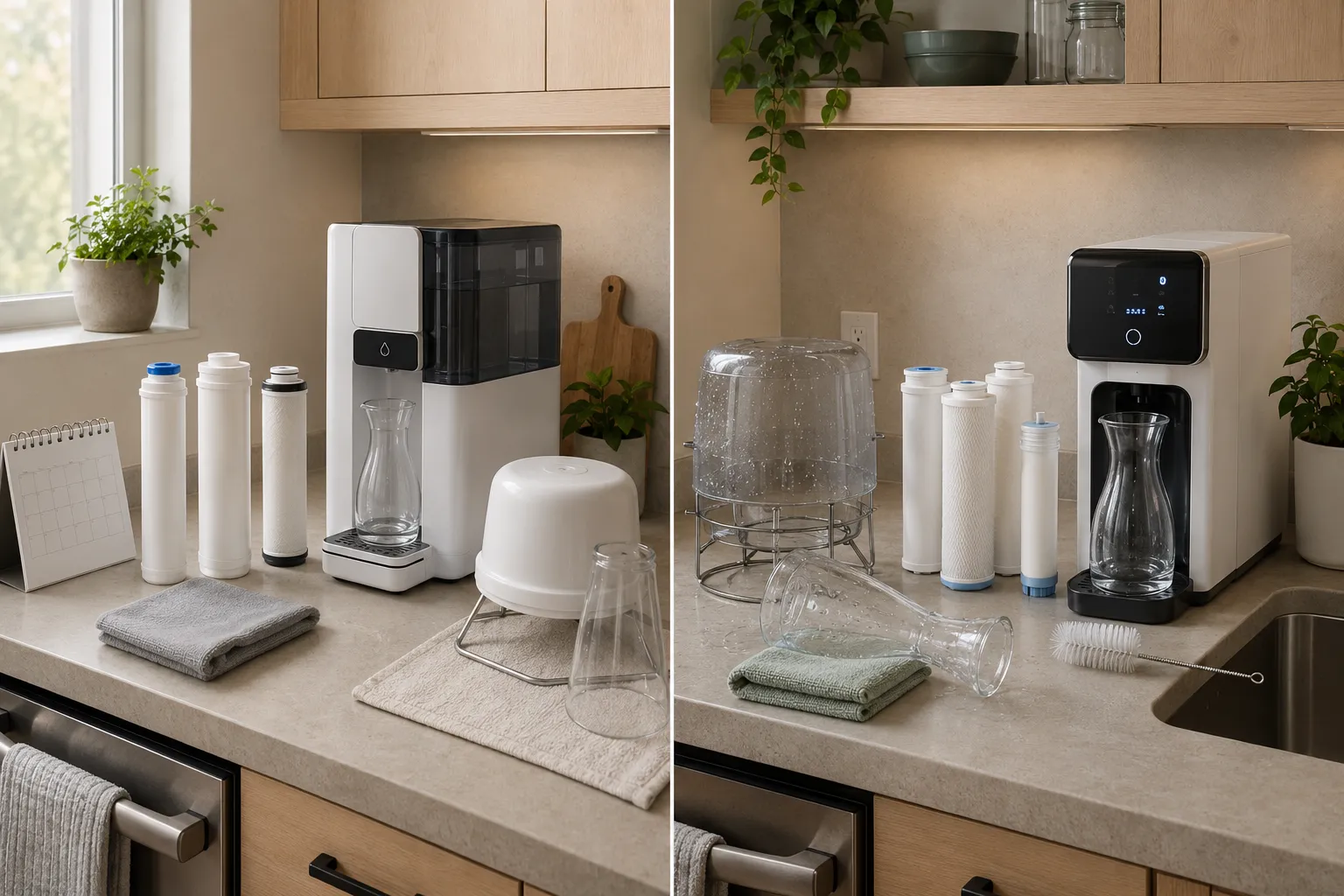
For both systems, maintenance is not an optional afterthought. A countertop RO unit occupies a food-prep area, handles water every day, and depends on clean removable parts and current filters.
With AquaTru, the scheduled pre/carbon, RO, and VOC filters create a predictable ownership calendar. Its support center also provides a Carafe manual, filter-change guidance, and a maintenance-mode article. The responsible approach is to follow those model-specific instructions, especially after storage, interrupted filtration, or an alert.
With Bluevua, the product page’s TDS display, filter-life tracking, and auto-rinse are useful prompts, not substitutes for the manual. Its official support center provides a dedicated ROPOT user guide, setup video, filter-change material, descaling guidance, and cleansing-kit guidance. Read the relevant instructions before attempting a cleaning method or assuming a replacement filter fits another ROPOT variant.
Which One Makes More Sense in an Apartment?
| Your priority | Better starting point | Why |
|---|---|---|
| You need confirmed size, weight, source-tank, and filter-interval information before choosing | AquaTru Carafe | Its current official support and product pages publish those base-model details clearly |
| You want the larger listed glass carafe | AquaTru Carafe | Manufacturer lists 64 oz |
| You want five stated stages with remineralization | Bluevua ROPOT | The base product page lists a remineralization stage after RO and carbon stages |
| You value visible TDS and an auto-rinse feature | Bluevua ROPOT | Both are described on the current product page |
| You cannot maintain a manual-fill, powered counter appliance | Neither | A simple pitcher, non-electric dispenser, or compatible faucet filter may fit your routine better |
The best choice is the one whose daily routine fits your kitchen. AquaTru is the clearer option for a shopper who needs more published base-model measurement and replacement information before committing counter space. Bluevua is the more feature-led option for someone who specifically values its stated five-stage architecture, remineralization, TDS display, and automatic rinsing, and who will verify the remaining installation figures in the current manual.
Before You Buy
- Confirm the exact variant name on the cart page. Do not assume ROPOT, ROPOT(UV), Lite, Carafe, Carafe Smart, and mineral-filter bundles have the same specifications.
- Measure body space, cabinet clearance, refill access, carafe access, and the route to a safe outlet.
- Decide whether manual filling and carrying the carafe to the refrigerator is realistic every day.
- Read the current owner manual for water handling, cleaning, filter replacement, and storage instructions.
- Verify current replacement-filter availability and warranty terms before treating either system as a long-term purchase.
- If a specific water-quality concern drives the purchase, use your utility report and the product’s current certification documentation rather than a generalized marketing claim.
FAQ
Do AquaTru Carafe and Bluevua ROPOT need a water line?
No permanent water line is described for either base model. Both use a manual-fill countertop workflow, which avoids sink modification but still requires regular refilling and a nearby outlet.
Does no drain hose mean there is no wastewater routine?
No. A countertop RO system can avoid a permanent drain hose while still requiring the owner to follow instructions for tanks, remaining water, cleaning, and disposal. Do not assume a particular pure-to-concentrate ratio unless the current manual for that exact model states one.
Is a higher TDS reading or a more stages always better?
No. A display or a stage count is not a complete decision framework. Compare the exact model’s documentation, certifications, replacement schedule, counter fit, and the water concern you are trying to address.
Can I use either system in a rental kitchen?
Usually, the no-permanent-plumbing format is simpler than an under-sink system, but you still need suitable counter space, a safe outlet, a refill path, and permission under any building or lease rules that apply to countertop appliances. The kitchen must support the entire routine, not only the product body.
Bottom Line
The AquaTru Carafe is the more straightforward choice for a renter who values a published 64 oz glass carafe, documented 2.5 L source tank, verified base-model size and weight, and a clear filter schedule. The Bluevua ROPOT is compelling for a renter who prefers its stated five-stage, remineralizing design, TDS display, and auto-rinse feature, but should confirm any still-unstated installation details directly from the current ROPOT manual before purchase.
Both are powered, manual-fill countertop RO systems. Choose only after the refill, carafe, cleaning, filter, outlet, and counter-space routines look sustainable in your actual apartment.