Disclosure
Affiliate disclosure
OmniHomeX may earn a commission from some links on this page. That does not determine what we cover, how we describe tradeoffs, or whether we recommend something at all.
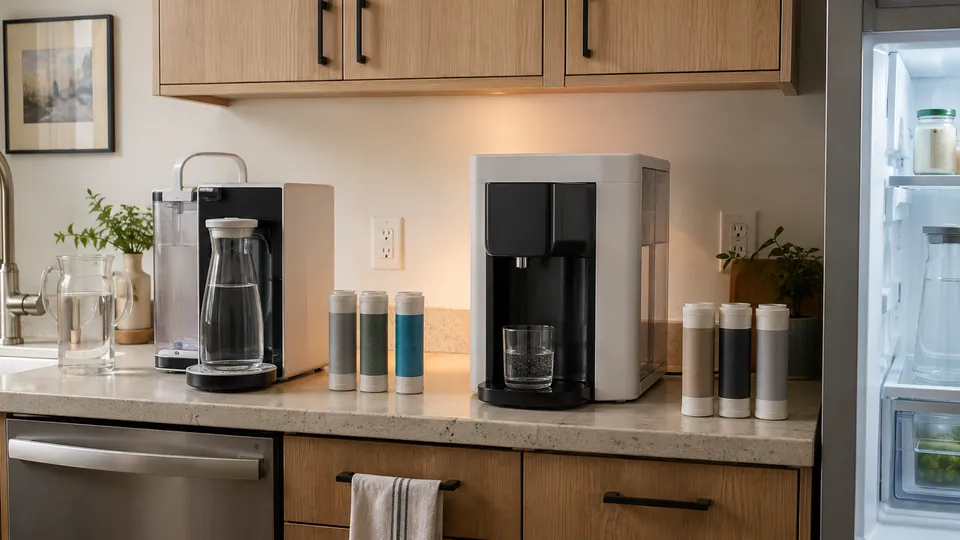
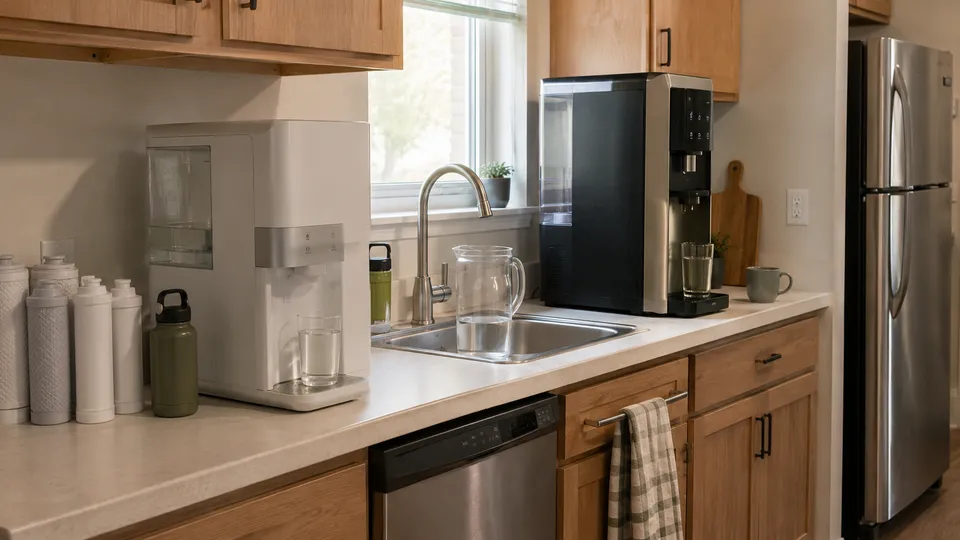
For most renters, a manual-fill countertop reverse-osmosis (RO) system is the simplest way to add RO filtration without drilling, altering the faucet, or modifying under-sink plumbing. The AquaTru Carafe is the compact glass-carafe starting point in this guide; AquaTru Classic offers more built-in water storage, Bluevua ROPOT adds visible monitoring and remineralization, and Waterdrop A1 is the larger hot-and-cold option.
None of these is a water filter you can forget about. You still need to fill a source tank, keep a powered counter location clear, follow the maker’s instructions for water left after processing, clean removable parts, and replace filters.
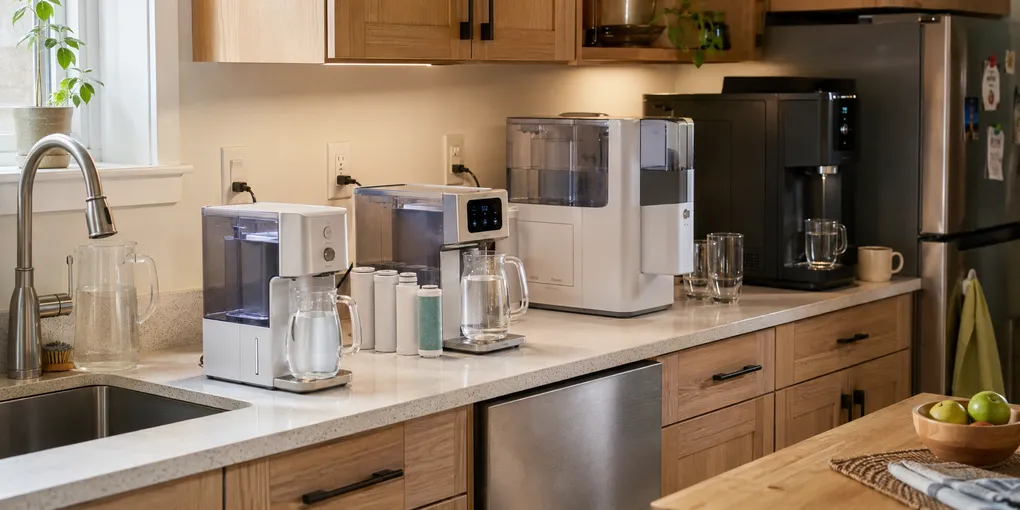
This guide compares four current models with distinct apartment roles: a compact glass-carafe system, a larger tank-first countertop RO unit, a carafe model with monitoring and remineralization, and a larger hot-and-cold dispenser. The facts below come from current manufacturer product and support pages. This is not hands-on testing, laboratory testing, or a promise that a system addresses every local water concern. Check the exact current product page, manual, and relevant local water information before ordering.
For a direct comparison between the two glass-carafe systems here, see AquaTru Carafe vs. Bluevua ROPOT for apartments. If you are still deciding whether RO fits your kitchen at all, start with our countertop water-filter guide for apartment renters.
Quick Picks: Which Apartment RO System Fits Your Routine?
| Apartment priority | Starting point | Why it fits |
|---|---|---|
| A compact, no-plumbing glass-carafe routine | AquaTru Carafe | 64 oz carafe, 2.5 L source tank, and a published stage-by-stage filter schedule |
| More stored water in a self-contained countertop RO unit | AquaTru Classic | 1 gal source tank and 0.75 gal clean-water tank in a larger fixed-counter setup |
| A glass carafe plus display-led maintenance signals | Bluevua ROPOT | 60 oz glass carafe, real-time TDS display, auto-rinse, filter-life tracking, and remineralization stage |
| A dedicated hot-and-cold RO beverage station | Waterdrop A1 | 136 oz source tank, cold-water tank, selectable dispensing, and maker-listed hot and cold temperatures |
Prices, filter revisions, availability, and bundle contents can change. Treat the product roles as a way to narrow your search, then verify the exact version in the current manual.
If you searched for a compact reverse-osmosis system for a small apartment, start with the AquaTru Carafe rather than assuming every countertop model is equally compact. The AquaTru Classic needs a dedicated storage location, while the Waterdrop A1 trades more counter space for hot-and-cold dispensing. Measure tank-removal clearance and the full working area before choosing by body dimensions alone.
If your shortlist has narrowed to AquaTru’s glass-carafe and larger tank-first models, read AquaTru Carafe vs. AquaTru Classic for apartments.
If the choice is a tank-first AquaTru Classic versus a larger hot-and-cold Waterdrop A1, see AquaTru Classic vs. Waterdrop A1 for apartments.
First Decide Whether the Daily Routine Fits
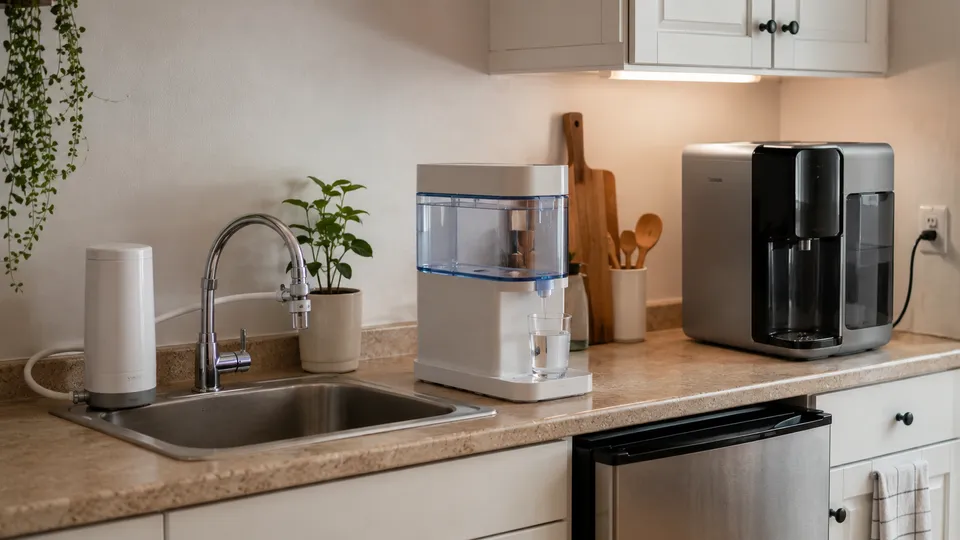
All four systems avoid a permanent under-sink water connection. That is useful in a rental, particularly if your faucet is pull-down, the lease restricts plumbing changes, or you do not want a diverter attachment. It also means the owner does the water-moving work.
Before comparing a filter count or display, decide whether you can realistically handle these steps:
- Fill the source tank from the sink without carrying water across a crowded kitchen.
- Leave enough room above and around the machine to remove tanks, carafes, and filters.
- Keep a stable nearby outlet available without routing a cord over the sink or cooking zone.
- Follow the current manual for remaining or concentrated water, cleaning, and storage.
- Keep replacement filters available for the exact model and variant you buy.
An RO machine that technically fits beneath a cabinet can still be a poor apartment fit when there is no room to lift the tank or set down a full carafe. The relevant measurement is the working footprint, not only the product body.
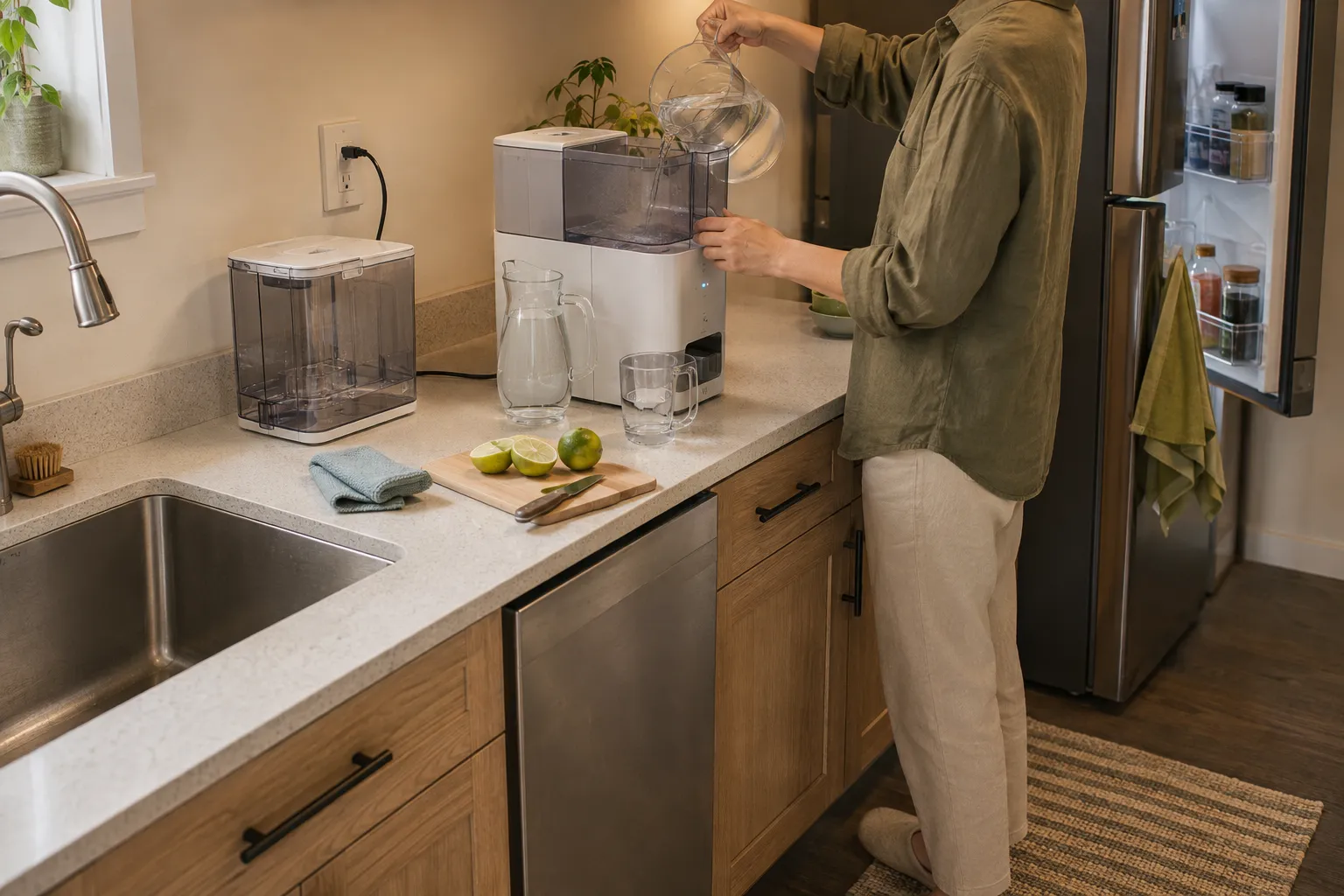
Best Compact Reverse Osmosis System for a Small Apartment: AquaTru Carafe
The AquaTru Carafe is the starting point for a renter who wants a manual-fill countertop RO system with a glass serving vessel and a clearly documented maintenance schedule. AquaTru lists a 64 oz borosilicate glass carafe and a 2.5 L tap-water tank. The selected base configuration here is the AquaTru Carafe with the VOC Carbon Filter, not the Carafe Smart or a mineral-boost bundle.
The product uses four maker-described stages: pre/carbon filtration, RO filtration, and VOC carbon filtration. AquaTru currently lists replacement intervals of six months for the pre/carbon filter, two years for the RO filter, and one year for the VOC carbon filter. It also describes the system as requiring no permanent plumbing or installation and provides a one-year manufacturer’s warranty.
The useful limitation is precision. AquaTru’s current support material contains inconsistent body-dimension formatting for the Carafe. Rather than publish a potentially misleading measurement, measure from the exact current manual or product diagram before assigning it to a narrow space under cabinets. The manufacturer lists the unit weight as 9 lb, but the real space question remains whether you can comfortably lift, fill, and remove the tank in your kitchen.
Choose the AquaTru Carafe when:
- You want a
64 ozglass carafe and a documented2.5 Lsource-tank routine. - You value a clear filter replacement schedule before committing to a model.
- You need an RO format with no permanent plumbing connection.
Skip it when:
- You need fully settled body-dimension data before you can plan the counter space.
- You do not want to refill a source tank or manage a powered countertop appliance.
- You prefer immediate hot or cold dispensing.
Best Larger Tank-First System: AquaTru Classic
The AquaTru Classic is the more substantial self-contained choice for a renter who wants larger listed water storage and can dedicate a counter location to it. AquaTru support lists the Classic at 14 x 12 x 14 in and 16 lb, with a 1 gal tap-water tank and a 0.75 gal clean-water tank. The base Classic with VOC Carbon Filter uses the same broad four-stage approach and the same published six-month, one-year, and two-year stage intervals as the Carafe configuration above.
It has no permanent plumbing requirement, but it should not be treated like a small pitcher. The Classic needs space for tank handling, access to a suitable outlet, and the routine described in its current manual for the system’s water management and cleanup. Its larger stored-water figures can reduce refill frequency for some households, while its 16 lb body and full working footprint make it less convenient to move in and out of storage.
Choose the AquaTru Classic when:
- You prefer
1 galsource-water storage and0.75 galof listed clean-water storage. - You can leave a
14 x 12 x 14 inunit in one stable, powered counter location. - You want a tank-first RO workflow without altering apartment plumbing.
Skip it when:
- Your counter must double as your main food-prep area.
- You plan to store the appliance in a cabinet between uses.
- You need the smallest and lightest glass-carafe setup.
Best for Monitoring and Remineralization: Bluevua ROPOT
The base Bluevua ROPOT is for a renter who specifically wants a glass-carafe countertop RO system with visible maintenance signals. Bluevua lists a 60 oz borosilicate glass carafe, a five-stage filtration path, real-time TDS display, automatic rinsing, filter-life tracking, no installation requirement, a 30-day return policy, and a one-year warranty. Its stated five stages are sediment, CTO carbon, RO, post-carbon, and remineralization with calcium and magnesium.
The routine remains manual: Bluevua describes filling the tank, plugging the unit in, pressing Start, and pouring from the carafe. The display and auto-rinse features may make system status easier to see, but they do not eliminate refilling, cleaning, or the need to follow the current manual for water management.
Some shopper-facing product pages list detailed ROPOT dimensions, tank capacities, waste ratios, or electrical figures. This article deliberately does not repeat those numbers because the current base-model official text reviewed did not present them clearly enough to publish as stable specifications. Verify those fields in Bluevua’s current base ROPOT manual before deciding that it fits a narrow counter.
Choose the Bluevua ROPOT when:
- You want the stated remineralization stage and a
60 ozglass carafe. - You value real-time TDS, filter-life tracking, and auto-rinse prompts.
- You are willing to confirm the remaining fit and water-management details in the current manual.
Skip it when:
- You need fully published body, source-tank, and wastewater figures before you shortlist a product.
- You do not want a manual-fill, powered countertop routine.
- You want hot and cold water from the same appliance.
Best Hot-and-Cold Beverage Station: Waterdrop A1
The Waterdrop A1 is the high-capacity, feature-heavy option. It is not a compact machine in the everyday apartment sense, even though its maker-listed width is only 7.8 in. Waterdrop lists the A1 at 18.3 x 7.8 x 17.1 in and 38.5 lb, with a 136 oz source-water tank, a 34 oz iced-water tank, and electricity required. Its product page describes manual filling and plug-in use with no under-sink installation or drilling for the normal setup.
For drink preparation, Waterdrop lists water as hot as 203 F, cold as 41 F, six temperature settings, and five dispensing volumes. It also lists seven filtration stages, a stated 2:1 pure-to-drain ratio, separate clean and waste-water areas, and an NSF/ANSI 372 certification statement. That certification concerns lead-free materials; it should not be presented as evidence that every filtration-performance claim has the same certification scope.
Waterdrop lists the A1-CF filter for up to six months or 550 gallons, and the A1-RO filter for up to 12 months or 1,100 gallons. Those are maker-listed replacement figures, not a universal schedule for every water source.
Choose the Waterdrop A1 when:
- You will use its hot and cold dispensing features regularly enough to justify a dedicated appliance station.
- Your counter can safely hold a
38.5 lbunit with access for its tanks, drip tray, filter work, and cleaning. - You want a larger manual-fill system and accept its size, power requirement, and water-management routine.
Skip it when:
- You want an appliance that can move around or store away easily.
- You only need a simple drinking-water filter.
- Your upper cabinets, outlet location, or counter depth constrain tank access.
If hot-and-cold dispensing is worth the A1’s larger footprint for your kitchen, check the current Waterdrop A1 product page for the exact model, availability, and purchase terms.
Side-by-Side Apartment Fit
| Model | Source and clean-water storage | Installation | Power | Published body information | Maintenance signals and schedule |
|---|---|---|---|---|---|
| AquaTru Carafe | 2.5 L source tank; 64 oz glass carafe | No permanent plumbing described | Powered countertop system | 9 lb; exact body-size formatting needs manual confirmation | Pre/carbon: 6 months; RO: 2 years; VOC carbon: 1 year |
| AquaTru Classic | 1 gal source; 0.75 gal clean tank | No permanent plumbing described | Powered countertop system | 14 x 12 x 14 in; 16 lb | Pre/carbon: 6 months; RO: 2 years; VOC carbon: 1 year |
| Bluevua ROPOT | 60 oz glass carafe; source-tank figure not published here | No installation required | Plug in, fill, and start | Exact base-model dimensions and weight not published here | Auto-rinse, real-time TDS, filter-life tracking |
| Waterdrop A1 | 136 oz source tank; 34 oz iced-water tank | No under-sink installation or drilling described | Yes | 18.3 x 7.8 x 17.1 in; 38.5 lb | CF: 6 months/550 gal; RO: 12 months/1,100 gal |
The blanks in this table are intentional. A reliable buying guide should distinguish between a maker-published specification and an unverified number repeated by a retailer or older review.
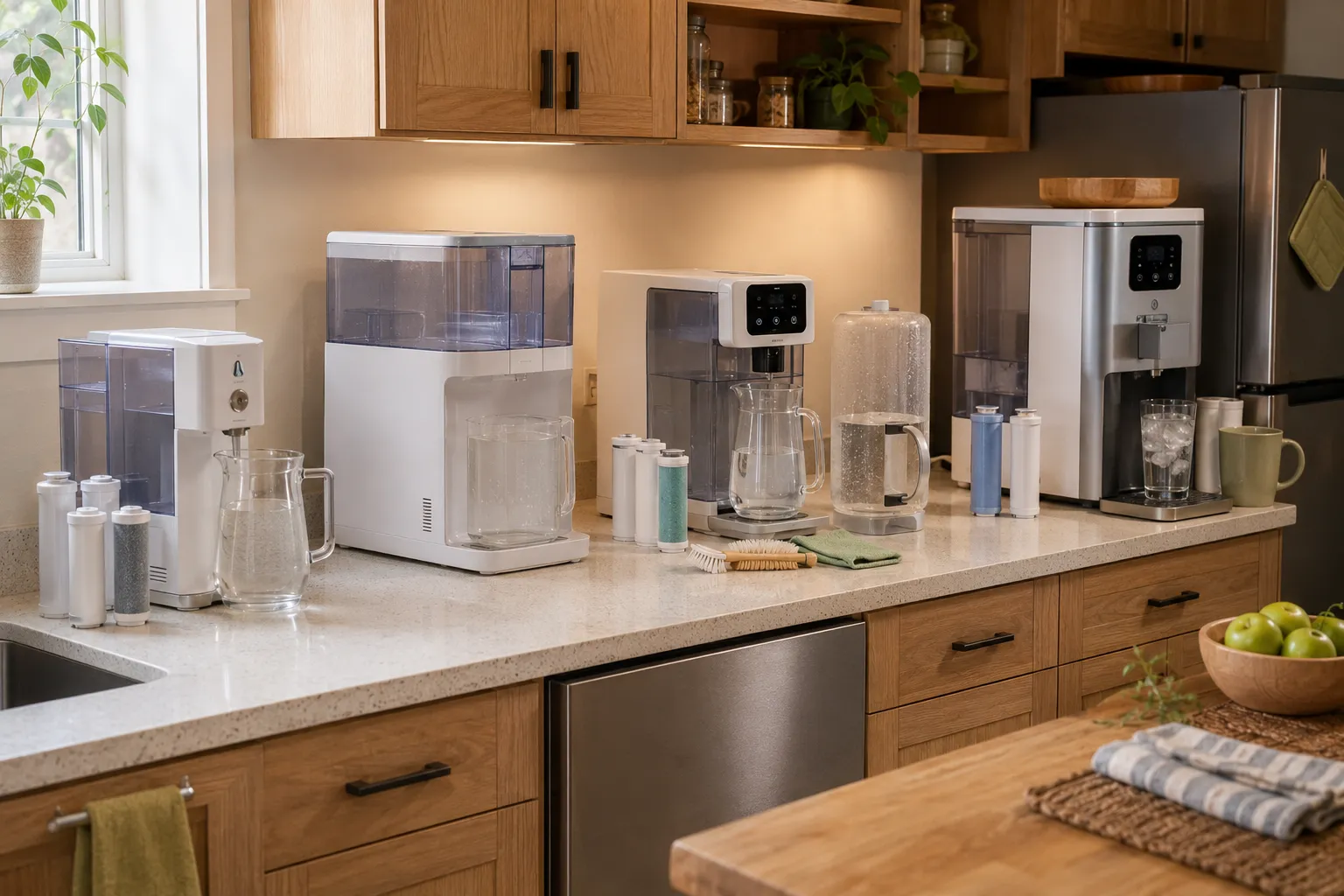
What “No Installation” Does and Does Not Mean
For these countertop RO systems, no installation generally means no permanent water line, under-sink drilling, or drain-hose connection. It does not mean no setup or maintenance. You still need a counter location, an outlet, a source-water filling routine, access to removable tanks or carafes, and a plan for cleaning and water management based on the exact manual.
That makes countertop RO different from the faucet-connected and non-RO systems in our apartment countertop water-filter guide. A compatible faucet filter can give on-demand water with a different set of restrictions. A simple refillable dispenser can take less space and avoid RO’s additional workflow. Neither is automatically better; the right choice depends on the kitchen and your actual routine.
Apartment Counter Checklist
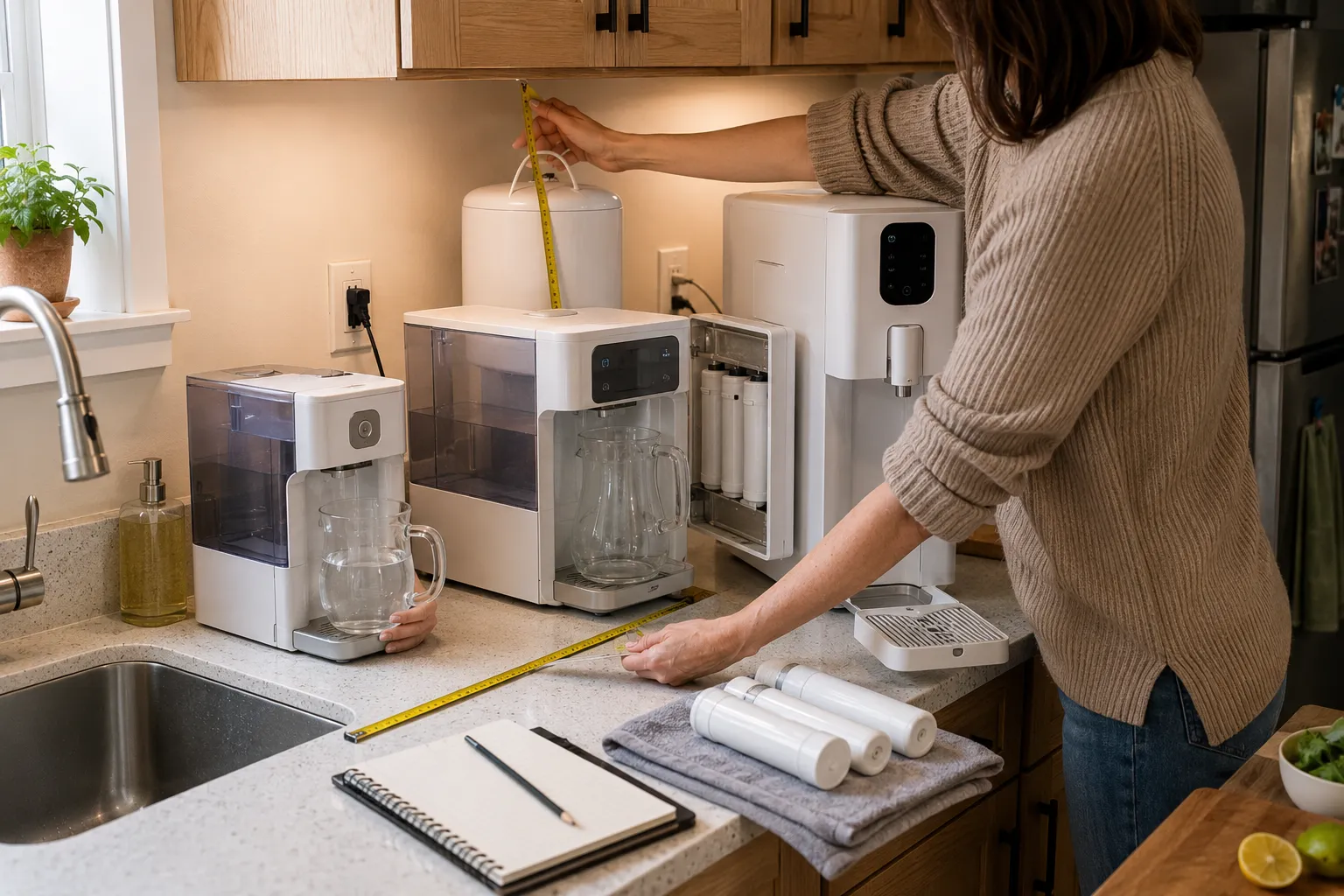
Before ordering any countertop RO system, measure and confirm:
- Counter depth and width. Include the working space in front of the appliance, not just the base.
- Upper-cabinet clearance. You need room to lift a source tank, access filters, and remove a carafe.
- Outlet location. Use a nearby, stable outlet. Do not plan around a stretched cord crossing wet or food-prep areas.
- Refill route. A tank is only convenient if the sink-to-appliance route is clear and easy to keep dry.
- Water-management routine. Read the exact manual before assuming how any remaining or concentrated water is handled.
- Filter access and storage. Check current replacement availability and leave room for filter changes and drying removable parts.
- Counter load. A heavier model such as the Waterdrop A1 needs a stable surface that can remain dedicated to the appliance.
FAQ
Do countertop reverse-osmosis systems need a water line?
Not the manual-fill systems in this guide. Their rental-friendly format avoids a permanent water-line installation, but it replaces that connection with source-tank filling, powered operation, cleaning, and model-specific water-management steps.
Does a countertop RO system need a drain hose?
The products covered here are presented by their manufacturers as self-contained countertop systems rather than permanent drain-hose installations. That does not mean there is no remaining-water or wastewater routine. Follow the current manual for the exact model instead of assuming that all countertop RO systems work alike.
Is a larger water tank always better for an apartment?
No. A larger source tank can reduce refills, but it also affects weight, filling access, counter use, and the amount of water you handle at once. A smaller carafe system can be easier to fit into a constrained kitchen when the refill routine is realistic.
Does more filtration stages mean a better choice?
Not by itself. Compare the exact model version, current manufacturer documentation, replacement filters, counter fit, daily routine, and any water-quality need you are trying to address. Do not treat a stage count or a TDS display as a complete water-quality decision.
Bottom Line
The AquaTru Carafe is the clearest fit for a renter who wants a 64 oz glass carafe, a documented 2.5 L source tank, and a published filter schedule, while verifying its current dimensions directly from the manual. The AquaTru Classic makes more sense when the 1 gal source tank and 0.75 gal clean-water tank outweigh its larger, fixed-counter footprint. The Bluevua ROPOT is the feature-led glass-carafe option for shoppers who value its stated remineralization, display, and auto-rinse functions and will confirm its remaining fit details. The Waterdrop A1 is a true appliance station for renters who will regularly use its hot and cold dispensing features and have a stable location for a 38.5 lb machine.
Choose the routine before the product. If refilling, cleaning, storage, and counter access are not sustainable in your apartment, a countertop RO system will not become convenient merely because it avoids plumbing.