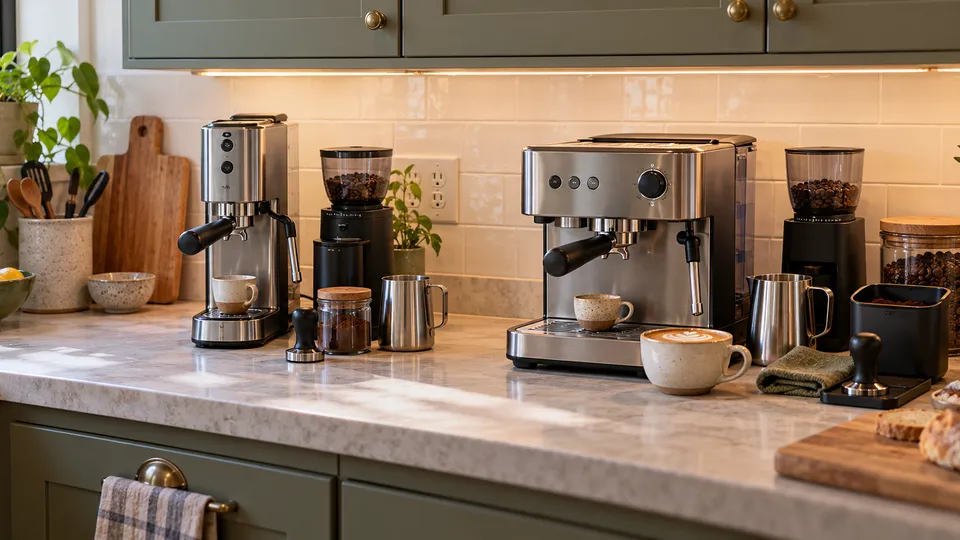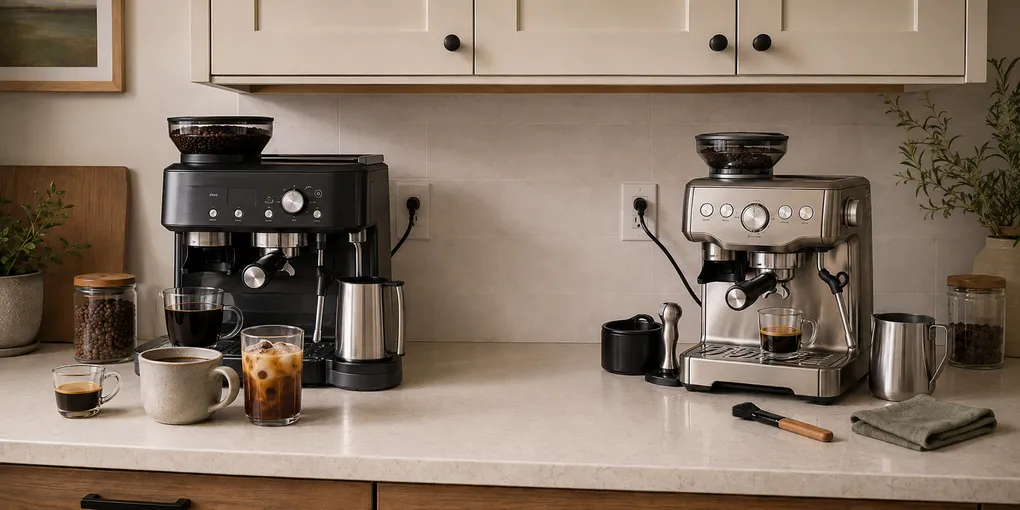
The Ninja Luxe Cafe Premier ES601 and the Breville Barista Express BES870XL both combine a grinder and espresso machine in one appliance. They are not interchangeable choices. The Ninja is built around a guided, multi-format coffee routine with espresso, drip coffee, cold brew, and hands-free milk frothing. The Breville is built around a more traditional espresso routine: grind, dose, tamp, extract, and steam milk yourself.
For a small apartment, that difference matters more than the fact that both have bean hoppers. A machine can replace a separate grinder, but it still needs room for water, a portafilter, a milk jug, cleanup tools, and the actions you repeat every morning.
If you have not decided whether an espresso setup belongs in your kitchen at all, start with our broader guide to coffee makers for small apartments. This page is for a narrower choice: two all-in-one bean-to-cup espresso systems with very different routines.
Quick Answer
Choose the Ninja Luxe Cafe Premier ES601 if you want one main machine for espresso, drip coffee, and cold brew, and you value grind guidance, a built-in scale, and hands-free milk frothing.
Choose the Breville Barista Express BES870XL if espresso is the point, you want a more hands-on portafilter and steam-wand routine, and you are willing to learn the process rather than have the machine guide more of it.
Neither is a casual substitute for a narrow pod brewer or a stored manual brewer. Both deserve a planned counter zone.
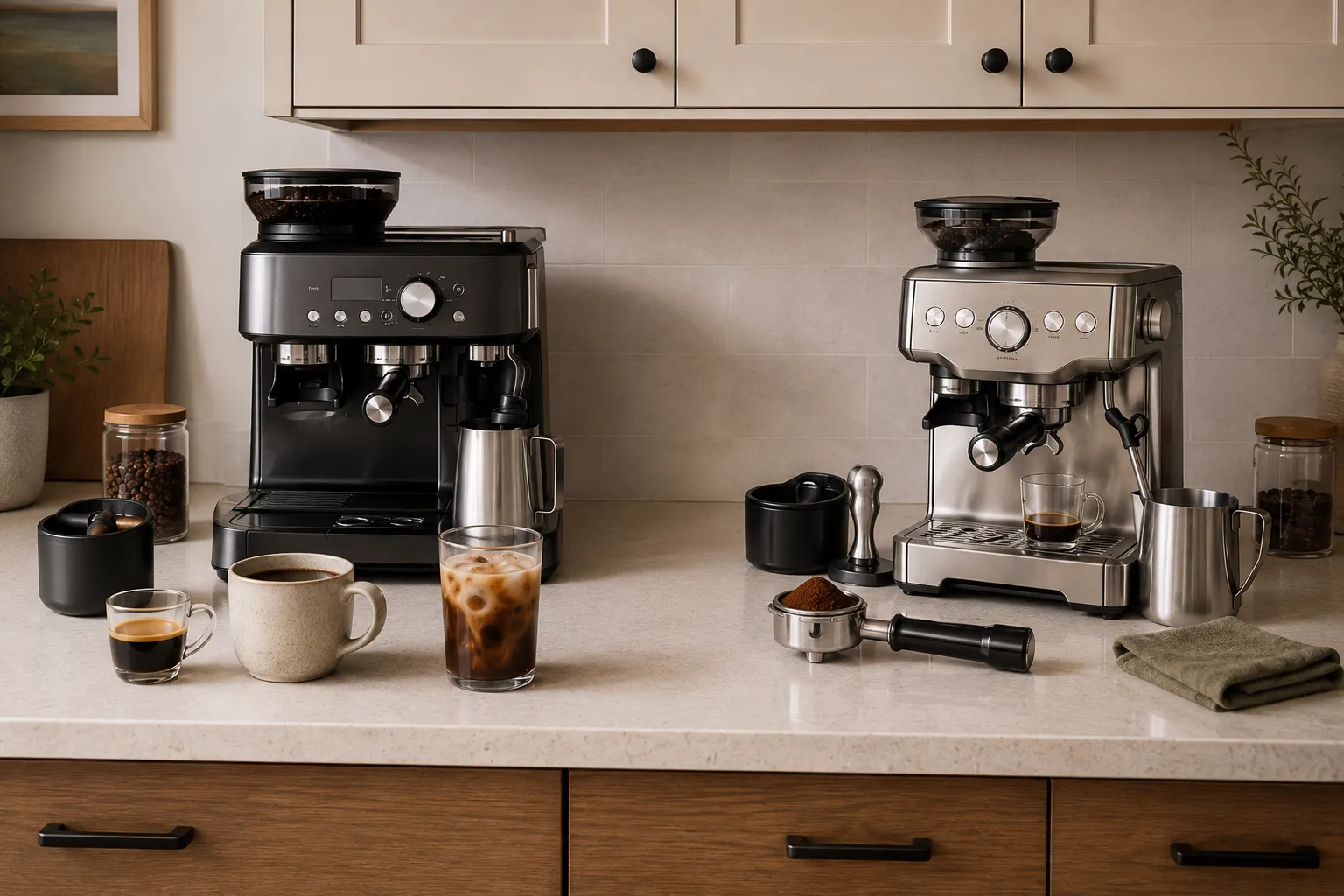
At a Glance: Verified Differences
| Decision point | Ninja Luxe Cafe Premier ES601 | Breville Barista Express BES870XL |
|---|---|---|
| Main drink formats | Espresso, drip coffee, and cold brew | Espresso-focused machine |
| Grinder | Integrated conical burr grinder with 25 settings | Integrated conical burr grinder with 16 settings |
| Dosing approach | Built-in scale and Barista Assist guidance | On-demand dose control; user handles the portafilter workflow |
| Milk workflow | Four hands-free hot or cold froth presets | Manual steam wand for hand-crafted microfoam |
| Portafilter | Use the exact included basket and portafilter for the model | 54 mm stainless-steel portafilter; Breville states an 18 g dose |
| Water and bean storage | Confirm the exact current manual before purchase | Official page lists a 67 oz water tank and 1/2 lb bean hopper |
| Electrical information | Official product page lists 120 V, 1,650 W, and a 43 in cord | Confirm the electrical rating for the exact U.S. or local-market model |
| Warranty | One-year limited warranty | One-year limited warranty |
The current Ninja product page has inconsistent published physical-size and weight fields. Rather than repeat a figure that may be wrong, this guide does not use a Ninja body measurement as a selling point. Check the current ES601 owner’s guide and measure your real working area before buying.
The Real Choice: Guided Multi-Drink Routine or Manual Espresso Routine
The Ninja’s strongest case is not that it has a grinder. The Barista Express has one too. Its case is that it joins several drink formats in one system and guides more of the process. Ninja describes the ES601 as a 3-in-1 system with espresso, drip coffee, and cold brew modes. Its Barista Assist system provides grind-size recommendations and adjusts brew settings, while the built-in scale supports weight-based dosing.
That makes the Ninja the more logical route when your household alternates between espresso-style drinks, regular brewed coffee, and cold drinks. You are accepting a larger, more involved appliance in exchange for avoiding a separate drip brewer or another grinder.
The Barista Express is a different commitment. Breville positions it as a bean-to-espresso machine with a 54 mm portafilter, low-pressure pre-infusion, 9-bar extraction, PID-controlled Thermocoil heating, and a manual steam wand. It does not make drip coffee or cold brew in the way the Ninja does. Its value is a focused espresso workflow, not format flexibility.
For a comparison of several espresso routes, including a narrower machine that does not include a grinder, read compact espresso machines for small apartments.
Grinding and Dosing: What the Machine Guides, and What You Still Do
Both products reduce the number of appliances on the counter because each includes a conical burr grinder. That is useful in a small kitchen, but it does not make the process hands-off.
Ninja ES601: More Guidance Around the Grind
Ninja states that the ES601 has 25 grind settings, a built-in scale, and Barista Assist technology. Its system recommends a grind size for the selected drink and supports weight-based dosing. This is useful for a buyer who wants a machine to take on more of the early setup decisions.
You still need to keep beans accessible, fit the portafilter or other brewing piece into the machine, empty coffee grounds, wipe the work area, and clean the parts named in the owner’s guide. Guidance reduces some decision-making; it does not remove the coffee routine.
Breville Barista Express: More Direct Control
Breville states that the Barista Express has an integrated precision conical burr grinder with 16 grind settings and dose control. The machine grinds on demand, but the user is still responsible for handling the portafilter, distributing and tamping the coffee, starting the shot, and learning how the results respond to adjustments.
This is the better match when that hands-on espresso process is the reason you want the machine. It is the less suitable match when you mainly want a regular mug of drip coffee with the least possible attention each morning.
If you prefer a separate grinder because you want more choices around storage or brew methods, see our guide to compact coffee grinders for small apartments.
Milk Drinks: Hands-Free Programs vs. Manual Steaming
Milk workflow is often the point where these machines stop being comparable on a simple specification chart.
Ninja describes its Dual Froth system as combining steaming and whisking, with four hands-free preset programs for hot or cold microfoam using dairy or plant-based milk. That suits someone who values repeatable milk drinks without standing at the steam wand throughout the process.
Breville describes the Barista Express as using a manual steam wand for hand-crafted microfoam. The machine can make milk drinks, but the user steams and textures the milk. That is a feature for someone who wants to practice and control the workflow, not a shortcut for someone who wants the machine to take over.
Do not choose between the two based on a claim that one makes universally better milk drinks. Choose based on whether you want a guided program or a manual skill-based task in your daily routine.
Small-Apartment Fit: Measure the Work Zone, Not Only the Cabinet
Breville currently lists the Barista Express dimensions as 15.9 W x 13.1 D x 12.4 H in, a 67 oz water tank, and a 1/2 lb bean hopper on its U.S. product page. Those figures help rule a counter in or out, but they are not the entire footprint.
For either machine, check these before buying:
- Bean-hopper access: You need clearance above the hopper to add beans and remove it when the manual requires it.
- Water access: A rear or top reservoir can turn a seemingly suitable cabinet position into an awkward daily task.
- Portafilter movement: Leave room in front of the machine to lock in, remove, dose, and knock out the portafilter.
- Milk area: A milk jug needs a stable place beside the machine before and after steaming or frothing.
- Cleanup zone: Keep a cloth, brush, and grounds container or tray close enough that cleanup does not spread across the kitchen.
- Outlet and cord route: Use a grounded outlet within the stated cord reach. Do not rely on an extension cord unless the exact manual explicitly permits the setup.
The Ninja’s official page confirms a 43 in cord, 120 V operation, and 1,650 W. Its currently displayed body-size and weight fields are not reliable enough to compare numerically here. Treat the exact ES601 manual and the usable space around your counter as the deciding source before ordering.
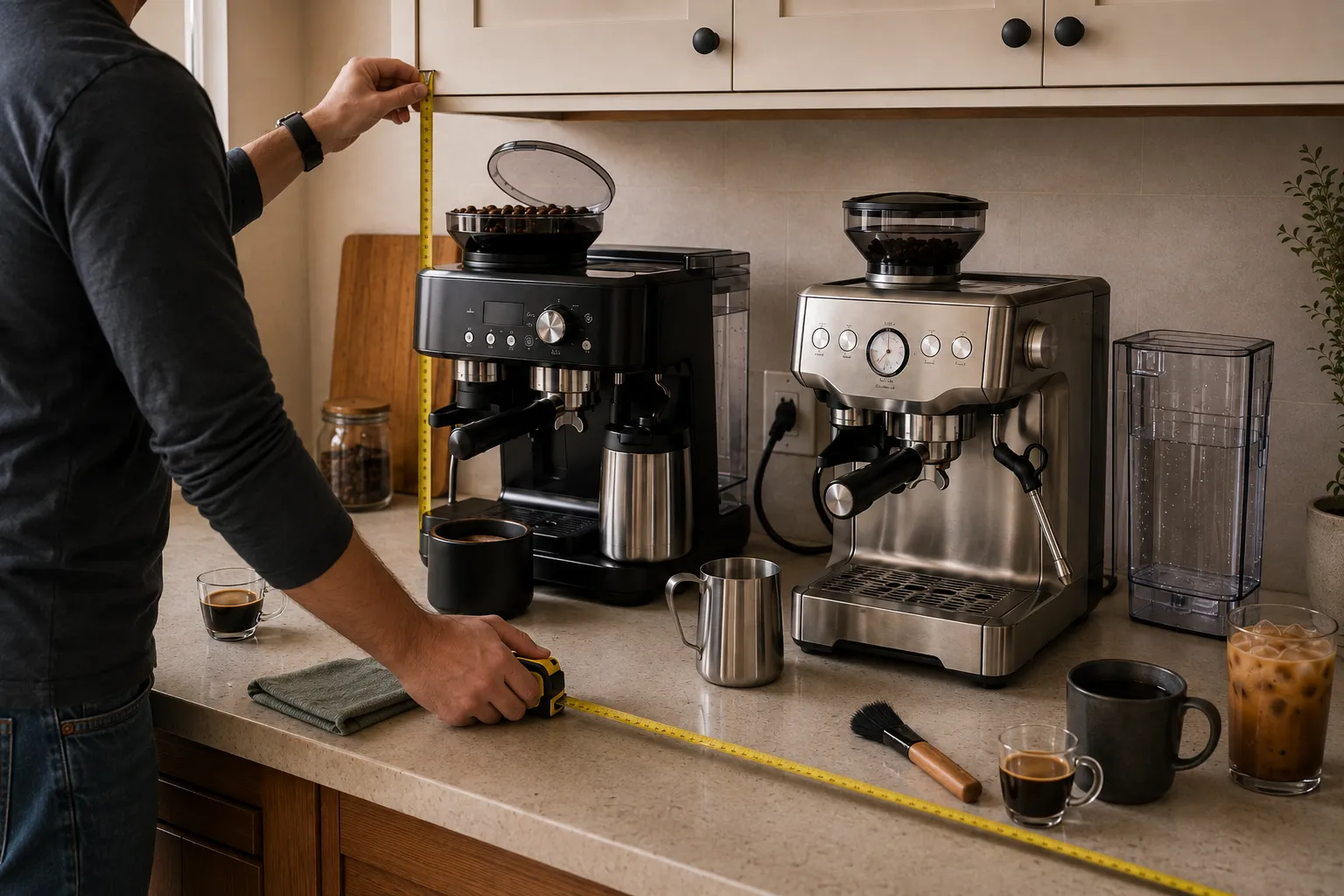
For a broader apartment coffee-station layout, see how to set up a simple coffee or tea corner.
Cleanup and Maintenance Are Part of the Purchase
An all-in-one coffee system removes the need for a separate grinder, but it combines multiple maintenance tasks in one place. Both machines have a grinder area, water system, drip area, coffee grounds, and milk-related cleanup to manage.
The practical difference is the workflow you are maintaining:
- The Ninja combines multiple drink modes and an automated frothing system. Follow the current owner’s guide for the exact cleaning, descaling, and removable-part instructions for the ES601.
- The Breville has a more manual portafilter and steam-wand routine. Breville sells water filters, descaler, cleaning tablets, a steam-wand cleaner, and grinder-cleaning parts for the Barista Express ecosystem, which is a reminder that those areas need regular attention.
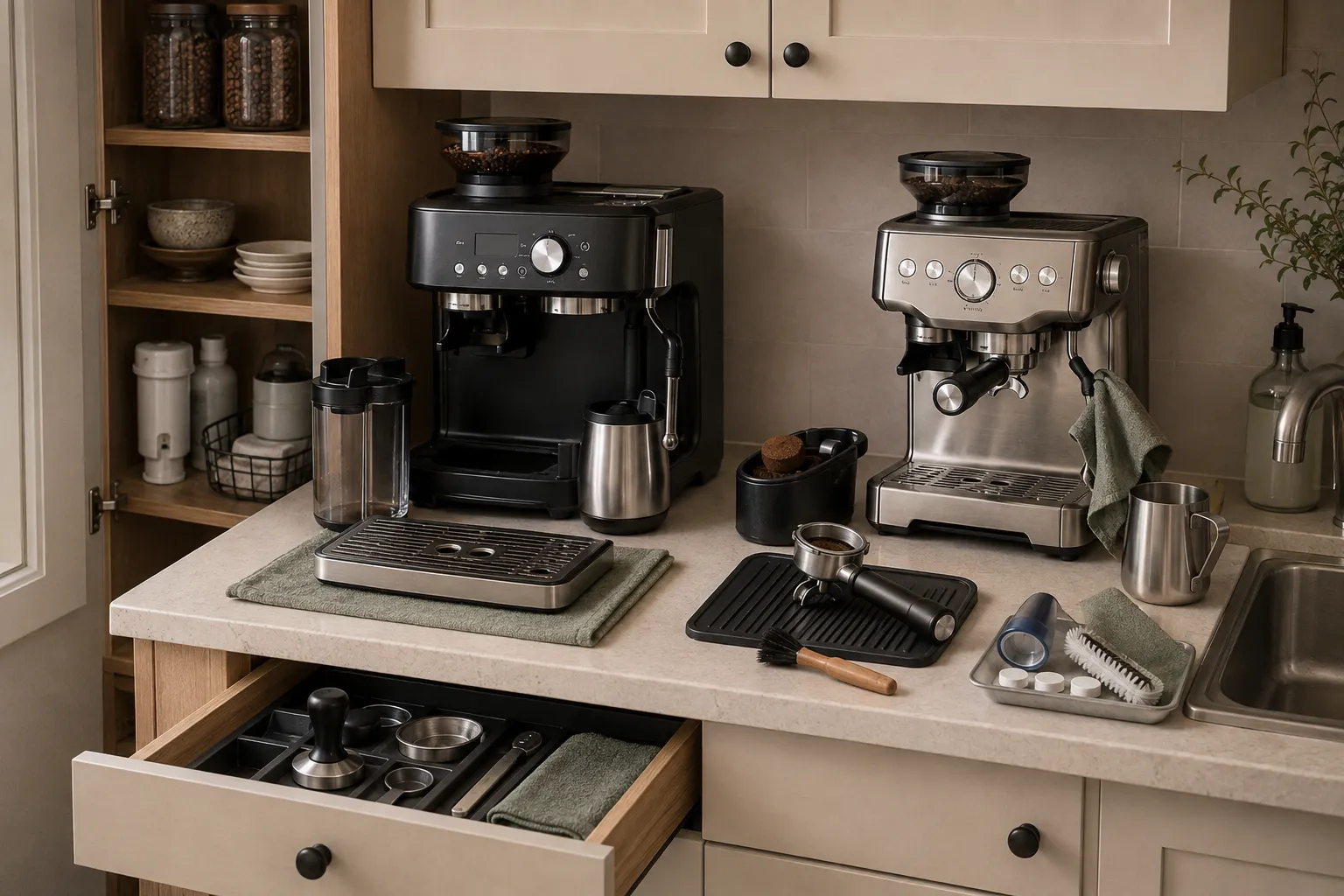
Neither machine is a good purchase if you want a coffee maker that can be ignored after use. The better choice is the one whose cleanup steps match the drinks you will actually make.
Who Should Buy Each One?
Choose the Ninja Luxe Cafe Premier ES601 if:
- You want espresso, drip coffee, and cold brew from one main appliance
- You prefer guidance around grind size and brewing decisions
- Hands-free hot or cold milk frothing matters more than practicing a steam wand
- You would rather consolidate several coffee formats than build a traditional espresso station
- You can verify the current manual and plan enough real counter clearance for the machine and its accessories
Choose the Breville Barista Express BES870XL if:
- Espresso is your main goal rather than drip coffee or cold brew
- You want an integrated grinder but a more hands-on portafilter workflow
- You want to steam and texture milk yourself
- You are willing to learn through dosing, tamping, extraction, and cleanup
- The listed width, depth, height, hopper access, and front working space fit your coffee area
What This Comparison Does Not Decide
This guide does not test espresso flavor, long-term durability, noise, or retailer bundles. It also does not treat a current sale price as a permanent advantage. Those factors can change by market, color, bundle, and time.
Before purchasing either machine, confirm the exact model number, included accessories, owner documentation, electrical rating, warranty terms, and current physical measurements from the manufacturer. In a small apartment, a missing inch of cabinet clearance or an awkward water-fill route can matter more than an extra preset.
FAQ
Is the Ninja ES601 a fully automatic espresso machine?
Ninja describes the ES601 as an intelligent espresso and coffee system with guided settings, a built-in grinder and scale, and hands-free frothing. It still involves beans, a portafilter or brewing component, grounds disposal, water, and cleanup. Treat it as a guided all-in-one system rather than a zero-work appliance.
Does the Breville Barista Express make regular drip coffee?
No. The Barista Express is an espresso-focused machine. It has an integrated grinder and can make espresso and milk drinks, but it is not a drip coffee or cold-brew maker. Choose it when espresso is the regular routine.
Do these machines remove the need for a separate coffee grinder?
For the machine’s intended integrated workflow, each includes a conical burr grinder. A separate grinder may still make sense if you want to switch frequently between brew methods, keep the machine off the counter, or have a different grinder requirement. It is not required simply because either machine has a grinder.
Which one is better for a very narrow apartment counter?
Do not assume either is narrow enough from a product category label. Breville publishes a current body measurement, while Ninja’s currently displayed physical fields need manual-level confirmation. In both cases, measure the machine body, bean-hopper clearance, water-fill route, front portafilter area, milk-jug space, and outlet access before deciding.