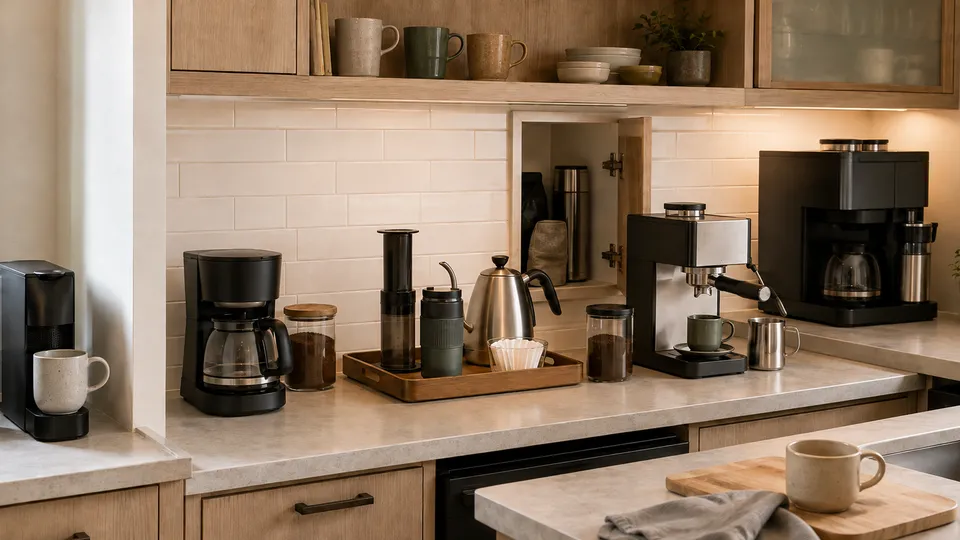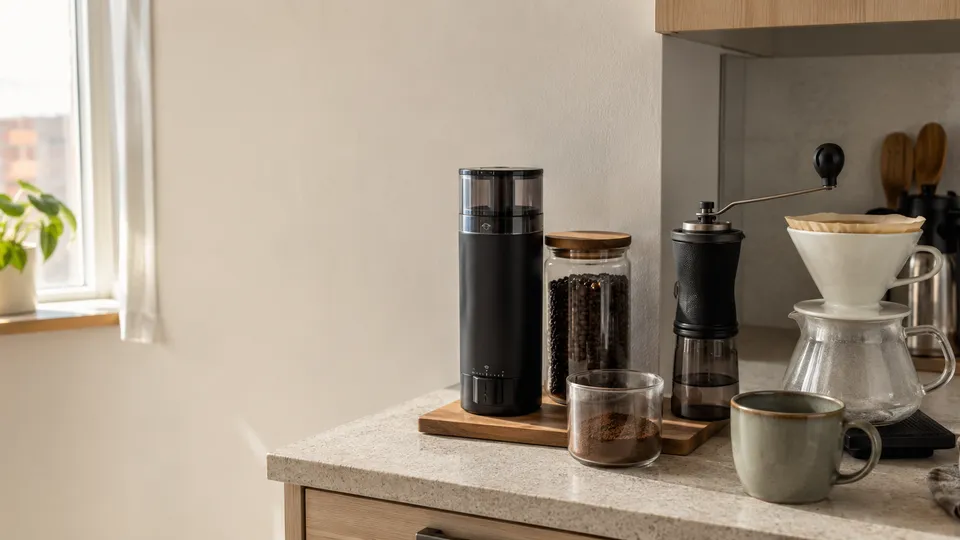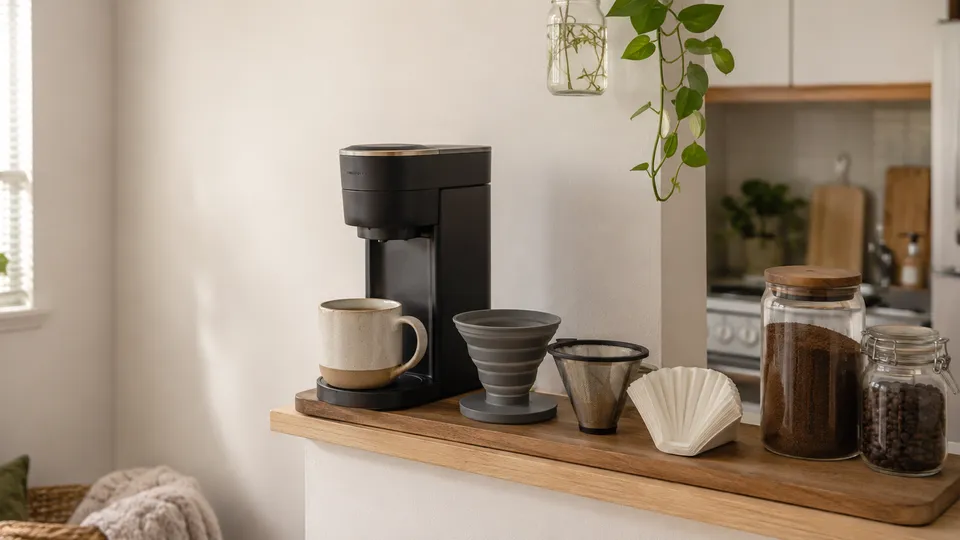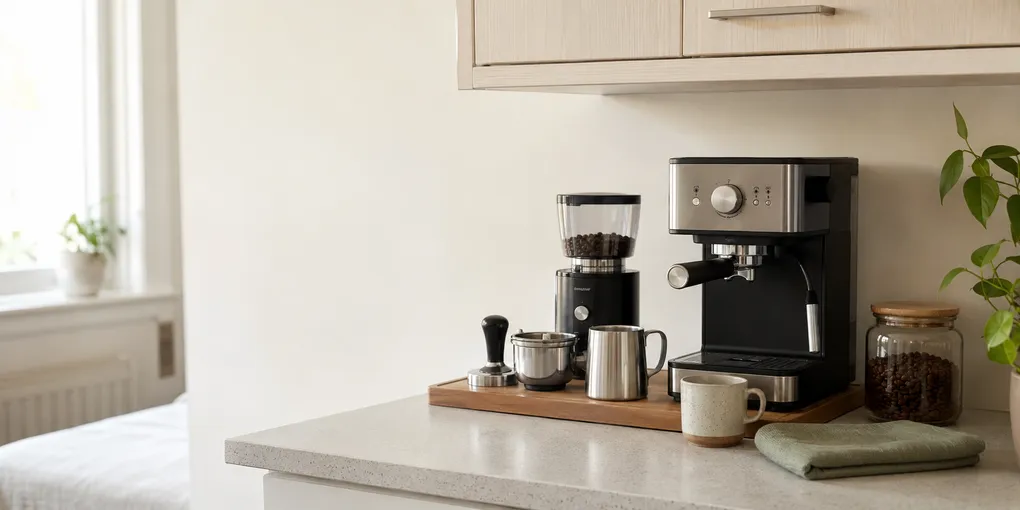
An espresso machine can make a small apartment coffee routine feel more intentional, but it can also take over the counter faster than expected. A compact espresso machine needs to fit as a daily workstation, not merely as a narrow rectangle beneath a cabinet. The machine is only part of the footprint: you may also need a grinder, a tamper, a milk jug, a knock box, coffee storage, and enough open space to fill a water tank or lock in a portafilter.
The best compact espresso machine is not automatically the narrowest one. A small espresso machine can save width but still need a separate grinder. A machine with automatic milk texturing can simplify lattes but may need more counter depth. An all-in-one grinder system can replace several appliances, but it may be too tall or deep for a tight cabinet run.
This guide compares four named models with distinct small-apartment roles. It separates the decision to buy a narrow espresso machine and separate grinder from the alternative of one larger all-in-one machine or a stored manual press. Dimensions, stated features, and operating limits were checked against official product pages, manuals, or support material. It does not claim hands-on testing, current retailer prices, or a universal best-tasting espresso.
If you have not decided whether an espresso setup makes sense for your routine, start with coffee pods vs. ground coffee for a small apartment. If you already know you need a separate grinder, see compact coffee grinders for small apartments.
For a broader comparison of coffee makers for small apartments, including pod, drip, manual, and all-in-one routes, see our small apartment coffee maker guide.
Quick Picks
| Need | Pick | Why it fits |
|---|---|---|
| Best for the narrowest counter | De’Longhi Dedica Arte EC885M | U.S. listing gives a body width of 5.9 in, keeping the machine notably narrow |
| Best for frequent milk drinks | Breville Bambino Plus | Compact body with automatic or manual milk texturing and an automatic steam-wand purge |
| Best built-in grinder system | Ninja Luxe Cafe Premier ES601 | Built-in conical burr grinder, 25 grind settings, weight-based dosing, and multiple coffee formats |
| Best for no permanent counter space | Flair NEO Flex | Collapsible manual press with no integrated heater and a stated 4 lb weight |
Availability, model variations, colors, and bundles can change by market. Check the exact model number, electrical requirements, counter clearance, and current manual before buying.
How These Compact Espresso Picks Were Chosen
Small-apartment espresso buyers usually have one of four real constraints:
- The counter is narrow, so machine width matters most
- Milk drinks are part of the daily routine, so the steam workflow matters
- One appliance needs to replace a grinder and more than one coffee maker
- The setup must store away rather than live on the counter
That is why these are not four versions of the same machine. Each product answers a different layout and routine question. The guide is deliberately cautious about heat-up speed, shot quality, noise, durability, and ease of cleaning because those experiences depend on beans, water, grind setting, technique, maintenance, and expectations.
What “Compact” Means for an Espresso Setup
Width is the obvious measurement, but depth and height often decide whether a machine works in a small kitchen. A shallow counter can make a narrow machine awkward. Low upper cabinets can prevent you from removing a bean hopper or water tank. A machine may fit as an object but still fail as a daily workstation.
| Setup question | Why it matters |
|---|---|
| How wide is the free counter section? | This determines whether a narrow manual machine is the sensible choice |
| How deep is the counter after the backsplash and outlet are considered? | A deeper all-in-one machine can crowd the prep area even when its width seems acceptable |
| Is there cabinet clearance above the machine? | Bean hoppers, water reservoirs, and lids need room to open or lift off |
| Do you already own an espresso-capable grinder? | Most compact semi-automatic machines do not grind beans for you |
| Do you make milk drinks most days? | A steam wand and milk jug add a workflow that a simple espresso-only routine does not need |
Measure the space where you will actually make coffee, not an empty part of the counter. Leave room to handle the portafilter, place a cup, and set down a milk jug or grounds container. A small tray can keep the machine’s accessories together, but it cannot create more working clearance.
For a broader coffee-station layout, see how to set up a simple coffee or tea corner.
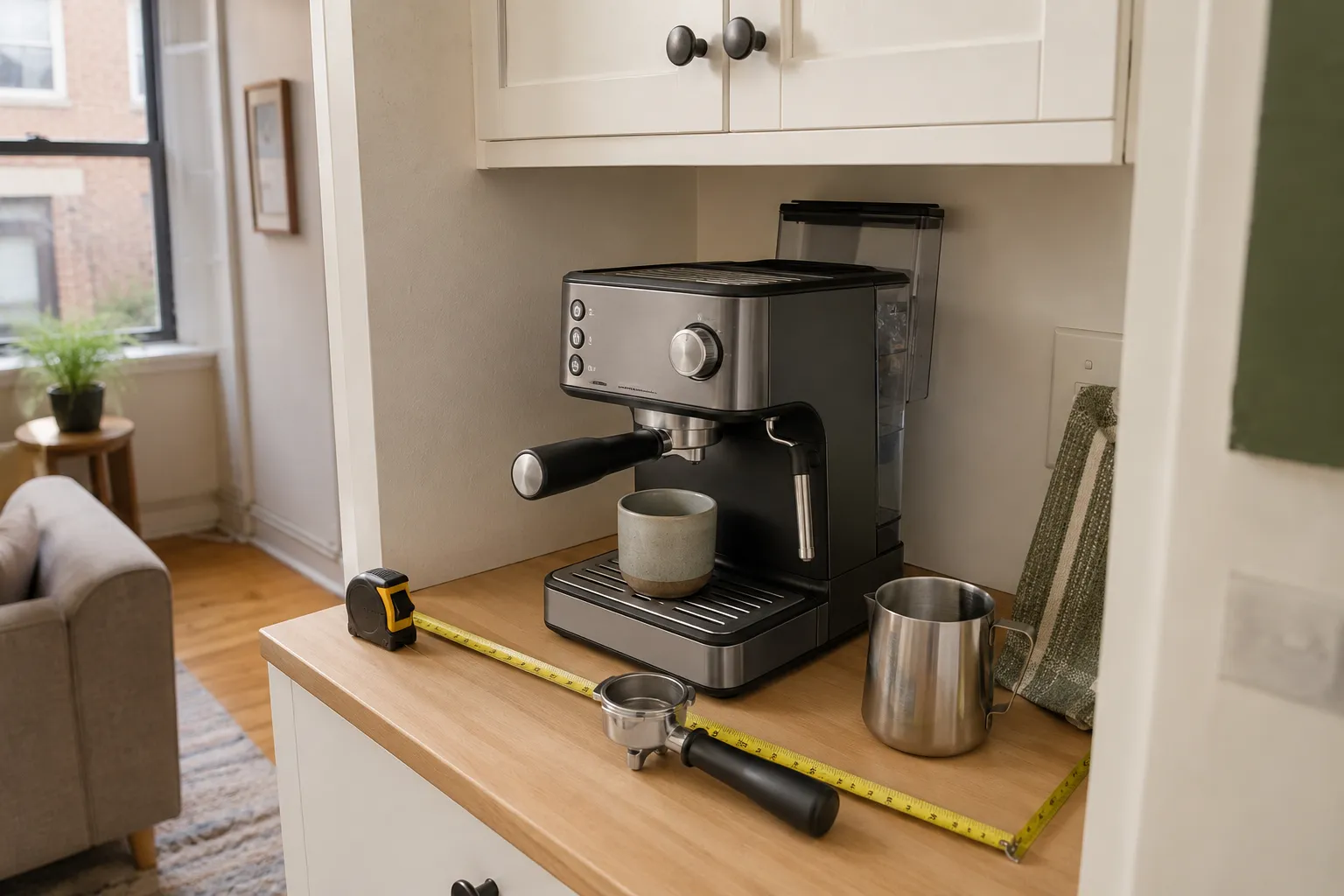
Best for the Narrowest Counter: De’Longhi Dedica Arte EC885M
The De’Longhi Dedica Arte EC885M is the clearest pick when width is the primary limit. De’Longhi’s U.S. listing gives dimensions of 5.9 x 13 x 12 in (width x depth x height), and its U.S. support page identifies the EC885M model. It is a manual espresso machine, not a bean-to-cup system.
That narrow body is the reason to consider it. It leaves more of the counter open for a grinder, kettle, or normal food preparation than many wider espresso machines. It is a manual setup, however, not a one-button bean-to-cup system. The apartment advantage comes from the slim machine body, not from eliminating the rest of the espresso routine.
Why it fits:
- U.S. listed width of
5.9 in - Manual espresso format keeps the machine role straightforward
- U.S. listed maximum cup height of
4.5 in - A reasonable starting point when your counter is narrow but you still want an electric espresso machine
The tradeoff is planning the companion gear. You need coffee that is suitable for espresso, and whole-bean users need a separate grinder. Milk drinks also require your own milk workflow and cleanup. Confirm exact availability and specifications for the version sold in your market before buying.
This is the practical choice for a narrow coffee station, not an all-in-one shortcut.
Best for Frequent Milk Drinks: Breville Bambino Plus
The Breville Bambino Plus is the small-apartment option to consider when lattes and cappuccinos are a regular part of the routine. Breville’s U.S. listing for the BES500 currently gives 11.9 x 7.4 x 14.3 in (labeled width x depth x height). Other regional and variant listings differ, so verify the exact seller SKU and measure the working clearance rather than treating one set of dimensions as universal. The manufacturer also states that it uses a 54 mm stainless-steel portafilter with 18 g of coffee and supports both automatic and manual milk texturing.
The milk workflow is the point of difference. Breville specifies three adjustable milk temperatures, and the official instructions describe an automatic steam-wand purge after texturing. That does not make the machine maintenance-free, but it can make the post-milk routine more structured than a basic manual steam setup.
Why it fits:
- Compact official dimensions for a milk-capable electric espresso machine
- Automatic or manual milk texturing lets the routine stay flexible
- Three stated milk-temperature settings
- Automatic steam-wand purge is a useful cleanup-related feature
- 54 mm portafilter and 18 g capacity are clearly stated by the manufacturer
The limitation is that it does not include a grinder. A Bambino Plus setup only remains compact if you deliberately choose a grinder and store the accessories well. It also needs counter room beside the machine for a milk jug and for handling the portafilter.
Choose this role when milk drinks matter more than owning the narrowest possible espresso machine.
For the exact narrow-counter decision, see our De’Longhi Dedica Arte EC885M vs. Breville Bambino Plus comparison.
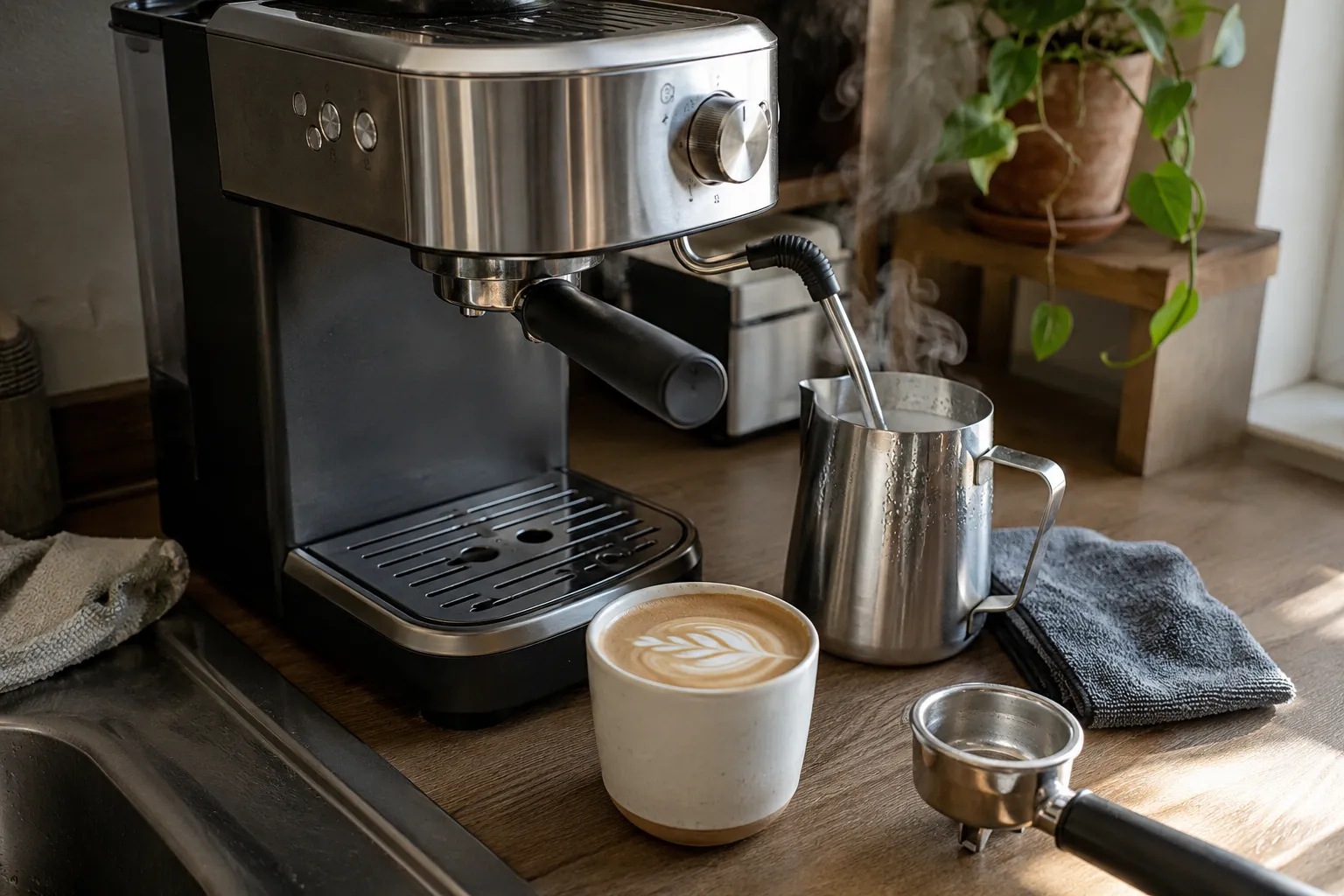
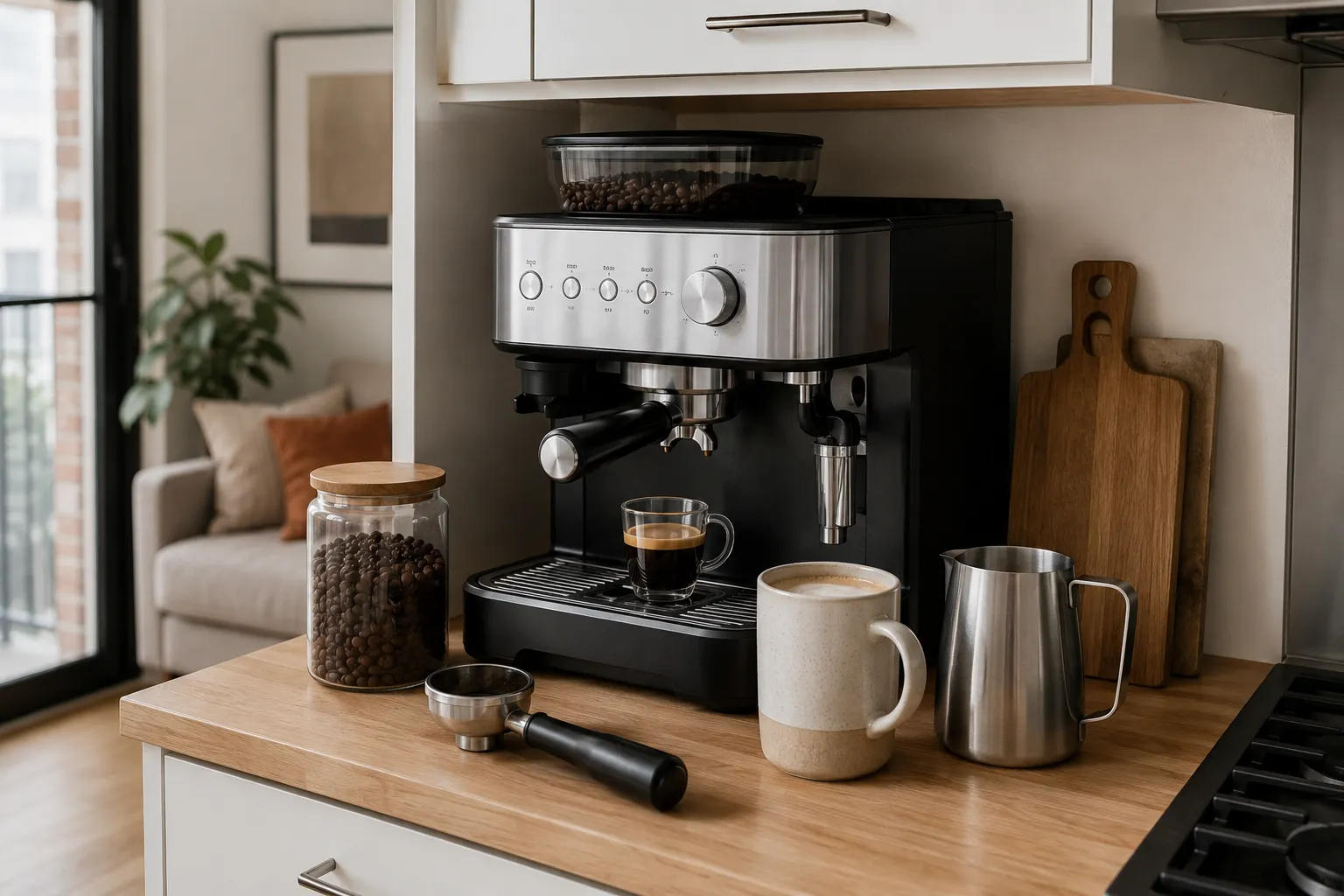
Best Built-In Grinder System: Ninja Luxe Cafe Premier ES601
The Ninja Luxe Cafe Premier ES601 is the conditional all-in-one choice. The current SharkNinja ES601 product page identifies it as a three-in-one espresso, drip-coffee, and cold-brew system with a one-year limited warranty. It has an integrated conical burr grinder, 25 grind settings, and weight-based dosing through its built-in scale.
It can simplify an apartment coffee station because one device covers several jobs that would otherwise occupy separate counter space. That is useful for someone who switches between espresso and brewed coffee and does not want a stand-alone grinder beside a separate brewer.
The essential warning is size. Ninja’s official listing gives product dimensions of 15.75 x 15.24 x 20.51 in. Those measurements make this a space-saving consolidation option, not a small machine for every small kitchen. Its height and depth deserve the same attention as its width, especially below upper cabinets.
Why it fits:
- Integrated conical burr grinder with 25 stated grind settings
- Built-in scale for weight-based dosing
- One machine covers espresso, drip coffee, and cold brew according to Ninja
- Can replace a separate grinder and additional coffee maker in the right layout
Do not choose it just because you live in a small apartment. Choose it only when you have the depth and vertical clearance and genuinely want one machine to take over multiple coffee jobs. If the counter is narrow or the cabinet gap is low, a smaller espresso machine plus a compact grinder may be easier to live with.
For the specific choice between the Ninja’s guided multi-drink workflow and a traditional built-in-grinder espresso workflow, read Ninja Luxe Cafe ES601 vs. Breville Barista Express for small apartments.
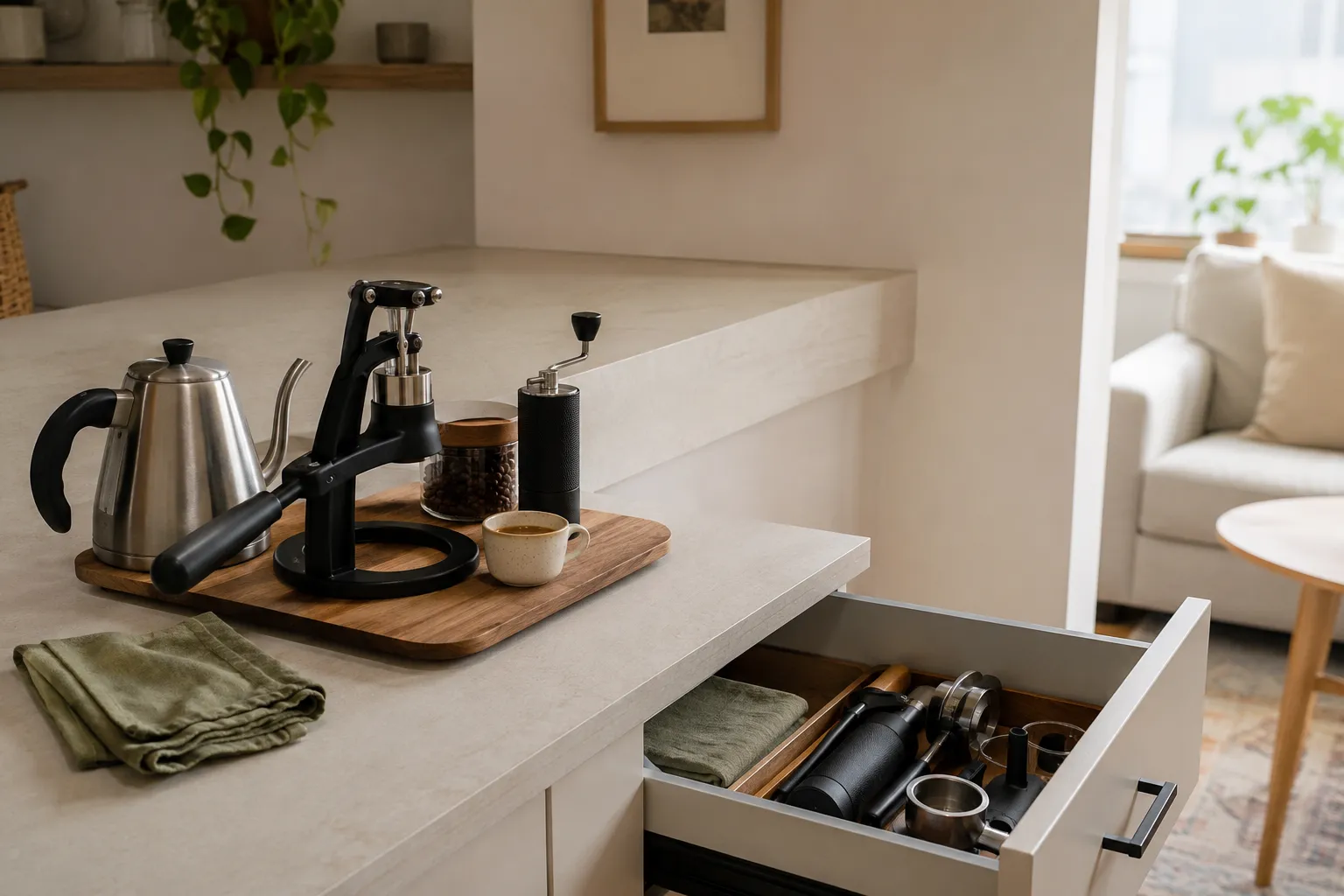
Best for a Stored Non-Electric Setup: Flair NEO Flex
The Flair NEO Flex is the alternative for someone who does not want an espresso machine permanently connected to the counter. Flair’s buyer guide lists the NEO Flex as collapsible, around 4 lb, with a 40 mm portafilter and a stated 12-18 g dose range. It has no integrated heater.
That changes the setup rather than removing it. Flair’s quick-start instructions call for just-boiled water, so you still need a kettle or other hot-water source. You also need coffee ground for espresso, whether that comes from a separate grinder or pre-ground coffee. There is no built-in milk function.
Why it fits:
- Collapsible format can store in a drawer or cabinet after use
- No permanent outlet or espresso-machine footprint required
- Official 12-18 g dose range suits a single espresso routine
- A good match for people who value storage flexibility over convenience
The tradeoff is active participation. You heat the water, prepare the coffee, operate the lever, and clean the parts yourself. It is not the sensible pick for a rushed morning or for someone who wants a built-in milk-drink workflow.
Use this approach when counter storage is the real problem and you are comfortable with a manual routine.
Do You Need a Compact Espresso Machine With a Grinder?
The useful choice is not “more features” versus “fewer features.” It is where the equipment will live and what work you want to do every morning.
| Your apartment routine | Better direction | What to accept before buying |
|---|---|---|
| You have a narrow counter but can store gear nearby | A slim machine such as the Dedica Arte plus a separate grinder | You will move, store, and clean two appliances instead of one. |
| You make milk drinks most days and already have espresso-ready grounds or a grinder | A compact milk-capable machine such as the Bambino Plus | The milk jug, portafilter, and grinder still need working space beside the machine. |
| You want one appliance for grinding, espresso, drip coffee, and cold brew | An all-in-one system such as the Ninja ES601 | Its height and depth can consume more usable counter space than two small appliances. |
| You cannot leave an espresso appliance out | A stored manual press such as the Flair NEO Flex | You still need hot water, espresso-ready coffee, and time for a hands-on routine. |
A separate grinder gives you freedom to choose the espresso machine and grinder independently; the grinder can also serve another brewer. An integrated grinder reduces the appliance count, but it does not make the full coffee workflow disappear. For espresso and other brew methods, the grinder still needs to suit the coffee you plan to make. Our compact grinder guide explains the distinction between a hand grinder, a narrow electric burr grinder, and a grinder intended for espresso through brewed coffee.
For a compact espresso machine with a grinder, compare the whole working footprint before assuming it is the smallest setup. The Ninja ES601 combines grinding, espresso, drip coffee, and cold brew, but its official 15.75 x 15.24 x 20.51 in dimensions mean it needs a permanent counter zone with room above it for the hopper and tank. A slim espresso machine paired with a compact grinder can take two storage locations, yet leave more usable space in front of a shallow counter or beneath low cabinets. Choose the all-in-one route when reducing appliance count and switching between drink formats matter more than having the smallest machine body.
Which Setup Fits Your Apartment?
Choose the De’Longhi Dedica Arte EC885M when a very narrow machine body is your top requirement and you are prepared to use a separate grinder or espresso-ready coffee.
Choose the Breville Bambino Plus when you make milk drinks frequently and want a compact electric machine with a more guided milk workflow.
Choose the Ninja Luxe Cafe Premier ES601 when you have enough counter depth and height and want one appliance to cover grinding, espresso, drip coffee, and cold brew.
Choose the Flair NEO Flex when you need to store the setup away and accept the manual work of heating water and operating a lever.
Small-Kitchen Setup and Maintenance
An espresso setup becomes easier to live with when its accessories have a defined home. Keep the coffee, brush, towel, and any small dosing tools on one tray or in one nearby drawer. Do not plan around a machine alone and then discover the milk jug, grounds container, and grinder have nowhere to go.
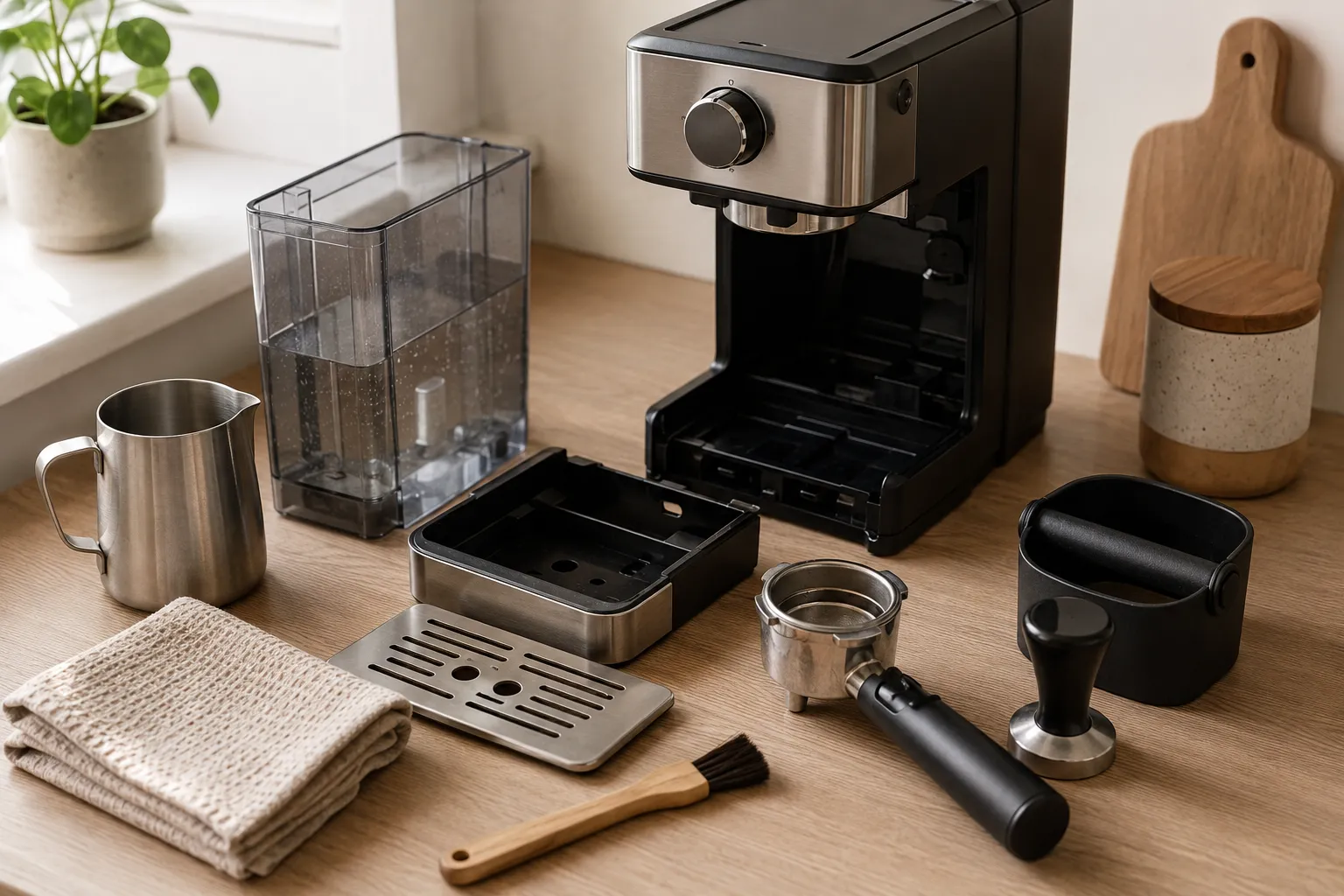
- Measure counter width, depth, and clearance beneath upper cabinets before buying
- Keep electric machines near a safe, accessible outlet
- Confirm how the water tank, bean hopper, and drip tray are removed for cleaning
- Store a manual press and its parts completely dry after use
- Keep milk tools separate from dry coffee supplies so cleanup stays simple
- Avoid adding a second coffee maker until your daily routine proves that you need it
For a pod-free brewed-coffee setup that may require less counter commitment, read pod-free single-serve coffee makers for small apartments.
FAQ
Can a compact espresso machine make lattes?
Some can, but the milk workflow varies. The Bambino Plus has automatic and manual milk-texturing modes. The Dedica Arte is a manual espresso machine with its own milk workflow. The Flair NEO Flex has no built-in milk function, so it is not the right choice if milk drinks are central to your routine.
Do I need a separate grinder for a compact espresso machine?
Usually, yes. The Dedica Arte, Bambino Plus, and Flair NEO Flex do not replace a separate grinder for whole-bean coffee. The Ninja Luxe Cafe Premier ES601 is different because it includes a conical burr grinder. Confirm the grinder’s intended brew range before purchasing any separate model.
How much space should I leave around an espresso machine?
Leave room to fill water, lock in and remove the portafilter, place a cup, and work with a milk jug if you make milk drinks. Also measure overhead clearance for removable parts. The exact amount depends on the machine and your counter layout, so the manufacturer’s current manual is the final check.
Is a non-electric espresso maker better for a tiny kitchen?
It can be better when permanent counter space is the limiting factor. A manual press can store away, but it shifts the work to a kettle, a grinder or pre-ground coffee, and a hands-on brewing routine. It is a space decision, not an automatic convenience upgrade.
Bottom Line
The De’Longhi Dedica Arte EC885M is the narrow-counter choice. The Breville Bambino Plus is the stronger fit for frequent milk drinks. The Ninja Luxe Cafe Premier ES601 works when a larger all-in-one appliance can replace several smaller machines. The Flair NEO Flex is the stored, non-electric alternative.
For a small apartment, the right espresso machine is the one that fits the entire coffee routine, not merely the empty rectangle on the counter. Measure first, decide whether you need a grinder and milk workflow, and choose the smallest setup that still matches how you actually make coffee.