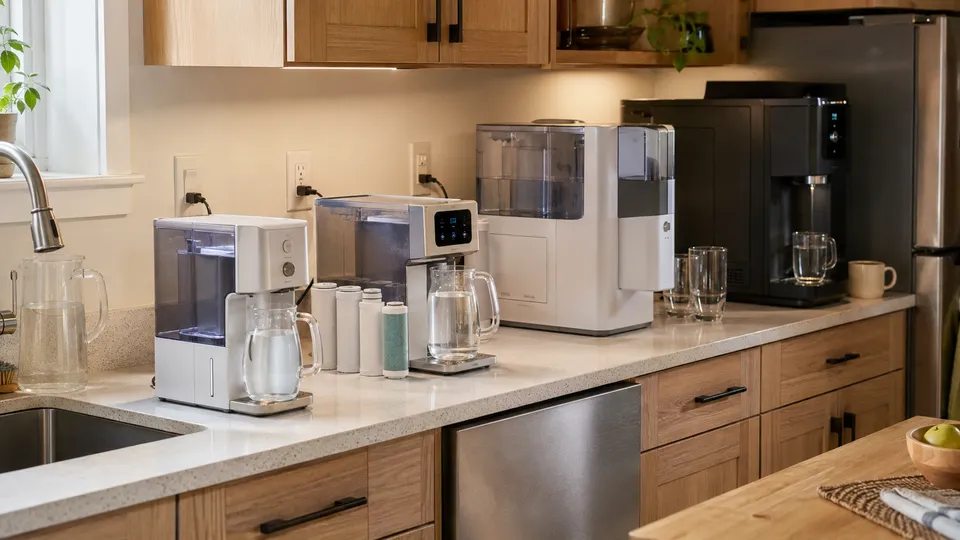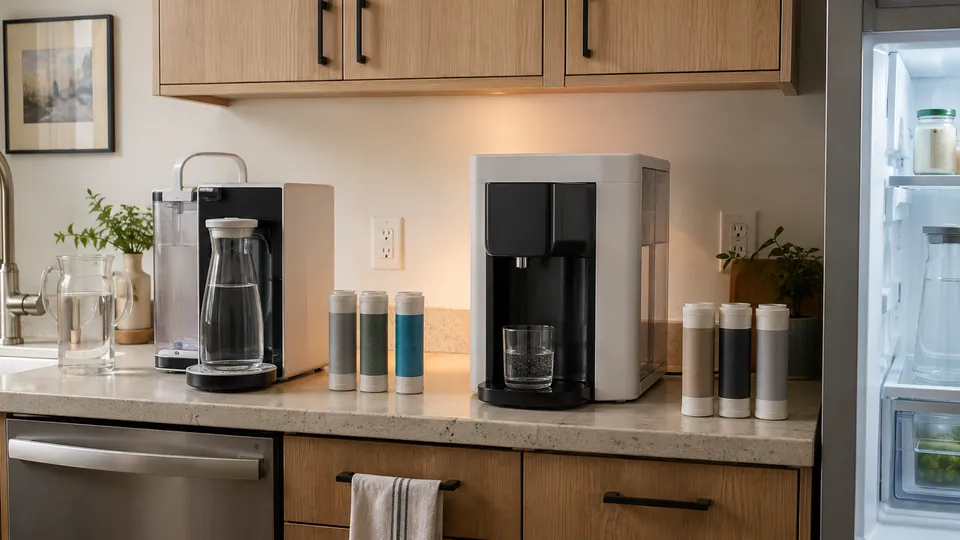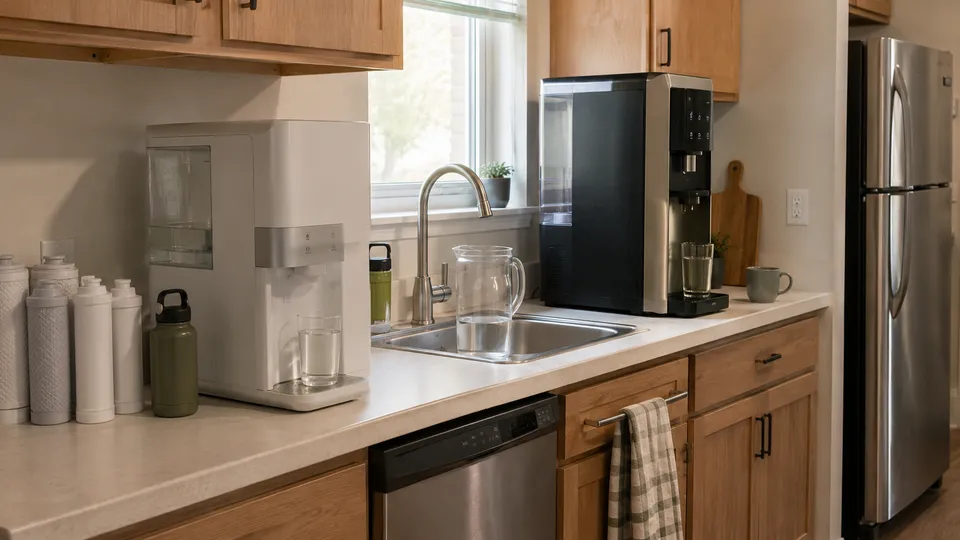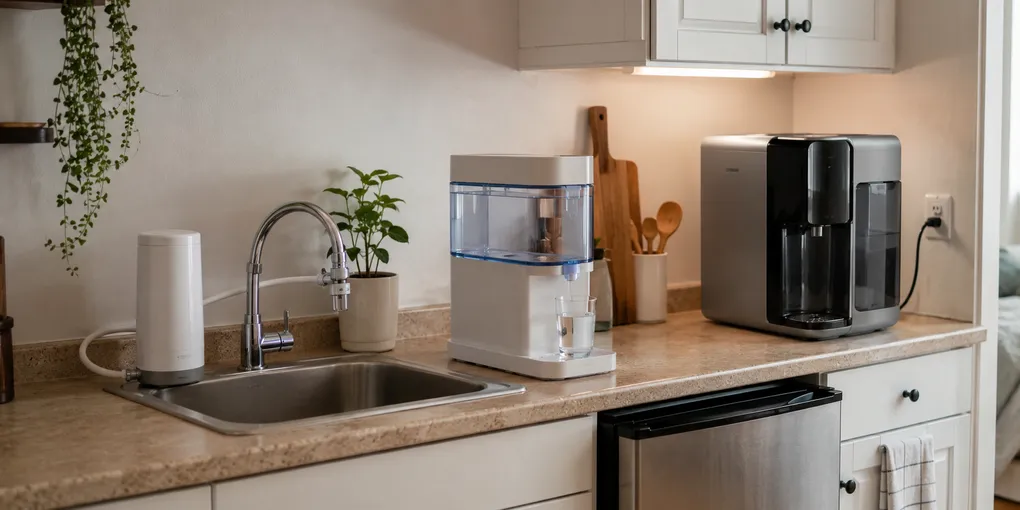
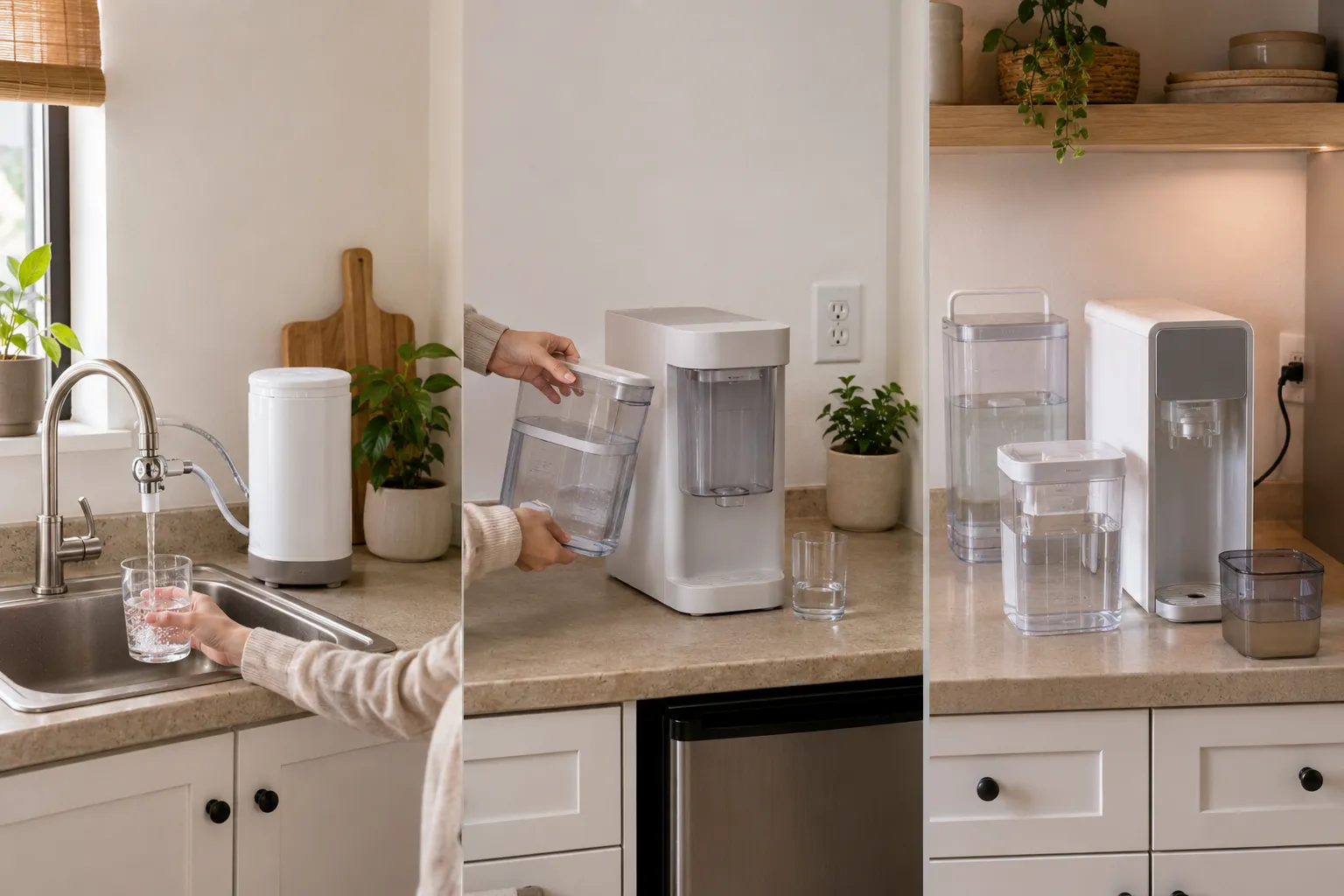
A countertop water filter can make sense in an apartment because it avoids a permanent under-sink installation. But “countertop” describes where a unit sits, not how it works. Some models attach to a threaded faucet. Some require you to fill a tank by hand. Some use reverse osmosis (RO), which adds electricity and concentrated-water handling. Others simply filter water from a small reservoir.
The right choice starts with your kitchen, not a feature list. Check your faucet, the space below upper cabinets, the nearest outlet, and how much daily refilling you will realistically keep up with. For a broader small-kitchen planning check, see which small appliances make sense in a first apartment.
The products below were selected because their manufacturers currently publish a clear supply method, dimensions, power requirement, tank or flow details, and replacement-filter information. This is not hands-on testing, a laboratory comparison, or a promise that a particular filter will solve every local water-quality concern. Review the current product page, manual, and any relevant water report before buying.
For a focused comparison between two current manual-fill countertop RO systems with glass carafes, read AquaTru Carafe vs. Bluevua ROPOT for apartments.
If you have already decided on RO and want to compare the larger product roles, including carafe, tank-first, monitored, and hot-and-cold options, see countertop reverse osmosis systems for apartments.
Quick Picks
| Apartment need | Pick | Why it fits |
|---|---|---|
| Compatible standard faucet and no outlet nearby | iSpring CT10-W | Compact, non-electric, faucet-connected filtration with no stored-water routine |
| Small counter and simple fill-and-dispense routine | Aquasana Clean Water Machine | Compact 64 oz reservoir with no permanent water-line connection |
| No plumbing with a traditional countertop RO workflow | AquaTru Classic | Separate source and clean-water tanks, plus a documented concentrated-water tank |
| Premium hot and cold countertop RO | Waterdrop A1 | Plug-in RO system with temperature controls and separate clean/waste-water areas |
Product prices, availability, filter revisions, and certification details can change. The roles in this guide are more useful than a temporary sale price: each one solves a different rental-kitchen constraint.
Choose the Water Source Before You Compare Filters
The quickest way to narrow this category is to decide how water will enter the appliance.
| System type | Your daily routine | Main apartment limitation |
|---|---|---|
| Faucet-connected, non-RO | Switch a diverter valve when you want filtered water | Requires a compatible standard threaded faucet; not a default fit for pull-down or pull-out faucets |
| Fill-and-dispense, non-RO | Fill a built-in tank, then dispense | Needs an outlet and regular refilling |
| Fill-and-filter RO | Fill the source tank, wait for filtering, and empty concentrated water as directed | Uses power, takes more counter volume, and adds a wastewater routine |
| Hot-and-cold RO | Fill the tank, plug in, then dispense at selected temperatures | Large, heavy, power-dependent, and intended for a dedicated counter location |
Do not assume that a faucet adapter fits every kitchen. A pull-down faucet, pull-out faucet, hidden aerator, or nonstandard thread can rule out a diverter-style system. That issue is common enough that it deserves a separate compatibility check before you buy any faucet-connected appliance.
What to Measure in an Apartment Kitchen
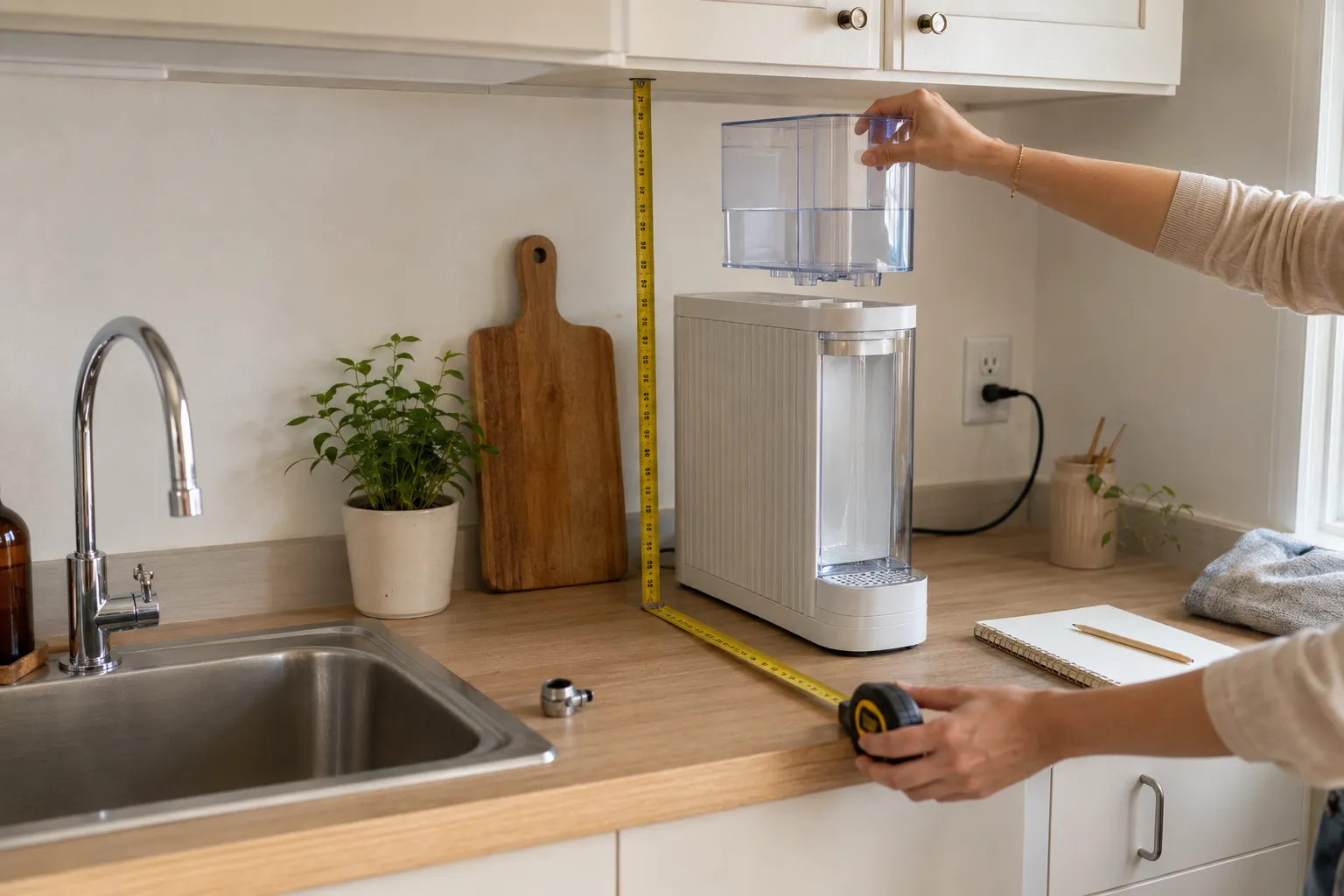
Countertop filters are usually narrow, but their working footprint is larger than the body dimensions. Before you shortlist a model, measure:
- Counter depth and upper-cabinet clearance. A tall tank must be lifted out or filled without hitting cabinets.
- Outlet access. Refillable electric systems and RO units need a stable nearby outlet. Avoid a cord stretched across the sink or food-prep area.
- Faucet type. A standard removable aerator is different from a pull-down or pull-out spray head.
- Refill path. A water tank is practical only if you can fill and carry it without spilling through a crowded kitchen.
- Wastewater routine. Countertop RO models avoid a drain hose, but their concentrated water still has to be emptied according to the maker’s instructions.
- Counter ownership. A machine you leave out every day should not eliminate your only useful prep surface. The same tradeoff appears when planning space-saving appliances for a tiny kitchen.
Best for a Compatible Faucet and No Electricity: iSpring CT10-W
The iSpring CT10-W is the straightforward fit when you have a conventional faucet with a removable, compatible aerator and do not want a tank or an electrical appliance on the counter. The manufacturer lists it at 7 x 7 x 15 in and 3.5 lb. It connects through a diverter valve and adapter, so filtered water flows when you turn the faucet and switch the valve.
That supply method is its main advantage and its main limitation. There is no water reservoir to fill, no electricity requirement, and no RO wastewater tank to empty. But it is not a universal rental-kitchen choice. The installation instructions distinguish between faucets with internal and external threads. If your faucet is pull-down, pull-out, has a recessed aerator, or is otherwise nonstandard, verify compatibility before treating this as a viable option.
The CT10-W uses a multi-layer replacement cartridge. iSpring lists a maximum output of up to 4,000 gallons and a typical replacement interval of roughly six to nine months, depending on source-water conditions and taste preference. It also states that this model does not lower total dissolved solids (TDS), which is an important distinction from choosing an RO system.
Choose the CT10-W when:
- You have a compatible threaded faucet and want filtered water on demand.
- You prefer no reservoir, no drain tank, and no plug-in appliance.
- You understand that it is a non-RO system rather than a substitute for every filtration method.
Skip it when:
- Your faucet cannot accept the documented diverter and adapter setup.
- You want a self-contained machine that can sit away from the sink.
- You need an RO workflow for your own water-quality decision.
Best Small Fill-and-Dispense Option: Aquasana Clean Water Machine
The Aquasana Clean Water Machine is the compact choice for renters who want a self-contained countertop filter without a faucet adapter or permanent water line. The manufacturer lists a 64 oz tank, 9.69 x 7.96 x 11.61 in dimensions, and a 6.2 lb system weight. Its routine is simple: plug it in, fill the tank, and dispense filtered water.
This is not an RO system, so the practical workflow is different from a countertop RO machine. You are not connecting it to plumbing or routing a drain hose. Instead, you accept a smaller reservoir and a recurring refill task in exchange for a much more compact body.
Aquasana lists one replacement filter for up to 300 gallons or six months. The compact dimensions make it easier to place under cabinets than the larger RO options in this guide, but measure the clearance needed to remove or refill the tank rather than relying only on the 11.61 in body height.
Choose the Clean Water Machine when:
- You have limited counter space but can keep an outlet available.
- You want to avoid faucet compatibility questions.
- A
64 oztank fits your normal drinking and cooking routine.
Skip it when:
- You do not want to refill a small tank regularly.
- You want an RO system or built-in hot and cold dispensing.
- The only available counter location is far from a safe outlet.
Best Traditional Countertop RO Option: AquaTru Classic
The AquaTru Classic is the choice for a renter who wants a self-contained RO system and is willing to give it a permanent counter location. AquaTru’s current support documentation lists dimensions of 14 x 12 x 14 in, a 16 lb empty weight, a 1 gallon tap-water tank, and a 0.75 gallon clean-water tank. It uses 120V, 60Hz power.
The important apartment detail is not just that it needs no fixed plumbing. RO systems concentrate some of what does not pass through the membrane. AquaTru says the Classic collects concentrated water in a separate tank for disposal. That means there is no sink drain hose to route, but there is still a hands-on emptying step. Do not describe any countertop RO machine as “waste-free” or assume it can be treated like a simple water pitcher.
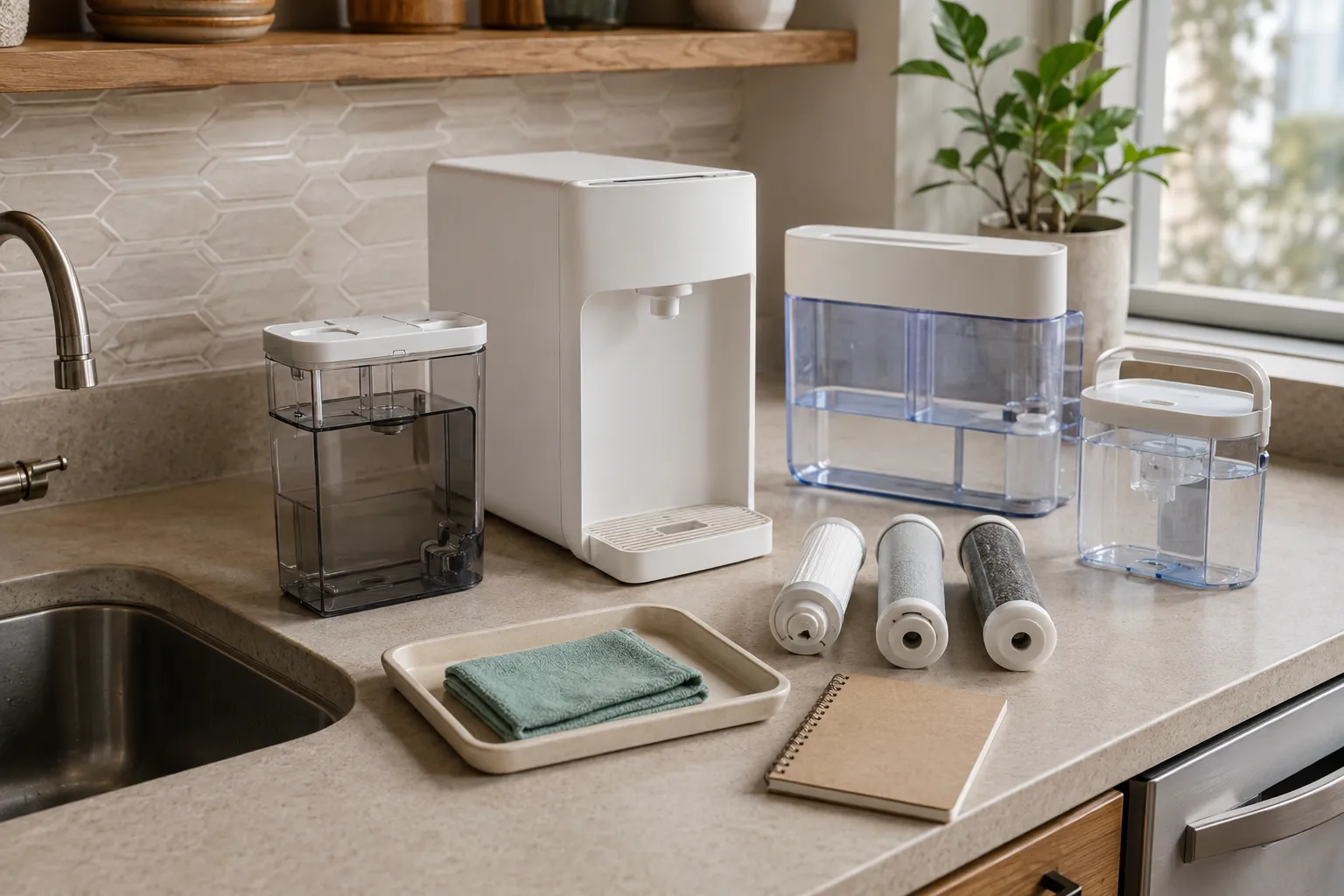
The product uses a pre/carbon filter, an RO filter, and a VOC carbon filter. AquaTru currently lists the pre/carbon stage at six months, the RO filter at two years, and the VOC carbon filter at one year. Those intervals are part of ownership cost and maintenance planning, not a reason to delay replacement when the product indicates it is due.
Choose the AquaTru Classic when:
- You want RO without under-sink installation or a faucet connection.
- You have the counter depth, vertical clearance, and outlet for a larger machine.
- You accept filling the source tank and emptying the separate concentrated-water tank.
Skip it when:
- You need the smallest possible footprint.
- You want a non-electric option.
- You do not want a refill-and-empty routine.
Best for Hot and Cold Water: Waterdrop A1
The Waterdrop A1 is a higher-end countertop RO dispenser for a kitchen where the filter will become a dedicated beverage station. The manufacturer lists a narrow but tall 18.3 x 7.8 x 17.1 in footprint and a 38.5 lb product weight. It requires electricity and is designed as a fill-and-plug-in system, with no under-sink installation or drilling described for its normal setup.
Its feature set is different from the other picks: the product page lists hot water up to 203 F, cold water down to 41 F, and selectable dispense volumes. Waterdrop also lists a 136 oz water tank, a 34 oz iced-water tank, separate clean and waste-water areas, and a stated pure-to-drain ratio of 2:1.
That convenience comes with a larger commitment of space and routine. It is considerably heavier than the other products here, needs an outlet, and should be placed where tank filling, filter access, and waste-water emptying are easy. Treat its narrow width as a reason to measure depth and height more carefully, not as proof it will fit under every cabinet.
Waterdrop lists the A1 CF filter at up to six months or 550 gallons, and the RO filter at up to 12 months or 1,100 gallons.
Choose the Waterdrop A1 when:
- You want countertop RO plus dedicated hot and cold dispensing.
- Your kitchen can spare a stable, powered location for a 38.5 lb appliance.
- You value the beverage-station workflow enough to manage a larger water tank and waste-water routine.
Skip it when:
- You only need a small, simple drinking-water filter.
- You lack cabinet clearance, a nearby outlet, or a stable counter surface.
- You want a system that can be stored in a cabinet between uses.
Side-by-Side Apartment Fit
| Model | Water supply | Stored water | Drainage or wastewater | Power | Listed dimensions | Filter schedule |
|---|---|---|---|---|---|---|
| iSpring CT10-W | Compatible threaded faucet via diverter | None | No RO wastewater tank; faucet connection required | No | 7 x 7 x 15 in | Up to 4,000 gal or about 6-9 months |
| Aquasana Clean Water Machine | Manual tank fill | 64 oz | No permanent water-line or drain-hose setup | Yes | 9.69 x 7.96 x 11.61 in | 300 gal or up to 6 months |
| AquaTru Classic | Manual tap-water tank fill | 1 gal source, 0.75 gal clean | Separate concentrated-water tank to empty | Yes, 120V/60Hz | 14 x 12 x 14 in; 16 lb | 6 months, 1 year, and 2 years by filter stage |
| Waterdrop A1 | Manual tank fill | 136 oz water tank, 34 oz iced-water tank | Separate clean and waste-water areas; stated 2:1 pure-to-drain ratio | Yes | 18.3 x 7.8 x 17.1 in | CF: 6 months/550 gal; RO: 12 months/1,100 gal |
A Practical Decision for Renters
Choose a faucet-connected model only after confirming that your faucet has the right kind of removable aerator. It is the lowest-effort daily routine when it fits, but it is the least forgiving of unusual fixtures.
Choose a small fill-and-dispense model when you want flexibility in placement and can refill a modest tank. It is usually the least disruptive option for a small kitchen with a standard outlet.
Choose countertop RO only when you have decided that the additional filtration approach, power requirement, counter space, and concentrated-water routine all make sense for your household. Do not upgrade to RO simply because it sounds more comprehensive.
Choose a hot-and-cold RO station when your apartment has the counter space and you will actually use the temperature features every day. It is a kitchen appliance, not a compact substitute for a pitcher.
Before You Order
- Photograph your faucet and identify whether its aerator is removable and threaded.
- Measure width, depth, height under cabinets, and the path to a safe outlet.
- Decide whether you prefer on-demand faucet flow or a tank you refill yourself.
- For RO, plan where and how you will empty concentrated water according to the manufacturer instructions.
- Check current replacement-filter availability and the exact model number, not just a similar listing or an older review.
- Read your lease or building rules if your kitchen has restrictions on appliances, water use, or counter loads.
FAQ
Do countertop water filters need installation?
Some do not need plumbing, but that does not mean every model is installation-free. A faucet-connected filter needs a compatible faucet adapter. A refillable electric unit needs a safe outlet and a practical tank-filling routine. A countertop RO system also needs a plan for concentrated water.
Can I use a countertop filter with a pull-down faucet?
Do not assume so. Faucet-connected units typically rely on an adapter at the aerator. Pull-down and pull-out faucets often create a compatibility question rather than a guaranteed fit. Check the exact faucet and the product manual before buying.
Does a countertop RO filter need a drain hose?
Not necessarily. The countertop RO models in this guide use internal tanks rather than a permanent drain connection. However, they still collect concentrated water that the owner needs to empty as directed. No drain hose does not mean no wastewater task.
How often do countertop water-filter cartridges need replacing?
It depends on the specific model, filter stage, local water, and product guidance. The ranges in this article are the manufacturers’ listed intervals for the named models, not a universal schedule. Replace filters according to the model’s current instructions and indicators.
Bottom Line
For a compatible standard faucet, the iSpring CT10-W keeps the routine simple and does not need electricity. For a compact tank-based appliance that avoids faucet adapters, the Aquasana Clean Water Machine is the practical small-counter choice. The AquaTru Classic is the more involved self-contained RO option, while the Waterdrop A1 is for renters who will genuinely use a larger hot-and-cold RO beverage station.
Choose the water-supply method first. Once that matches your faucet, counter, outlet, and refill tolerance, the product choice becomes much clearer.