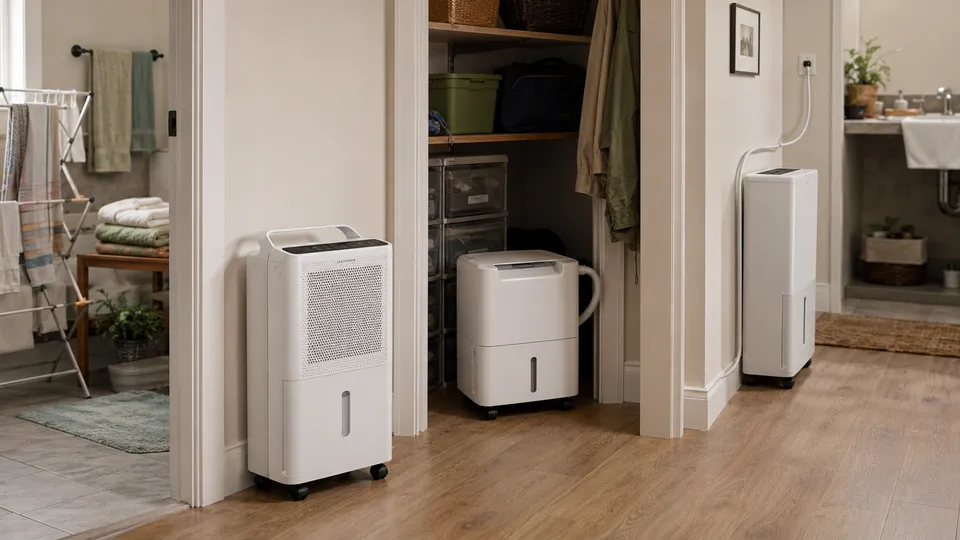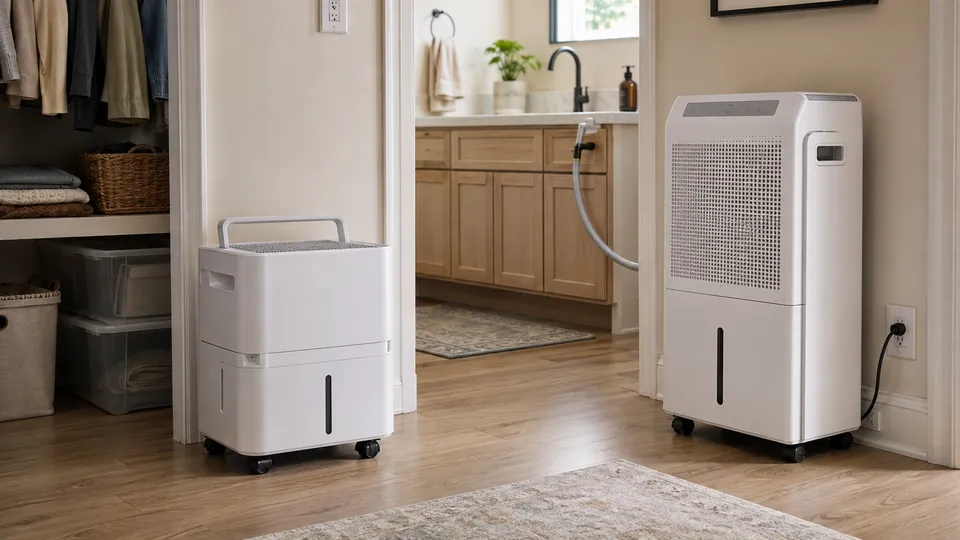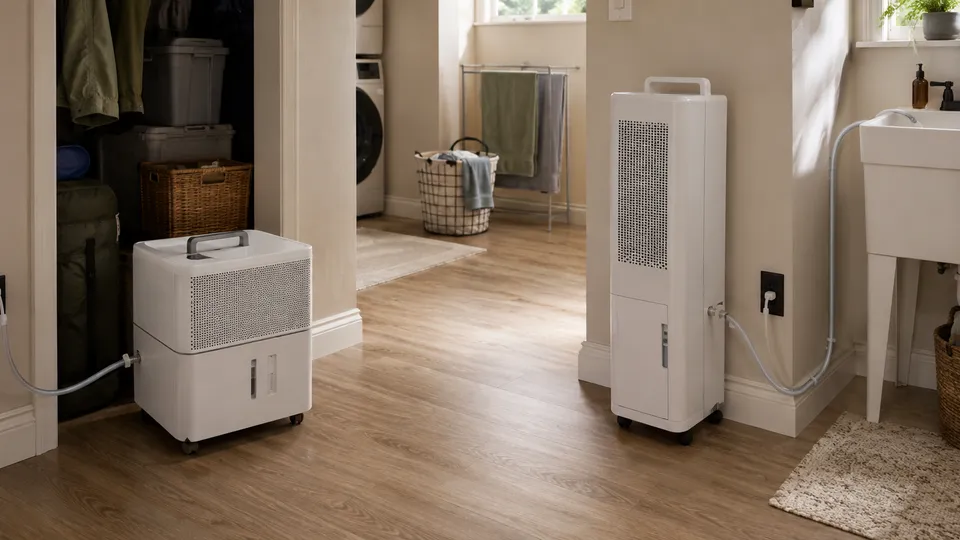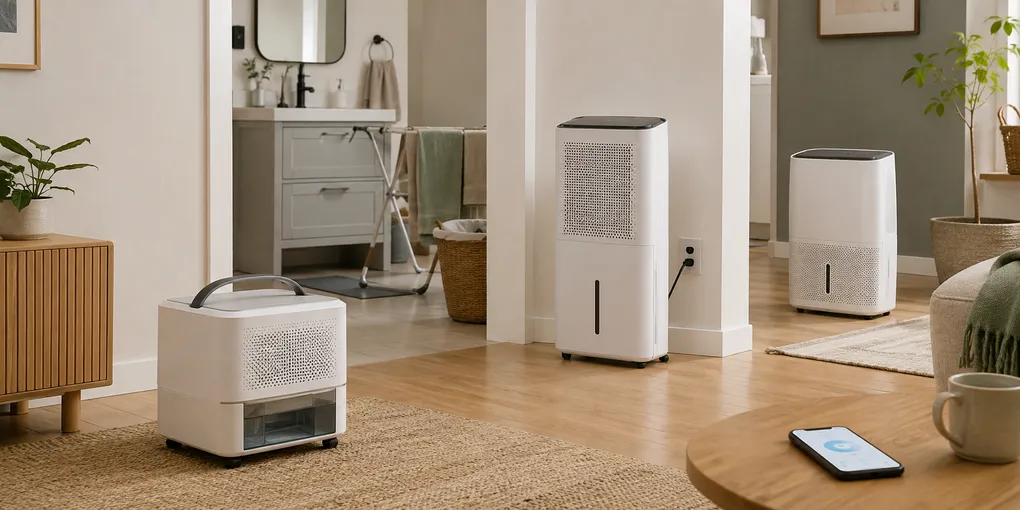
An apartment dehumidifier does not need a drain hose to work. It needs a realistic water routine. If you do not have a nearby floor drain, a safe downhill hose route, or permission to leave a hose across a room, the built-in tank is not a backup feature. It is the way you will use the machine every day.
“Without a drain hose” does not mean “bucketless.” A normal compressor dehumidifier still collects water in its built-in tank, which you remove and empty by hand. This guide is for renters who can manage that tank routine; it is not a guide to passive moisture absorbers or a promise that a machine can run without any water handling.
This guide focuses on three tank-first roles: a model designed to store compactly, a narrow conventional unit for tighter floor space, and a Wi-Fi model for renters who want to check settings without standing beside the machine. It does not treat a gravity-drain port or an optional pump as a reason to buy a larger unit when there is nowhere safe for the water to go.
Best Dehumidifiers Without a Drain Hose: Quick Answer
Choose the Midea Cube 20 Pint MAD20S1QWT when the machine must fit into a small closet or be stored between humid periods. Its lift-and-twist body can run extended or nest down for storage, and Midea lists wheels, a handle, smart control, and no built-in pump.
Choose the GE 20 Pint ADEW20LY when a shallow footprint and a straightforward front bucket matter more than app controls. Its official dimensions are only 10 in deep, and GE lists automatic shut-off, automatic defrost, a water-full indicator, and a 72 in minimum power cord.
Choose the Frigidaire 22 Pint with Wi-Fi FHDD2234W1 when you want a modest-capacity model with remote monitoring and an Energy Star-certified design. Frigidaire lists it at 19.8 in high, 14.7 in wide, and 11.1 in deep.
None of these machines eliminates the need to empty water when you use the tank. Before ordering, identify the nearest sink or tub, make sure the full bucket can be carried there without stairs or obstacles, and leave room for airflow around the appliance.
Choose the Right No-Drain-Hose Setup
Use the water route to make the purchase decision before comparing secondary features. A drain port or optional hose does not make a unit hands-off when there is no safe, permitted destination for the water.
| Your apartment constraint | Better product role | Do not assume |
|---|---|---|
| No approved drain is nearby, or a hose would cross a doorway or walking path. | Choose a tank-first model and plan to empty its built-in bucket. This is the normal use case for all three models in this guide. | That an optional hose connection makes a gravity-drain setup safe. |
| The appliance must store away between humid periods. | Choose the Midea Cube 20 for its lift-and-twist, storage-first form. | That the larger tank design removes the need to carry water. |
| Depth is the limiting measurement beside a bathroom or utility wall. | Choose the GE ADEW20LY and measure the front bucket’s removal path as well as its 10 in body depth. | That a shallow body leaves no working clearance to empty the bucket. |
| You want to check settings or status without walking to the appliance. | Choose the Frigidaire FHDD2234W1 when Wi-Fi monitoring is a feature you will use. | That remote monitoring empties or drains the tank. |
| You have a documented, permitted drain destination and a hose route that can stay secure. | Compare a pump-equipped unit only after confirming the exact model’s owner-guide limits. | That every dehumidifier can pump water uphill or that a pump removes the need for a bucket fallback. See best dehumidifiers with built-in pumps for apartments. |
Exact Models Compared
| Detail | Midea Cube 20 Pint MAD20S1QWT | GE 20 Pint ADEW20LY | Frigidaire 22 Pint Wi-Fi FHDD2234W1 |
|---|---|---|---|
| Official daily removal rating | 20 pints/day | 20 pints/day | 22 pints/day |
| Manufacturer room-size claim | Up to 1,500 sq. ft. | Very damp spaces; do not treat this as an apartment-wide promise | Check the current product page for its stated room guidance |
| Depth x width x height | 13.5 x 13.5 x 13.39 in | 10 x 13.5 x 19.5 in | 11.1 x 14.7 x 19.8 in |
| Listed product weight | 33.07 lb | Not stated on the current official product page reviewed for this guide | Not stated on the current official product page reviewed for this guide |
| Built-in pump | No | Not stated on the current official product page reviewed for this guide | Not stated on the current official product page reviewed for this guide |
| Tank-first convenience signals | Lift-and-twist storage, wheels, handle | Front bucket, water-full indicator, automatic shut-off | Wi-Fi monitoring; confirm current tank and alerts on the live listing |
| Power / noise | Not published in the current official product specs reviewed for this guide | 72 in minimum cord published; noise figure not published on the current official page reviewed | Not published in the current official product specs reviewed for this guide |
| Warranty | 1 year | Verify current warranty conditions before ordering | Verify current warranty conditions before ordering |
Product availability, included hoses, and retailer bundles change. At the time this guide was researched, Midea’s direct page showed a notification option rather than direct checkout for the Cube 20, while a separate retailer listing showed the model for sale. Confirm the exact model and seller before treating a current listing as available.
Why a Tank-First Choice Is Different
A continuous drain hose only works when the machine, hose route, and destination all make sense. A gravity-drain route must run downward to an appropriate destination. A pump can change the height limitation on compatible models, but it still needs a permitted, secure place to discharge water.
If your apartment does not have that setup, select the machine as though you will empty the tank every time it fills. That changes the buying priorities:
- A lighter or more manageable bucket routine can matter more than a higher headline removal rating.
- A narrow machine can be more useful than one with a larger claimed coverage area if it is the only unit that fits safely beside a bathroom or laundry corner.
- Wheels help on one level, but they do not solve stairs, thresholds, or the need to lift a bucket to a sink.
- A humidistat, full-tank shut-off, and a visible alert are more useful than an optional hose you cannot safely use.
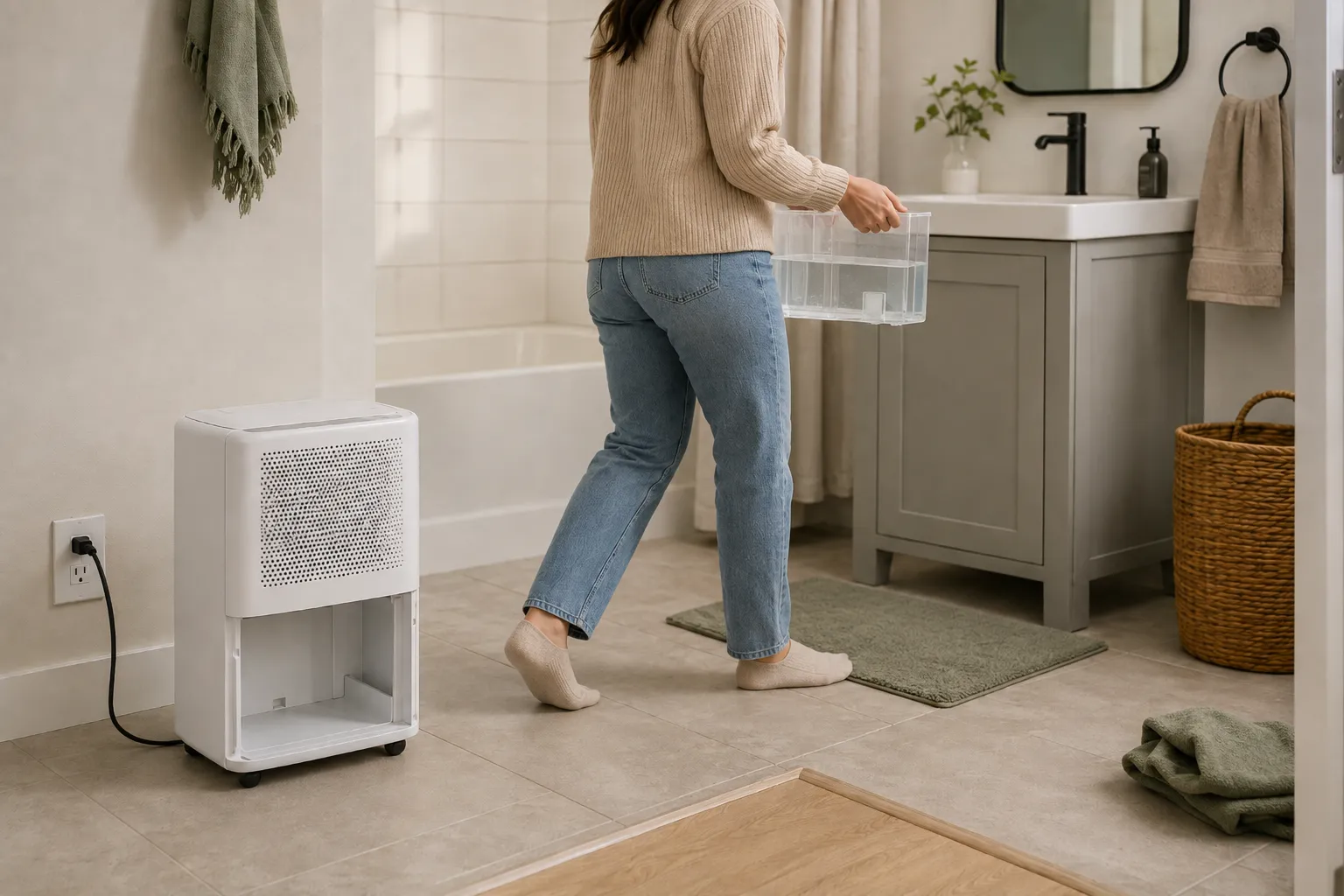
Do not set a full water tank on a counter, shelf, or unstable rolling cart to avoid one trip to the sink. Keep the machine level on the floor, use the tank as the owner guide directs, and clear the walking path before carrying water.
The Three Apartment Roles
1. Midea Cube 20: storage-first apartment pick
The Midea Cube 20 is the right role when the dehumidifier needs to disappear after use. Midea’s lift-and-twist design can operate in an extended form and nest down for storage. The listed 13.5 in square footprint is compact relative to many conventional upright units, and the 33.07 lb listed product weight is more manageable than larger high-capacity models.
It also has four wheels, a handle, and smart control. Those features make the Cube easier to position and monitor, but they do not make a full tank weightless. The machine has no built-in pump, so its included hose is only relevant when a safe gravity-drain route exists.
Use it when storage is the main constraint and you are prepared to empty the tank routinely. Do not choose it merely because Midea advertises a large tank design; the current official product page does not give a fixed tank-volume figure that should be used to predict how many hours it will run in your apartment.
2. GE ADEW20LY: narrow-depth, straightforward bucket routine
The GE ADEW20LY is the more conventional option. Its 10 in depth is the clearest advantage for a narrow bathroom edge, utility corner, or wall section where a wider cube-like body would protrude too far into a walking route.
GE lists a front bucket, water-full indicator, automatic shut-off, automatic defrost control, and a 72 in minimum power cord. Those are useful practical details for renters: the bucket is accessed from the front, the unit should stop instead of running with a full bucket, and you can measure outlet placement before buying.
This is the sensible role for a renter who wants a normal tank routine rather than a large feature set. Measure the open space in front of the unit as well as the body depth, because a front bucket still needs room to slide out and be carried to the sink.
3. Frigidaire FHDD2234W1: Wi-Fi-aware small-apartment option
The Frigidaire 22 Pint with Wi-Fi is the role for someone who wants to check settings remotely rather than visit the appliance just to confirm whether it is running. Its 22 pints/day rating places it close to the two 20-pint models, so the appeal is the control experience and compact dimensions, not a dramatic jump in extraction capacity.
Frigidaire lists an Energy Star-certified design and dimensions of 19.8 in high, 14.7 in wide, and 11.1 in deep. That makes it a practical candidate when a narrow appliance depth is useful but you prefer an app-connected option. Wi-Fi does not empty the bucket for you; it is most useful when the physical emptying route is already easy.
Do Not Buy a Mini Dehumidifier for an Entire Apartment
Very small thermoelectric or “mini” dehumidifiers can be useful in a compact closet, a closed bathroom, or another genuinely tiny enclosed area. They are not interchangeable with a 20- or 22-pint compressor dehumidifier for an apartment bedroom, living room, or laundry-drying routine.
The problem is not the label on the box. It is the water load. Showering, cooking, wet laundry, and normal daily activity can add moisture faster than a tiny unit can manage. A small machine may still collect some water, but that does not make it a good primary choice for a larger lived-in space.
Measure the Working Footprint, Not Just the Cabinet
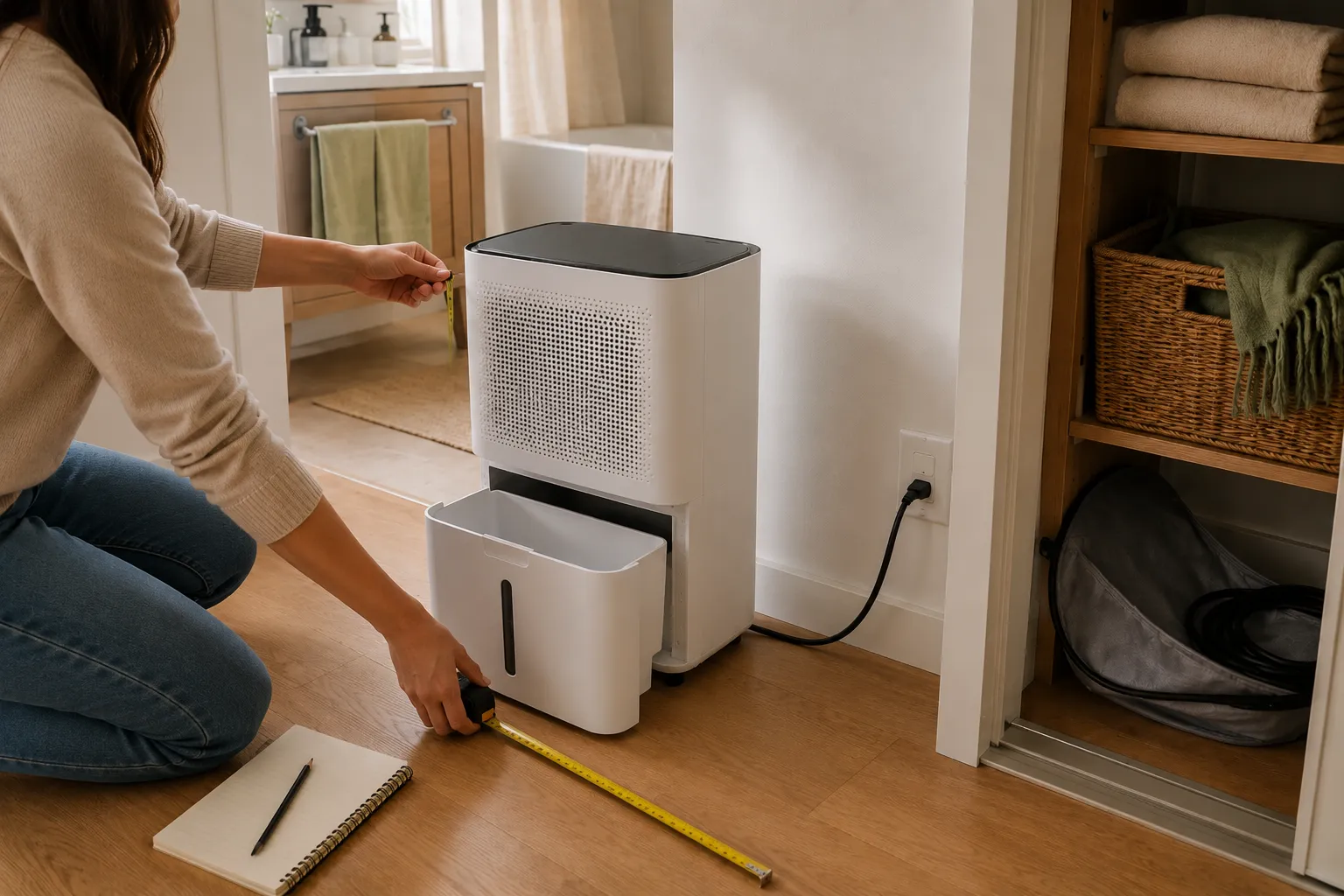
Before ordering, measure these five things:
- Machine space: Leave the clearance required by the owner guide around air intakes and outlets.
- Bucket access: Account for the front, side, or rear movement needed to remove the tank.
- Sink route: Walk the route from the machine to the sink or tub. Include thresholds, pets, rugs, and stairs.
- Outlet reach: Use the listed cord length to check placement. Do not assume an extension cord is allowed by the manufacturer.
- Storage position: If the machine is seasonal, measure it in its stored form with the cord and any accessories included.
Room-size claims are a starting signal, not a substitute for this check. The humidity source, door position, outdoor weather, laundry routine, temperature, and how often you empty the tank all affect the real result.
When a Drain Hose or Pump Is Actually Worth It
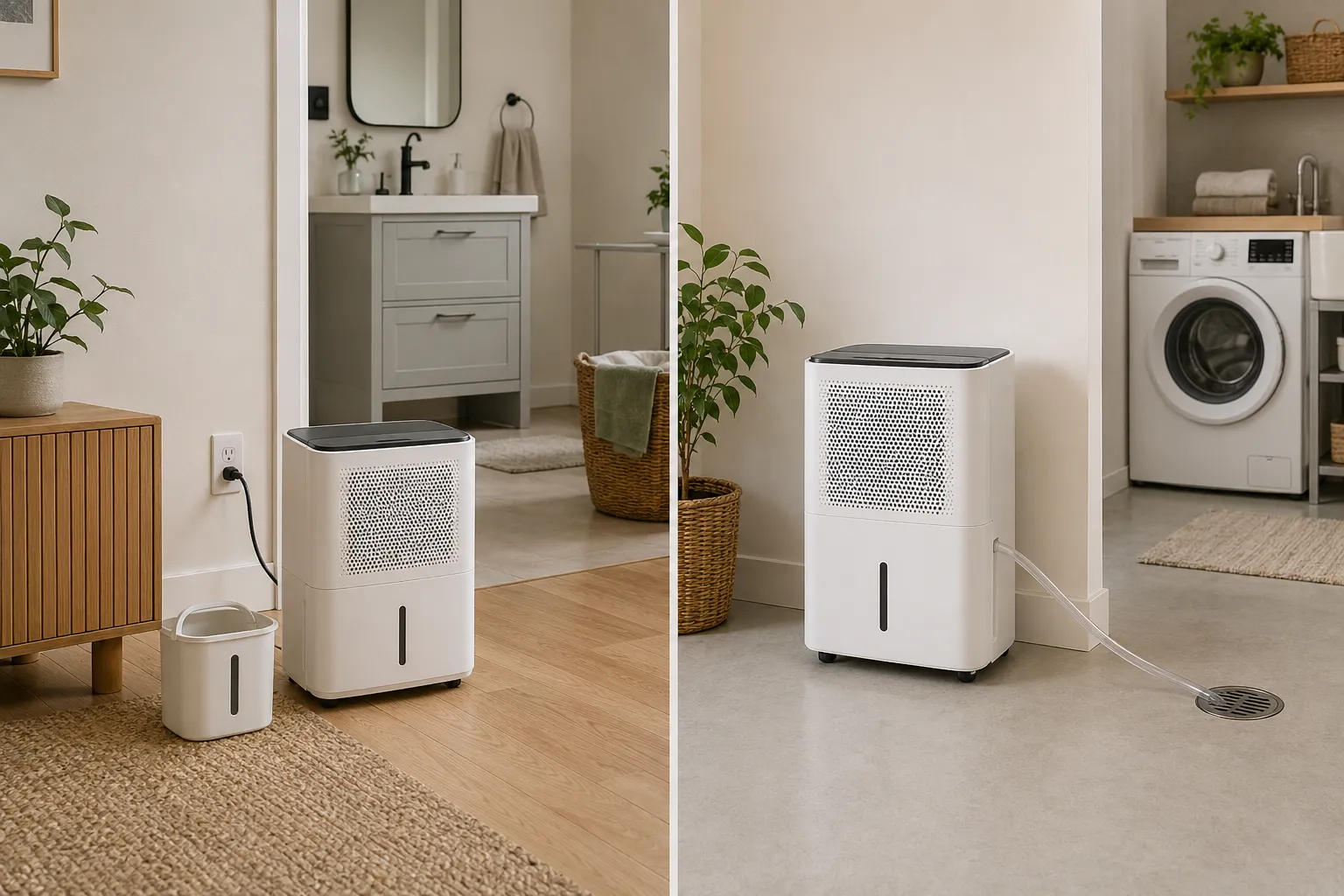
Buy for continuous drainage only after you can answer all three questions with a clear yes:
- Is there a permitted drain or sink nearby?
- Can a gravity hose slope downward without kinks, door crossings, or a trip hazard?
- If the route must rise, does the exact model have a built-in pump and does the owner guide allow that setup?
If any answer is no, use the tank. A hose that runs uphill, gets pinched under a door, or drains into an unstable container is not a hands-off setup. It is a leak risk.
If you do have a permitted drain destination and are deciding between two current 50-pint pump models, see Midea Cube vs. Frigidaire 50-Pint Pump Dehumidifier for Apartments. It explains why a pump still needs a documented hose route and a realistic bucket-emptying fallback.
For a wider three-model shortlist, see best dehumidifiers with built-in pumps for apartments. It separates storage-first, shallow upright, and longer pump-route roles instead of treating every pump model as the same rental solution.
FAQ
Can I use a dehumidifier in an apartment without a drain hose?
Yes. The built-in tank is designed for ordinary use. The practical question is whether you can empty it safely and regularly, not whether the machine has an optional drain port.
Is a higher pint rating always better for an apartment?
No. Higher removal capacity can help with heavier moisture loads, but it may also mean a larger, heavier appliance and a more demanding emptying routine. Select capacity after checking the actual room, moisture source, floor space, and water route.
Will a Wi-Fi dehumidifier stop me from emptying the tank?
No. Wi-Fi can help you monitor or adjust settings, but it does not replace manual tank emptying unless you have a safe compatible continuous-drain setup.
Is a pump useful when I have no drain nearby?
Not by itself. A pump can move water upward on compatible models, but it still needs a safe, permitted destination such as an appropriate sink or drain. Without one, the tank remains the practical option.
Bottom Line
For a no-hose apartment setup, choose the Midea Cube 20 when compact storage is the priority, the GE ADEW20LY when narrow depth and a simple front-bucket routine fit the space, or the Frigidaire FHDD2234W1 when Wi-Fi monitoring is the extra feature you will actually use.
The best dehumidifier is not the one with the biggest advertised room number. It is the one that fits safely, has a realistic tank-emptying path, and does not force you to build an unreliable hose setup just to live with it.