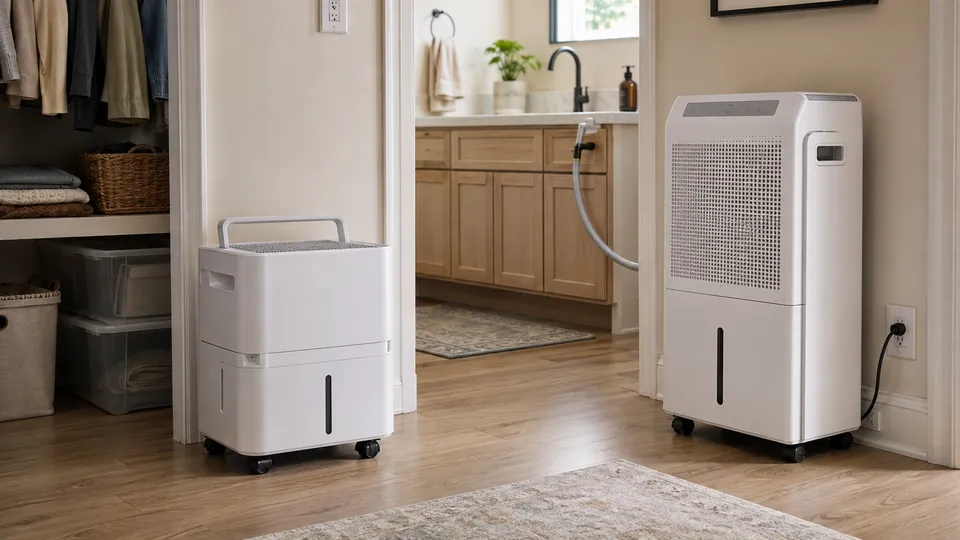
The Midea Cube MAD50PS1QWT and GE ADHE50PWF are both current 50-pint dehumidifiers with built-in pumps. For an apartment, that shared feature is only the beginning. The Midea is a short, lift-and-twist Cube that nests down for storage. The GE is a much taller conventional upright unit with a shallower body, a published 15-pint bucket, and a manufacturer-documented pump route to a suitable location up to 16 feet away.
The first decision is not which pump is stronger. It is whether you have a safe, permitted place for water to go. A built-in pump can make an upward route possible on the exact setup described in the owner guide. It does not make a hose across a doorway, an unsecured container, or an unapproved window route suitable.
This comparison covers only the Midea Cube 50-Pint with Pump, model MAD50PS1QWT, and the GE 50-Pint Portable Dehumidifier with Built-In Pump and Smart Dry, model ADHE50PWF. It does not mix in Midea’s no-pump Cube variants, a different Cube capacity, GE’s non-pump models, or retailer bundles. Specifications below come from current manufacturer product pages and owner documentation. This is not hands-on testing or a guarantee that either machine fits every rental.
For a wider shortlist, see best dehumidifiers with built-in pumps for apartments. If you have no workable drain route, begin with a manual-bucket dehumidifier for apartments without a drain hose.
Quick Answer
Choose the Midea Cube MAD50PS1QWT when seasonal storage is the real constraint. Midea lists a compact 14.45 D x 14.76 W x 14.57 H in body at 41.54 lb. Its distinctive lift-and-twist design can operate extended and nest down when the humid season ends. Midea also documents a built-in pump that can send water to a sink or out a window on a compatible setup.
Choose the GE ADHE50PWF when shallow front-to-back depth and a clearly documented longer pump route matter more. GE lists a 11.4 D x 14.4 W x 24.1 H in cabinet at 44 lb, a 15 pt bucket, and an included hose for pump drainage to a convenient location up to 16 ft away.
Choose neither simply because it says “pump.” Both still need a grounded wall outlet, owner-guide clearances, a hose route that stays out of walking paths, and a manual bucket-emptying fallback.
Verified Model Facts
| Detail | Midea Cube MAD50PS1QWT | GE ADHE50PWF |
|---|---|---|
| Exact model compared | Cube 50-Pint with Pump | 50-Pint Portable Dehumidifier with Built-In Pump and Smart Dry |
| Maker-listed removal rating | 50 pints/day | 50 pints/day |
| Listed dimensions | 14.45 D x 14.76 W x 14.57 H in | 11.4 D x 14.4 W x 24.1 H in |
| Listed product weight | 41.54 lb | 44 lb |
| Water bucket | Midea describes a large tank and extended or nested operation, but its current page does not provide a fixed usable tank number for this comparison. | 15 pt bucket capacity |
| Built-in pump | Yes. Midea says it can drain out a window or into a sink. | Yes. GE says the included hose can drain to a convenient location up to 16 ft away. |
| Continuous-drain signal | Midea describes an included hose for continuous drainage to a sink or floor drain. | GE lists a continuous-drain option in addition to the pump. |
| Filter and care | The owner manual calls for cleaning the air filter every two weeks and includes pump-filter and bucket-care instructions. | Permanent mesh filter with a filter-clean reminder; GE’s care guidance allows vacuuming or washing a dirty filter with mild dish soap and warm water. |
| Power boundary | The US owner manual specifies 115V / 60Hz; use the grounded outlet and cord guidance in the live manual. | Use a grounded wall outlet and follow the exact live owner guide. This guide does not state an electrical rating that was not consistently exposed on GE’s current official product page. |
| Warranty boundary | Current Midea product page lists a 1 year warranty. | Current GE product page shows no labor warranty. Read the written warranty before purchase rather than relying on retailer summaries. |
Room-size marketing claims are intentionally not used to decide the winner. Moisture source, room temperature, wet laundry, airflow, doors, and the water-removal route matter more in an apartment than a broad coverage label.
The Real Apartment Difference: Storage Shape vs. Fixed Upright Body
The Midea Cube is the storage-first choice. Its body is nearly square, short enough to fit under more furniture and shelving than a conventional upright unit, and designed to nest down between humid periods. That matters when a dehumidifier needs to leave the floor after a damp season instead of occupying the same corner all year.
The GE is the shallower choice, not the shorter one. Its 11.4 in depth is about three inches less than the Midea’s 14.45 in depth. That can be useful beside a bathroom wall, laundry edge, or narrow passage where front-to-back intrusion is the limiting measurement. At 24.1 in high, however, it needs much more vertical space and remains a fixed upright appliance in storage.
Neither measurement tells the full story. Before ordering, measure the working footprint:
- Airflow clearance required by the exact owner guide
- Space to remove and carry the water bucket
- Door swing, furniture, and walking path around the machine
- Hose route to a permitted sink, drain, or other approved destination
- The space needed to access the Midea’s nested or extended format
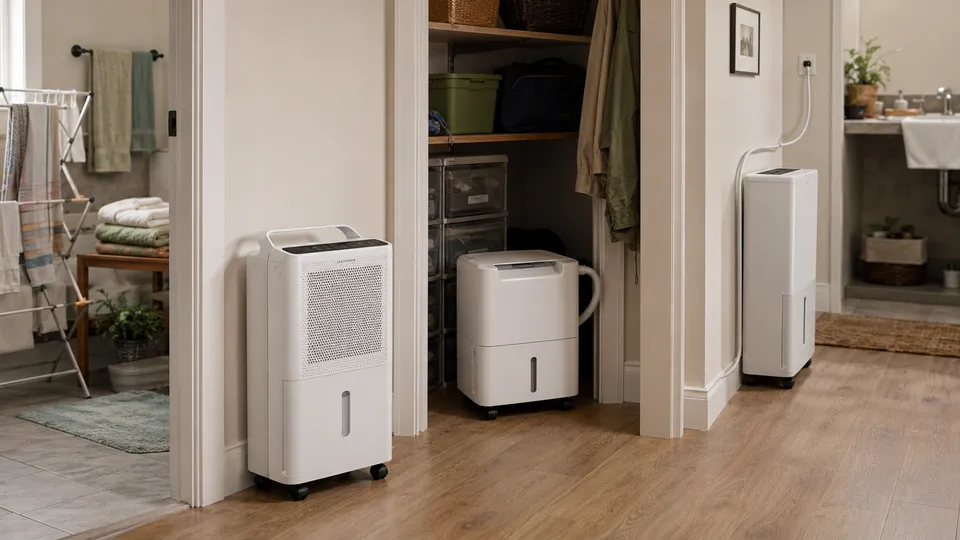
Both models weigh more than 40 pounds before the normal operating water load. Their wheels help with positioning on a single level; they do not make either machine appropriate for carrying upstairs or storing on a shelf.
.png)
Pump Drainage: A Useful Feature With Strict Boundaries
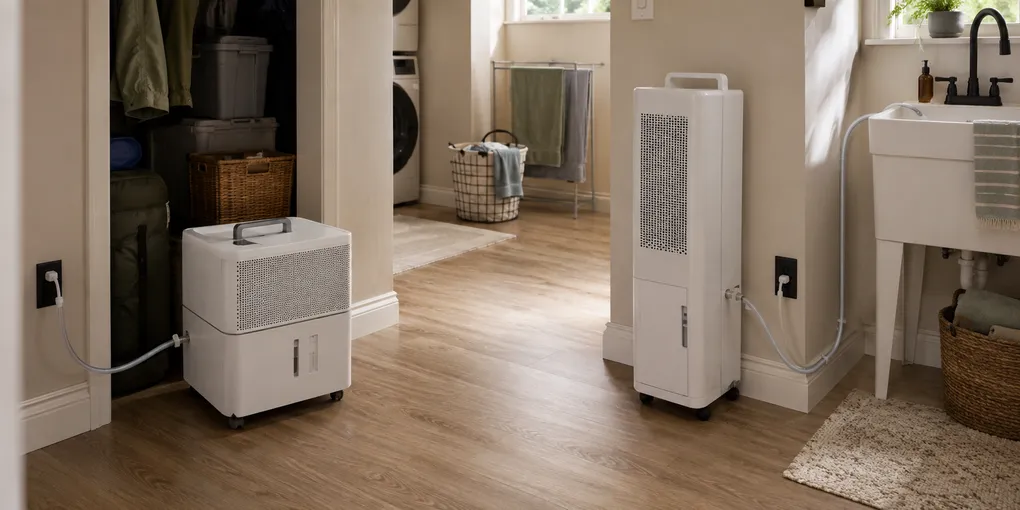
The pump is useful when the appliance sits below the destination, such as a sink rim, and the exact model supports that route. Midea describes its pump as sending water out a window or into a sink. GE states that its included hose can drain to a convenient location up to 16 ft away. Those are meaningful differences from a gravity-only drain hose, which must slope downward to work.
They are not permission to improvise. Check these points before choosing either machine:
- A permitted destination: Confirm that the lease, building rules, and location allow the proposed sink, drain, or window route.
- A protected path: Measure the full hose route. It should not cross a doorway, sit under a closing door, create a trip hazard, or bend sharply behind furniture.
- The model-specific instructions: Read the live manual for pump operation, hose connection, maximum lift or reach, cleaning, and storage. Do not transfer limits from a different Midea or GE model.
- A bucket backup: A hose can become blocked, disconnected, or unavailable after you move the unit. You still need a practical way to empty the bucket.
For an apartment with a realistic pump destination, GE’s published 16 ft route is the clearer reason to start with the ADHE50PWF. For an apartment where the hose run is short but storage is difficult, Midea’s Cube format may matter more. Neither is automatically better when there is nowhere safe to send water.
.png)
Water-Tank Routine Still Matters
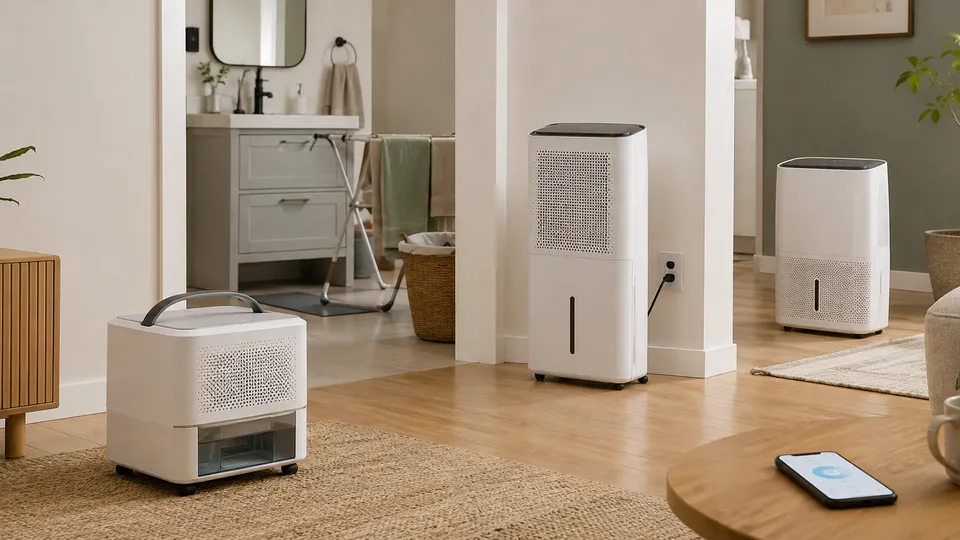
The Midea’s expanded tank design is intended to reduce trips to the sink, but the current product page does not publish a fixed usable tank capacity that supports a reliable number of hours between emptying. The GE does publish a 15 pt bucket capacity. That is helpful for planning, but it does not tell you how often you will empty it: humidity, wet laundry, shower use, outdoor weather, and target settings change the result.
Treat the bucket as part of the normal ownership routine for both models:
- Walk the route from the proposed placement to the nearest sink or tub, including rugs, thresholds, stairs, and doors.
- Check that you can remove the bucket without moving furniture or blocking a passage.
- Keep the appliance level on the floor and reinstall the bucket as the owner guide directs.
- Do not rely on an app alert, full-bucket shutoff, or a pump feature as a substitute for an emptying plan.
If this routine is unrealistic, do not solve it with a longer improvised hose. Reconsider the location, verify a compatible pump setup, or choose a smaller tank-first unit that better fits your actual space.
Filter, Hose, and Seasonal Care
Midea’s owner manual is unusually specific about recurring care: clean the air filter every two weeks, and keep the bucket, pump filter, and drain hose clean as directed. That routine is not cosmetic. Dust or debris in the filter can reduce airflow, while a neglected hose or pump filter can compromise the drainage setup you bought the appliance for.
GE lists a permanent mesh filter and a filter-clean reminder. Its official care guidance says to vacuum the filter or, when it is dirty, wash it with mild dish soap and warm water, then let it dry before reinstalling. The reminder is useful, but it does not replace looking at the filter, bucket, hose connection, and floor around the machine.
Before seasonal storage, follow the exact current owner guide for emptying water, cleaning the bucket and filter, drying the unit, and handling the cord. The Midea has the advantage if it must be stored compactly. The GE needs a taller, fixed storage spot, but its shallow body can be easier to place along a wall.
.png)
Which Apartment Setup Fits?
| Your priority | Better starting point | Why |
|---|---|---|
| Seasonal storage is the limiting constraint | Midea Cube MAD50PS1QWT | Lift-and-twist body can nest down outside humid months |
| Shallow depth matters beside a wall or narrow path | GE ADHE50PWF | 11.4 in listed depth versus Midea’s 14.45 in |
| You need a manufacturer-documented longer pump route | GE ADHE50PWF | Included hose and drainage to a convenient location up to 16 ft away |
| You want a compact, short body with a large-tank design | Midea Cube MAD50PS1QWT | 14.57 in listed height and expanded/nested format |
| You want a published fixed bucket capacity | GE ADHE50PWF | 15 pt bucket capacity |
| You have no safe, permitted drain destination | Neither as a pump-first purchase | Use the tank realistically or start with a no-hose apartment guide |
For another direct comparison involving the Midea Cube, read Midea Cube vs. Frigidaire 50-Pint Pump Dehumidifier for Apartments. It explains why a shallower upright body and a storage-first Cube are different rental decisions even when both have a pump.
Before You Buy
- Match the full model number: MAD50PS1QWT for the Midea Cube with pump and ADHE50PWF for the GE with pump.
- Check lease and building rules before routing water to a sink, window, or drain.
- Measure the body, bucket-access area, airflow clearance, hose path, outlet reach, and walking space.
- Read the live owner manual for the exact pump limits, hose procedure, electrical requirements, cleaning, and storage instructions.
- Plan to empty the bucket safely even if continuous drainage will be the usual workflow.
- Confirm current availability, included items, replacement parts, and written warranty terms with the seller before ordering.
FAQ
Does a built-in pump mean I will never empty the bucket?
No. A pump supports a compatible continuous-drain route while that route is installed and working. The bucket remains the backup for a blocked hose, a move to another room, or an apartment where the hose cannot be used safely.
Is the Midea Cube smaller than the GE?
It is much shorter and designed to nest down for storage. The GE is shallower from front to back. The Midea measures 14.45 in deep and 14.57 in high; the GE measures 11.4 in deep and 24.1 in high. Choose based on the dimension that limits your real placement.
Can I run either pump to a sink?
Both manufacturers describe sink-capable pump drainage on compatible setups. You still need to read the current guide for the exact connection, route limits, cleaning, and operating instructions, and confirm that the route is permitted and secure in your rental.
Should I use an extension cord for a dehumidifier?
Do not assume that an extension cord is acceptable. Use the grounded wall outlet and cord guidance in the exact owner manual. If the proposed placement cannot reach a suitable outlet without improvising, choose another placement or model.
Bottom Line
Choose the Midea Cube MAD50PS1QWT when the Cube’s compact height and nested seasonal storage solve a genuine apartment-storage problem. Choose the GE ADHE50PWF when its shallower body and published pump route of up to 16 ft better fit the floor plan and drainage destination.
Both are substantial 50-pint appliances. The right decision comes after you confirm a permitted water destination, a secure hose and outlet path, bucket access, required clearance, and the current owner instructions for the exact model. A pump is useful only when the rest of the apartment setup is already sound.