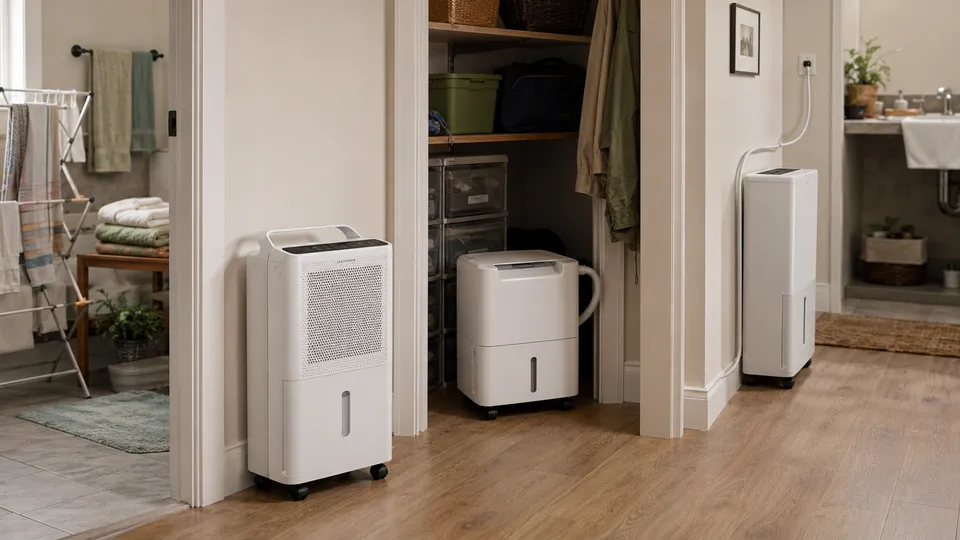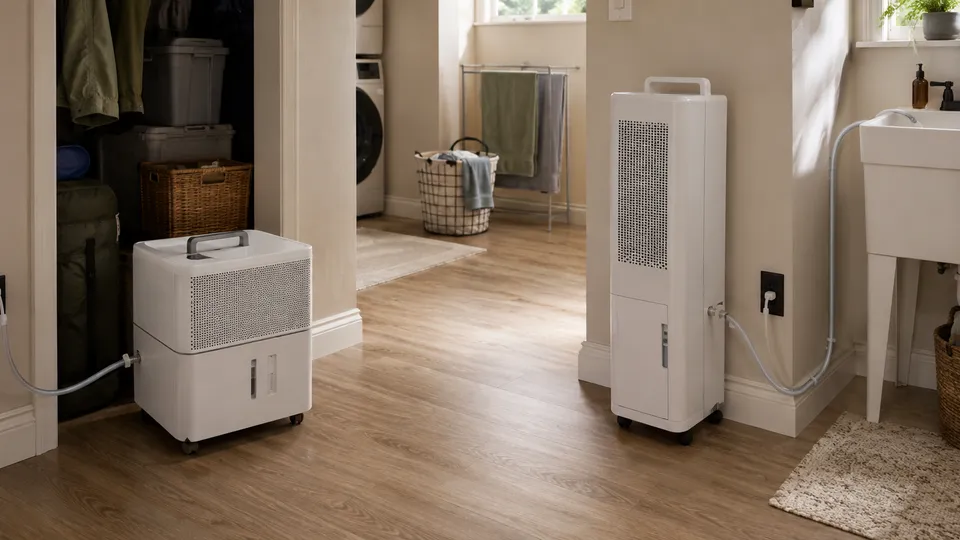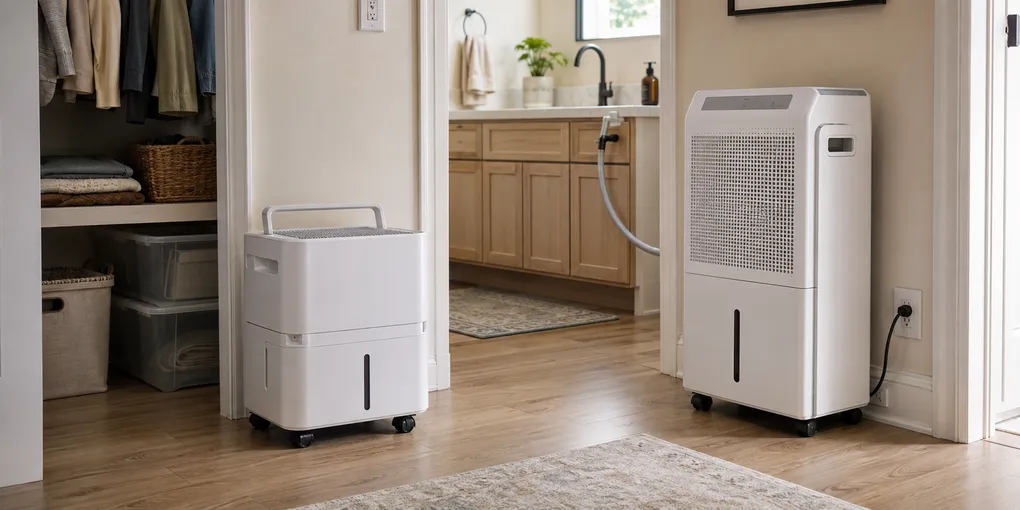
The Midea Cube MAD50PS1QWT and Frigidaire FHDP5033Y1 are both 50-pint dehumidifiers with a built-in pump. That does not make them interchangeable apartment purchases. The Midea is a short, lift-and-twist Cube design that can nest down for storage. The Frigidaire is a more conventional upright unit with a much shallower listed depth, a washable filter, Wi-Fi controls, and a pump the manufacturer describes as sending water upward into a sink or out a window.
For renters, the first question is not which machine has a pump. It is whether you have a safe, permitted place for water to go. A pump can make an uphill route possible on a compatible setup; it does not turn a hose across a doorway, an unsecured container, or an unapproved window route into a safe installation.
This comparison covers the current Midea Cube 50-Pint with Pump, model MAD50PS1QWT, and the current Frigidaire 50-Pint Built-In Pump Dehumidifier, model FHDP5033Y1. The main head-to-head table does not substitute Midea’s no-pump Cube, other Cube capacities, Frigidaire’s 60-pint unit, or discontinued Frigidaire variants. A separate section below explains the current white -A Midea pump and no-pump listings without mixing those SKUs into the Frigidaire specifications. Specifications come from current manufacturer product pages and linked owner documentation. This is not hands-on testing or a promise that either unit will suit every apartment.
For a tank-first option when you do not have a realistic drain route, start with a tank-first dehumidifier for apartments without a drain hose.
If you want to compare these two against a third current model with a manufacturer-documented longer pump route, read best dehumidifiers with built-in pumps for apartments.
If the Midea’s nested storage design appeals but you need to compare it with GE’s taller, shallower body and maker-listed 16 ft pump route, read Midea Cube vs. GE dehumidifier with pump.
Quick Answer
Choose the Midea Cube MAD50PS1QWT when seasonal storage and a compact nested body matter most. Midea lists the body at 14.45 x 14.76 x 14.57 in and 41.54 lb, with a lift-and-twist form that can operate extended and nest down for storage. The manufacturer also lists a built-in pump, wheels, a handle, SmartHome control, and an included hose for continuous-drain use.
Choose the Frigidaire FHDP5033Y1 when a shallow-depth upright body, washable filter, Wi-Fi controls, and a conventional bucket routine are more useful. Frigidaire lists it at 19.1 in high, 18.9 in wide, and only 9.9 in deep, at 41.89 lb. Its product page lists a built-in pump, continuous-drain option, automatic shutoff when the bucket is full, and a washable filter.
Choose neither solely because it says “pump.” Both need a permitted drainage destination, a hose path that will not kink or create a trip hazard, a grounded outlet, the clearances in the owner guide, and a practical fallback plan for manual bucket emptying.
Midea Cube 50-Pint With Pump vs. Without Pump
Midea currently exposes two closely related white 50-pint Cube listings in the US:
- MAD50PS1QWT-A: the product heading and feature list identify this as the model with a built-in pump.
- MAD50S1QWT-A: the product heading identifies this as the model without a built-in pump.
Both product pages list a 50-pint-per-day rating, the lift-and-twist Cube format, SmartHome control, wheels, and the same three body measurements plus a listed weight of 41.54 lb. However, the no-pump page’s specification block inserts a P into the model number and the current -A pages order the dimension labels differently from other official Midea Cube listings. The shared owner manual does not provide a clean model-specific dimension table. Treat these as the same general Cube-size class, but verify the model label and live dimensions with the seller instead of assuming the two listings are dimensionally identical.
| Buying question | With pump: MAD50PS1QWT-A | Without pump: MAD50S1QWT-A |
|---|---|---|
| Moisture-removal rating | 50 pints/day | 50 pints/day |
| Manual bucket use | Yes | Yes |
| Gravity continuous drainage | Supported with the normal drain hose; the unit must sit above the sink or drain | Supported with the normal drain hose; the unit must sit above the sink or drain |
| Drainage above the machine | The shared manual documents pump drainage to a sink or other drain, with a maximum pump height of 14 ft | No built-in pump; use a downhill gravity route or empty the bucket manually |
| Drainage accessories documented in the shared manual | Normal drain hose plus pump inlet and outlet hoses for pump-equipped units | Normal drain hose; pump hoses apply only to pump-equipped units |
| Extra maintenance | Pump filter and pump hose checks in addition to normal bucket, air-filter, and drain care | Normal bucket, air-filter, and gravity-drain care without the pump system |
| Warranty | One-year limited warranty | One-year limited warranty |
The pump does not increase the published moisture-removal rating. Its purpose is to move collected water to a compatible destination when gravity cannot do the job. Midea’s shared manual says the pump needs the bucket in place, cannot be used in bucketless mode, and may lift water up to 14 ft. It also says to empty the bucket at least weekly while using pump drainage and to keep the pump filter and hoses clean.
Choose the pump version only when the verified route must rise to a permitted sink or drain and the full hose path can follow the manual. Choose the no-pump version when manual bucket emptying or a continuously downhill gravity route already works. If the apartment has no safe drain destination, the pump version does not solve the underlying setup problem.
Verified Model Facts
| Detail | Midea Cube MAD50PS1QWT | Frigidaire FHDP5033Y1 |
|---|---|---|
| Exact model compared | Cube 50-Pint with Pump | 50-Pint Built-In Pump Dehumidifier |
| Maker-listed removal rating | 50 pints/day | 50 pints/day |
| Listed dimensions | 14.45 D x 14.76 W x 14.57 H in | 9.9 D x 18.9 W x 19.1 H in |
| Listed product weight | 41.54 lb | 41.89 lb |
| Pump and continuous drainage | Built-in pump; Midea says it can drain out a window or into a sink. The product page also describes an included hose for continuous drainage to a sink or floor drain. | Built-in pump; Frigidaire says that, when enabled, it discharges moisture upward into a sink or out a window. A continuous-drain option is also listed. |
| Manual water-tank signals | Midea describes a large tank for longer runtime and fewer trips to the sink; the current product page does not publish a fixed usable tank-volume figure. | Built-in bucket with automatic shutoff when full; the current product page does not publish a fixed bucket-volume figure. |
| Storage and moving signals | Lift-and-twist nested or extended body, wheels, and handle | Fixed upright body, caster wheels, and handle |
| Filter and care signals | Official owner documentation includes bucket-cleaning guidance; use the current manual for the exact filter-care routine. | Easy-to-clean washable filter listed on current product page |
| Warranty | 1 year | 1 year parts and 1 year labor |
The current Midea page includes inconsistent room-size language in different page sections. Rather than treating a manufacturer coverage number as an apartment-wide promise, this guide leaves it out. Moisture source, temperature, laundry drying, doors, and drainage routine matter more than a large coverage label.
A Pump Changes the Drain Route, Not the Apartment Rules
The Midea and Frigidaire both have a real advantage over a gravity-only machine: their manufacturers describe water being moved upward to a sink or out a window. That can matter where the dehumidifier must sit below the sink rim or where there is no nearby floor drain.
It does not mean either machine can drain anywhere. Before buying, confirm all of the following for the exact model:
- A permitted destination. A sink, drain, or window discharge route must be allowed by the lease and practical for the room. Do not drain into an unstable pail, bathtub edge, or container that may overflow.
- The hose route. Measure the full path. Keep it away from walking routes, closing doors, hot surfaces, and sharp bends.
- The owner-guide limits. Check the current manual for the pump’s maximum lift, hose requirements, connection procedure, and cleaning instructions. Those details should not be guessed from a product card.
- A manual-emptying backup. A pump route can fail, become blocked, or be unsuitable when you move the machine. You still need to be able to remove and empty the tank safely.
Midea’s product page separates two ideas: its built-in pump can send water out a window or into a sink, while its continuous-drain description says the included hose can go to a sink or floor drain. Frigidaire separately lists a built-in pump and a continuous-drain option. Treat those as setups to verify in each owner guide, not as proof that every hose path uses the pump in the same way.
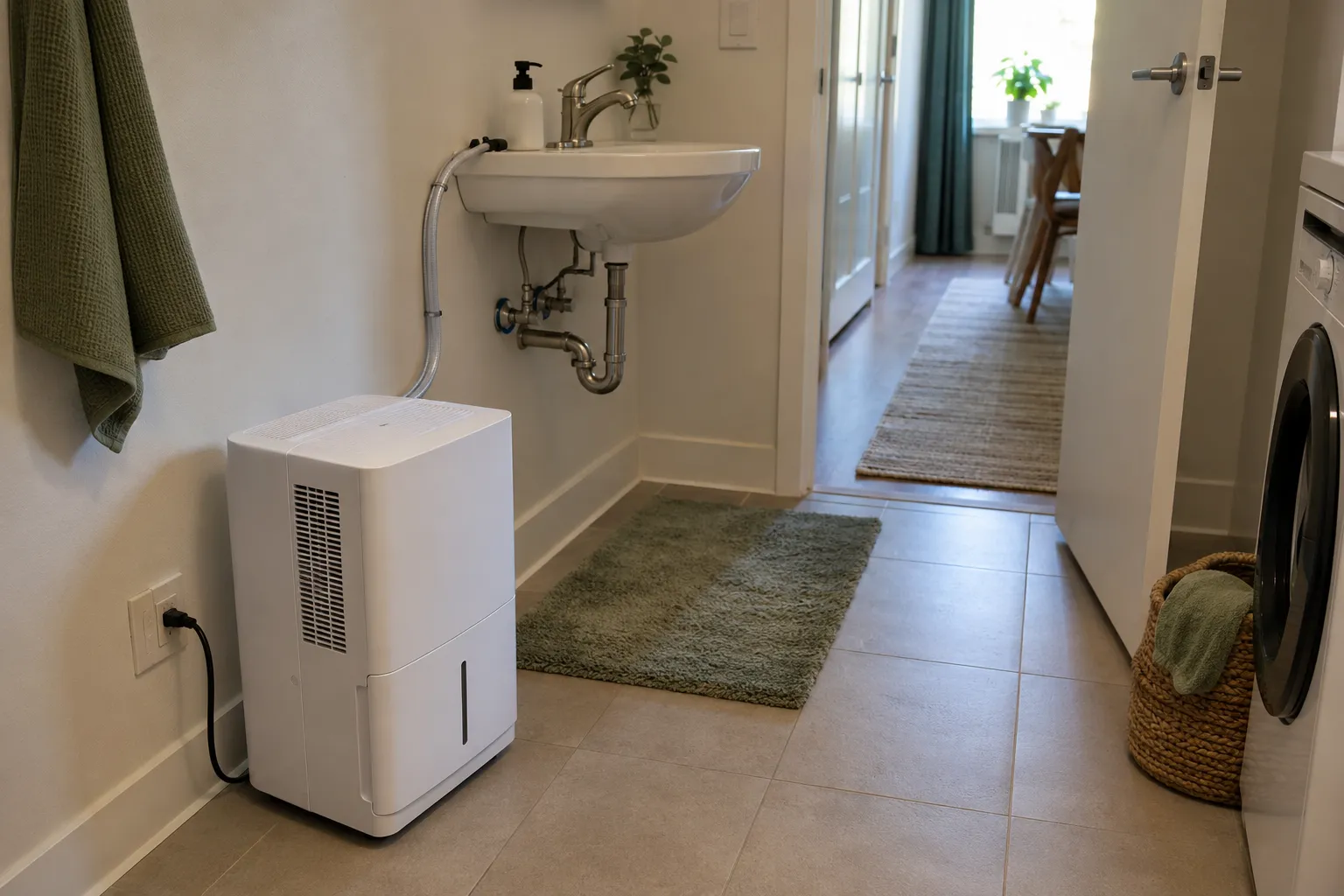
Footprint: Cube Storage vs. Shallow Upright Placement
The Midea Cube is shorter and more nearly square in its listed body dimensions: 14.45 in deep, 14.76 in wide, and 14.57 in high. Its distinguishing feature is the lift-and-twist design. Midea says it can operate in an extended form and nest down for storage, which can be useful for a seasonal appliance that must leave the floor between humid periods.
The Frigidaire is not the narrower machine overall, but its 9.9 in depth is materially shallower than the Midea’s 14.45 in depth. That can help along a bathroom wall, laundry edge, or narrow room path where front-to-back protrusion is the limiting dimension. Its 18.9 in width and 19.1 in height still need a stable floor location, access to the bucket, and the clearances specified in its owner guide.
Both models weigh about 42 lb before the normal operating water load. Wheels and handles help with positioning on one level, but they do not make either machine suitable for carrying up stairs or storing on a shelf. Measure the working footprint, not only the body:
- Airflow clearance around intake and outlet areas
- The space needed to remove the bucket and carry it to a sink
- Door swing, furniture, and walking path around the appliance
- The route to a permitted drain if you plan to use a hose
- The space needed to lift, nest, or access the Midea Cube in its storage position
Water Tank Routine Still Matters
A built-in pump is helpful only while the drainage setup is available and functioning. In ordinary apartment use, you should expect to interact with the water tank.
Midea says the Cube’s large tank capacity can mean a longer runtime and fewer trips to the sink, and it gives the appliance a handle and wheels for carrying and emptying. Frigidaire says its unit shuts off automatically when the water bucket is full. These are useful ownership signals, but neither current US product page gives a fixed water-tank volume that supports a reliable “hours between emptying” claim. Humidity levels change that timing substantially anyway.
Plan the tank routine before a purchase:
- Walk from the proposed placement to the nearest sink or tub, including thresholds, rugs, and stairs.
- Check that the bucket can be removed without moving furniture or blocking a doorway.
- Do not rely on a phone alert or automatic shutoff as a substitute for an emptying plan.
- Keep the unit level and follow the guide when reinstalling the bucket after emptying.
If that routine is unrealistic, do not solve it by improvising a long hose. Reconsider the placement, use a compatible pump route only after checking the manual, or select a smaller tank-first model that better fits the actual space.
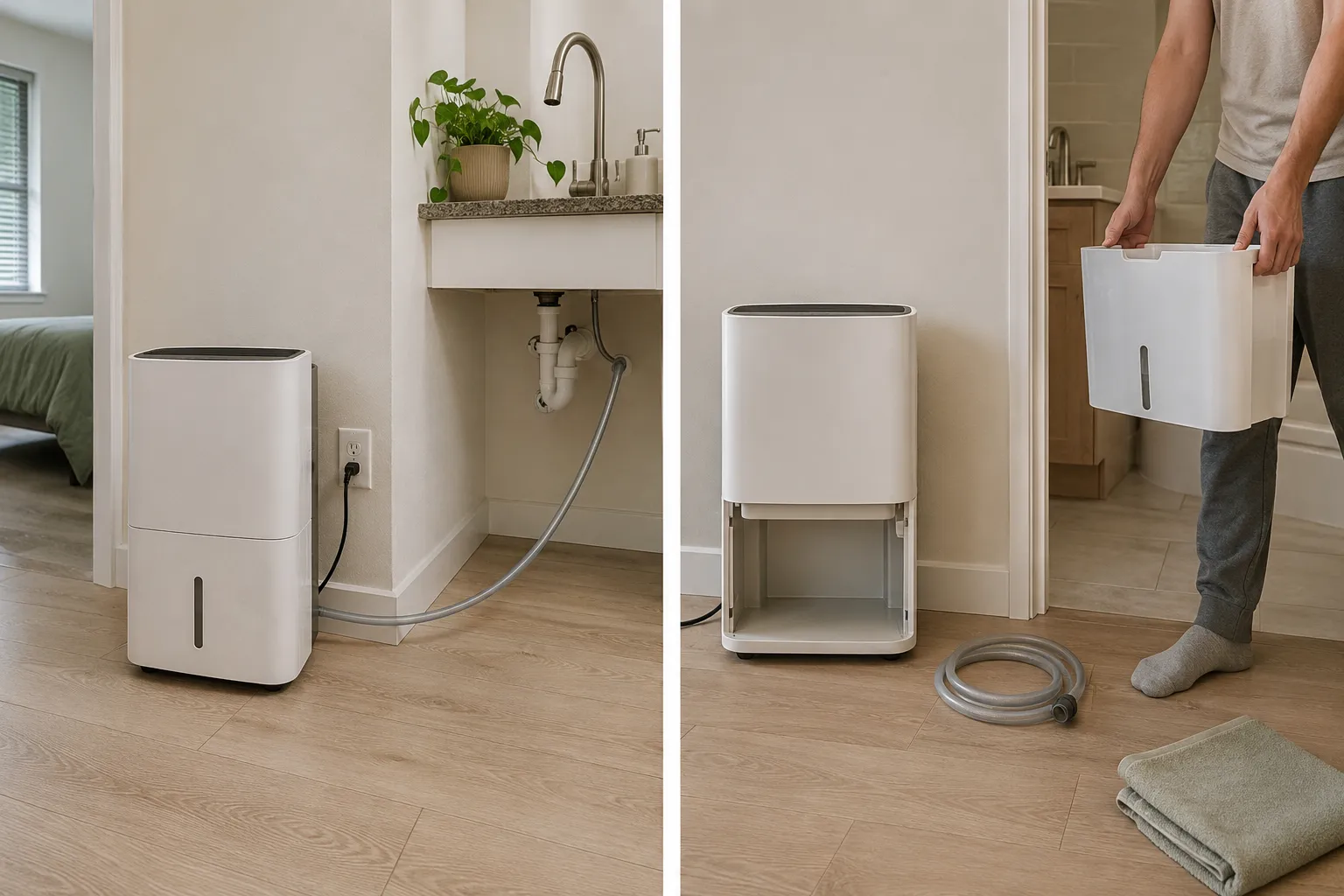
Maintenance: What the Official Pages Support
The practical maintenance burden is more than a filter line in a comparison table. A humid appliance collects water and air-borne dust, so bucket care, filter care, hose condition, and seasonal storage all matter.
Midea’s linked owner manual for the MAD50PS1QWT includes bucket-cleaning guidance, including cleaning the bucket thoroughly every few weeks. Its current product page does not publish a comparable exact filter-cleaning interval, so follow the current manual rather than applying a schedule from a different Midea model or retailer page.
Frigidaire lists an easy-to-clean washable filter on the FHDP5033Y1 product page and directs owners to its complete owner guide. The page does not give a standalone filter-cleaning interval, water-bucket size, or pump-lift number. Use the owner guide for those model-specific steps, and keep the drain connection and hose clean and accessible rather than hiding them behind furniture.
For either machine, dry and clean the unit as directed before seasonal storage. Do not assume that a built-in pump removes the need to inspect the bucket, hose, filter, and surrounding floor for leaks or residue.
Warranty and Availability Check
Both exact models currently list a one-year manufacturer warranty. Frigidaire specifies one year for both parts and labor; Midea’s product page lists a one-year warranty. Register the exact model, retain the receipt, and read the live warranty terms before buying because a retailer’s service plan is not the same as the manufacturer’s warranty.
Do not base a purchase on a stale price or listing. When this comparison was researched, Midea’s direct page offered a notification option rather than checkout, while Frigidaire’s direct page showed the FHDP5033Y1 in stock. Those signals can change quickly. Confirm the exact model number, package contents, seller, and current warranty information at checkout.
Which Apartment Setup Fits?
| Your priority | Better starting point | Why |
|---|---|---|
| You need the shortest listed body and seasonal nested storage | Midea Cube MAD50PS1QWT | 14.57 in listed height plus lift-and-twist nested/extended design |
| A shallow depth matters most along a wall or path | Frigidaire FHDP5033Y1 | 9.9 in listed depth versus Midea’s 14.45 in |
| You want a manufacturer-listed washable filter and Wi-Fi controls | Frigidaire FHDP5033Y1 | Both are listed on the current product page |
| You need a pump route to a sink or window and can verify the manual setup | Either, after setup verification | Both manufacturer pages describe an upward pump route to a sink or window |
| You have no permitted drain destination | Neither as a pump-first decision | Use the bucket realistically or consider a tank-first apartment option |
| You need an appliance that stores compactly outside humid months | Midea Cube MAD50PS1QWT | The nested Cube format is its distinct advantage |
Before You Buy
- Match the full model number: MAD50PS1QWT for the Midea Cube with pump, and FHDP5033Y1 for the Frigidaire 50-pint pump model.
- Check your lease and building rules before routing water to a sink, window, or drain.
- Measure the body, bucket-access area, airflow clearance, hose route, outlet reach, and walking path.
- Read the live owner guide for the exact pump-lift, hose, connection, cleaning, and storage instructions.
- Confirm a safe manual bucket-emptying routine even if you expect to use continuous drainage.
- Recheck current availability, package contents, and warranty terms with the seller before ordering.
FAQ
Does a built-in pump mean I do not need to empty the tank?
No. A pump can support a compatible continuous-drain route, but the machine still has a tank and you need a manual-emptying fallback. If there is no permitted drain destination or the hose route is unsafe, the tank is your normal water routine.
Can I put a pump dehumidifier anywhere in an apartment?
No. You still need a stable, level floor location, suitable airflow clearance, a grounded outlet, room to remove the bucket, and a safe drainage route if using a hose. The exact owner guide controls the pump and hose limits.
Is the Midea Cube smaller than the Frigidaire?
It is shorter and more compact in its listed nested-body dimensions, while the Frigidaire is much shallower front to back. The Midea is 14.45 in deep and 14.57 in high; the Frigidaire is 9.9 in deep and 19.1 in high. Measure the constraint that matters in your actual location.
Which one has the larger water tank?
Do not choose by an invented number. Midea describes a large tank with fewer trips to the sink, and Frigidaire lists a built-in bucket with full-bucket automatic shutoff. Neither current US product page gives a fixed usable tank-volume figure for a clean side-by-side comparison. Actual emptying frequency also depends on humidity conditions.
Bottom Line
Choose the Midea Cube MAD50PS1QWT when the Cube’s nested storage format and short listed body solve a genuine apartment-storage problem and you can verify a safe pump or tank routine. Choose the Frigidaire FHDP5033Y1 when its 9.9 in depth, washable filter, Wi-Fi control, and conventional upright placement fit your room better.
Both are substantial, approximately 42 lb 50-pint appliances. The buying decision should come after you confirm a drain destination, hose and outlet path, bucket-emptying route, clearance, and the owner guide for the exact model. A built-in pump is a useful feature only when the rest of that apartment setup is already sound.
Official Sources
- Midea Cube 50-Pint with Pump MAD50PS1QWT
- Midea MAD50PS1QWT owner manual
- Midea Cube 50-Pint with Pump MAD50PS1QWT-A
- Midea Cube 50-Pint without Pump MAD50S1QWT-A
- Midea shared Cube owner manual for MAD50S1QWT-A and MAD50PS1QWT-A
- Frigidaire 50-Pint Built-In Pump FHDP5033Y1
- Frigidaire FHDP5033Y1 complete owner guide