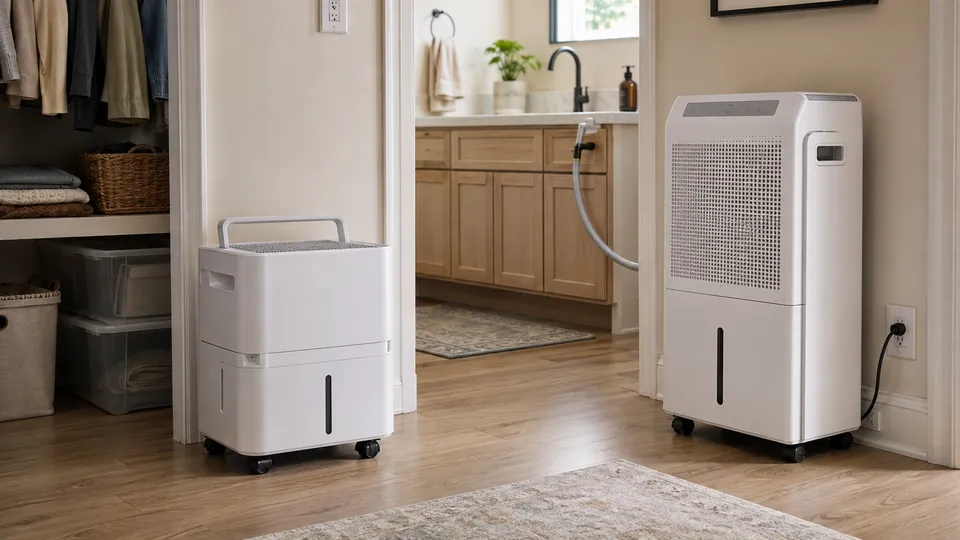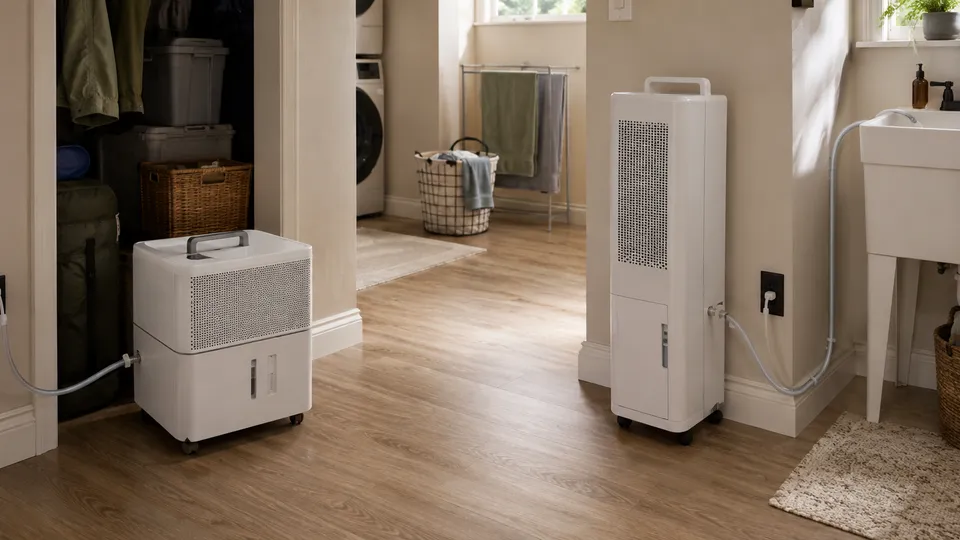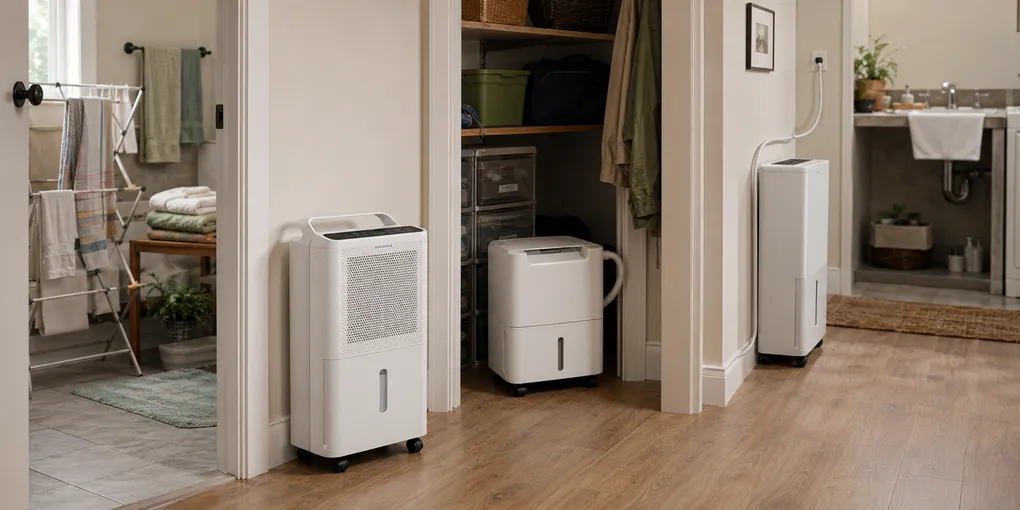
A dehumidifier with a built-in pump can be useful in an apartment when a normal gravity-drain hose cannot run downhill to a suitable drain. It is not a shortcut around the rest of the setup. You still need a permitted destination, a secure hose route, a nearby suitable outlet, space to remove the bucket, and a realistic plan if the hose route is unavailable.
This guide compares three current 50-pint models with manufacturer-documented built-in pumps. They are not “best” because they are the largest machines or because a pump makes them hands-off. They each solve a different apartment constraint: seasonal storage, shallow front-to-back placement, or a clearly documented longer pump route.
The exact models are the Midea Cube MAD50PS1QWT, Frigidaire FHDP5033Y1, and GE ADHE50PWF. This guide does not substitute no-pump versions, 60-pint versions, prior product generations, or retailer bundles. Specifications come from current manufacturer product pages and linked owner documentation; this is not hands-on testing or a guarantee that any model is appropriate for every rental.
If you do not have a safe route to a drain, begin with best dehumidifiers for apartments without a drain hose. For the direct decision between the Midea and Frigidaire models below, see Midea Cube vs. Frigidaire 50-Pint Pump Dehumidifier for Apartments. To compare Midea’s storage-first Cube with GE’s shallower, taller pump model, read Midea Cube vs. GE dehumidifier with pump.
Quick Answer
Choose the Midea Cube MAD50PS1QWT when the appliance has to store compactly outside humid months. Its lift-and-twist design can operate extended and nest down for storage. Midea lists the body at 14.45 x 14.76 x 14.57 in, 41.54 lb, and documents a built-in pump that can send water to a sink or out a window.
Choose the Frigidaire FHDP5033Y1 when shallow depth matters more than a compact storage shape. Frigidaire lists it at 9.9 in deep, 18.9 in wide, and 19.1 in high. It has a built-in pump, continuous-drain option, full-bucket automatic shutoff, Wi-Fi controls, and an easy-to-clean washable filter.
Choose the GE ADHE50PWF when the pump route is the main constraint and you can accommodate a taller body. GE lists an included hose and says the built-in pump can drain to a convenient location up to 16 ft away. Its 24.1 in height makes it the least cabinet-friendly choice of the three, so measure before treating that drainage flexibility as an advantage.
Choose none of them as a pump-first solution if you have no permitted place for discharged water. A full bucket is still the backup when a hose becomes blocked, is unsuitable in a new room, or cannot remain safely routed.
Verified Model Facts
| Detail | Midea Cube MAD50PS1QWT | Frigidaire FHDP5033Y1 | GE ADHE50PWF |
|---|---|---|---|
| Maker-listed removal rating | 50 pints/day | 50 pints/day | 50 pints/day |
| Listed body size | 14.45 D x 14.76 W x 14.57 H in | 9.9 D x 18.9 W x 19.1 H in | 11.4 D x 14.4 W x 24.1 H in |
| Listed product weight | 41.54 lb | 41.89 lb | Not shown in the current official product-page text reviewed for this guide |
| Pump and drainage | Built-in pump; Midea says it can discharge to a sink or out a window. Its page also describes an included hose for continuous drainage to a sink or floor drain. | Built-in pump; Frigidaire says it discharges moisture upward into a sink or out a window when enabled. A continuous-drain option is also listed. | Built-in pump and included hose; GE says it can drain to a convenient location up to 16 ft away. A continuous-drain option is also listed. |
| Bucket signals | Midea describes up to three times more water capacity, but its current page does not publish a fixed usable tank-volume number. | Built-in bucket with automatic shutoff when full; current page does not publish a fixed bucket-volume number. | 15 pint bucket capacity; full or missing bucket triggers an alarm. |
| Filter and care signals | Owner manual includes bucket-cleaning guidance; use the current manual for the exact filter-care routine. | Easy-to-clean washable filter listed. | Filter-cleaning reminder listed. |
| Power information | Official owner manual lists 115V, 60Hz. | Exact electrical values are not displayed in the current official product-page text reviewed; confirm in the current owner guide before buying. | Exact electrical values are not displayed in the current official product-page text reviewed; confirm in the current owner guide before buying. |
| Warranty | 1 year | 1 year parts and 1 year labor | Current product page links a written warranty; confirm its current terms before buying. |
Do not turn a room-coverage claim into an apartment sizing promise. The amount of moisture from showers, cooking, wet laundry, outdoor weather, open doors, and the actual hose or bucket routine has more effect on day-to-day ownership than a large coverage number on a product card.
A Pump Is Only Useful With a Safe Destination
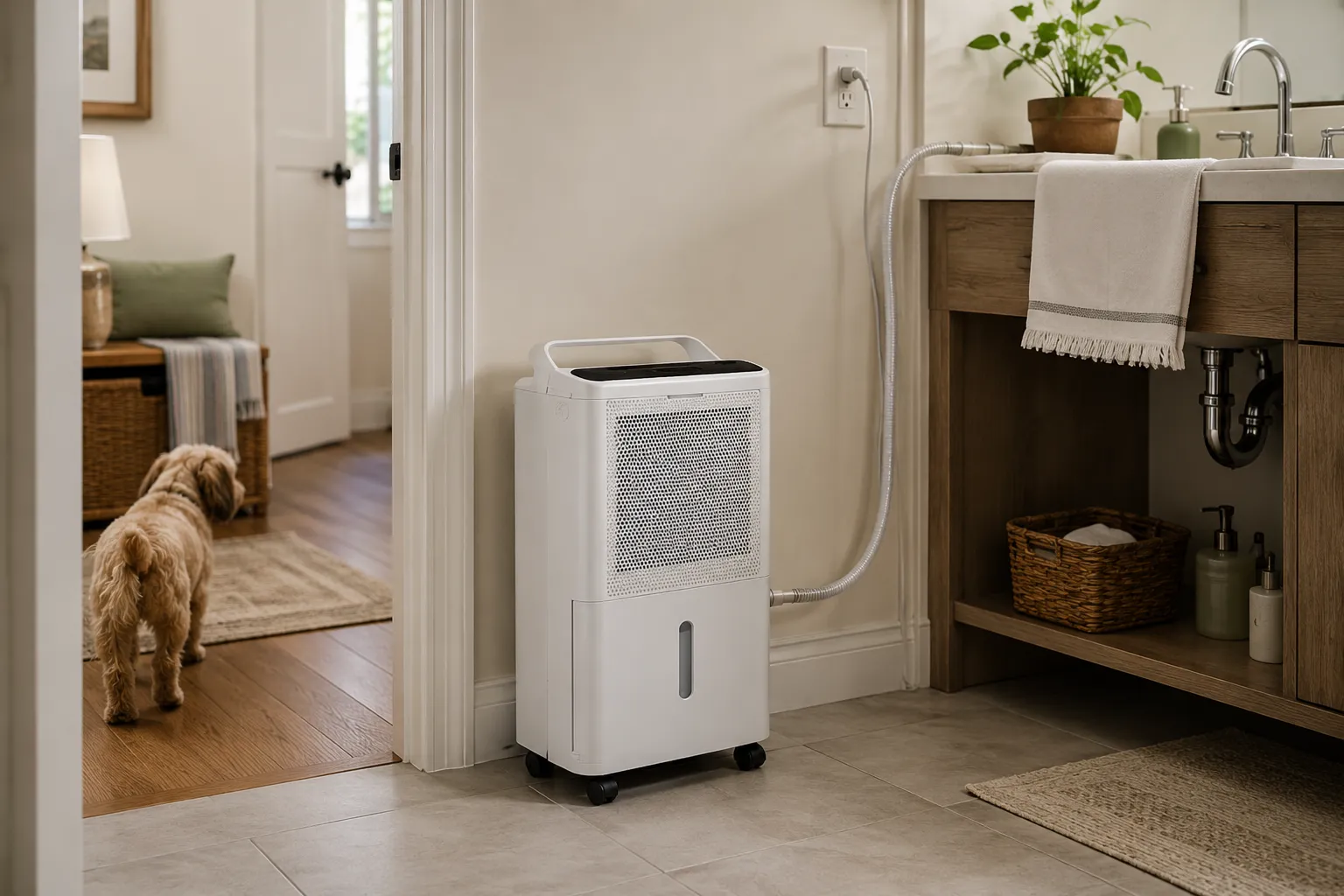
The central difference between a pump model and a gravity-only model is that the pump can help move water upward. That can matter when the available sink rim is higher than the unit’s drain port or when a low floor drain is unavailable.
Before ordering, answer these questions for the exact model and location:
- Where will the water end? Confirm that the sink, drain, or window route is allowed by the lease and practical for the room. Never drain to an unstable container or a location that could overflow.
- Can the hose stay protected? Measure the full route. Avoid door crossings, walkways, sharp bends, heat sources, and places where a pet or person can dislodge it.
- What does the manual permit? Pump lift, hose connection, cleaning, and routing limits vary by exact model. The product page is not a substitute for the owner guide.
- Can you empty the bucket? Keep a clear path to a sink or tub even when planning to use a pump. A blocked, disconnected, or seasonal hose should not leave the appliance with no safe fallback.
The GE’s documented 16 ft pump distance is useful only after this check. It is not permission to run a hose across an apartment or to a destination that cannot safely receive water. Likewise, Midea and Frigidaire describing a sink or window route does not establish that every window, sink, or rental rule is compatible.
1. Midea Cube: Best for Seasonal Storage
The Midea Cube’s reason to exist is its lift-and-twist design. It can run in an extended form and nest down when stored. For a renter who needs the machine to leave the floor after a wet season, this is a more meaningful feature than another generic fan-mode label.
Midea lists 14.45 in depth, 14.76 in width, 14.57 in height, and 41.54 lb. Its product page describes a built-in pump that can drain upward toward a sink or out a window, plus an included hose for continuous drainage to a sink or floor drain. The owner manual lists 115V and 60Hz, and includes bucket-cleaning guidance.
The tradeoff is that Midea’s headline about up to three times more water capacity is not a fixed usable-gallon figure on the current product page. Do not translate it into a promise about days between emptying. If you will use the bucket, humidity conditions and your actual routine still decide how often you carry water.
Start here when storage is the constraint and you can document a safe drain route. For a direct model-by-model comparison, read Midea Cube vs. Frigidaire 50-Pint Pump Dehumidifier for Apartments.
2. Frigidaire: Best for Shallow Upright Placement
The Frigidaire FHDP5033Y1 is the better starting point when a wall edge, bathroom passage, or utility corner is constrained front to back. Its listed 9.9 in depth is substantially shallower than the Midea Cube’s 14.45 in depth, although it is wider and taller at 18.9 x 19.1 in.
Frigidaire lists a built-in pump that discharges moisture upward into a sink or out a window when enabled. It also lists a continuous-drain option, a built-in bucket with automatic full-bucket shutoff, caster wheels, a handle, Wi-Fi controls, and a washable filter. The listed product weight is 41.89 lb; warranty coverage is one year for parts and one year for labor.
This is a sensible role when the appliance will remain in one practical floor location and shallow depth matters more than seasonal nesting. Do not buy it because the Wi-Fi connection appears to remove water handling. It can help with settings and status, but it cannot secure a hose or empty a bucket for you.
3. GE: Best When Pump-Route Distance Is the Priority
GE’s ADHE50PWF makes the clearest product-page statement about the pump route. The company lists an included hose and says the pump can drain water to a convenient location up to 16 ft away. It also lists continuous drain, an empty-bucket alarm, a filter-cleaning reminder, three fan speeds, Smart Dry, and a 15 pint bucket.
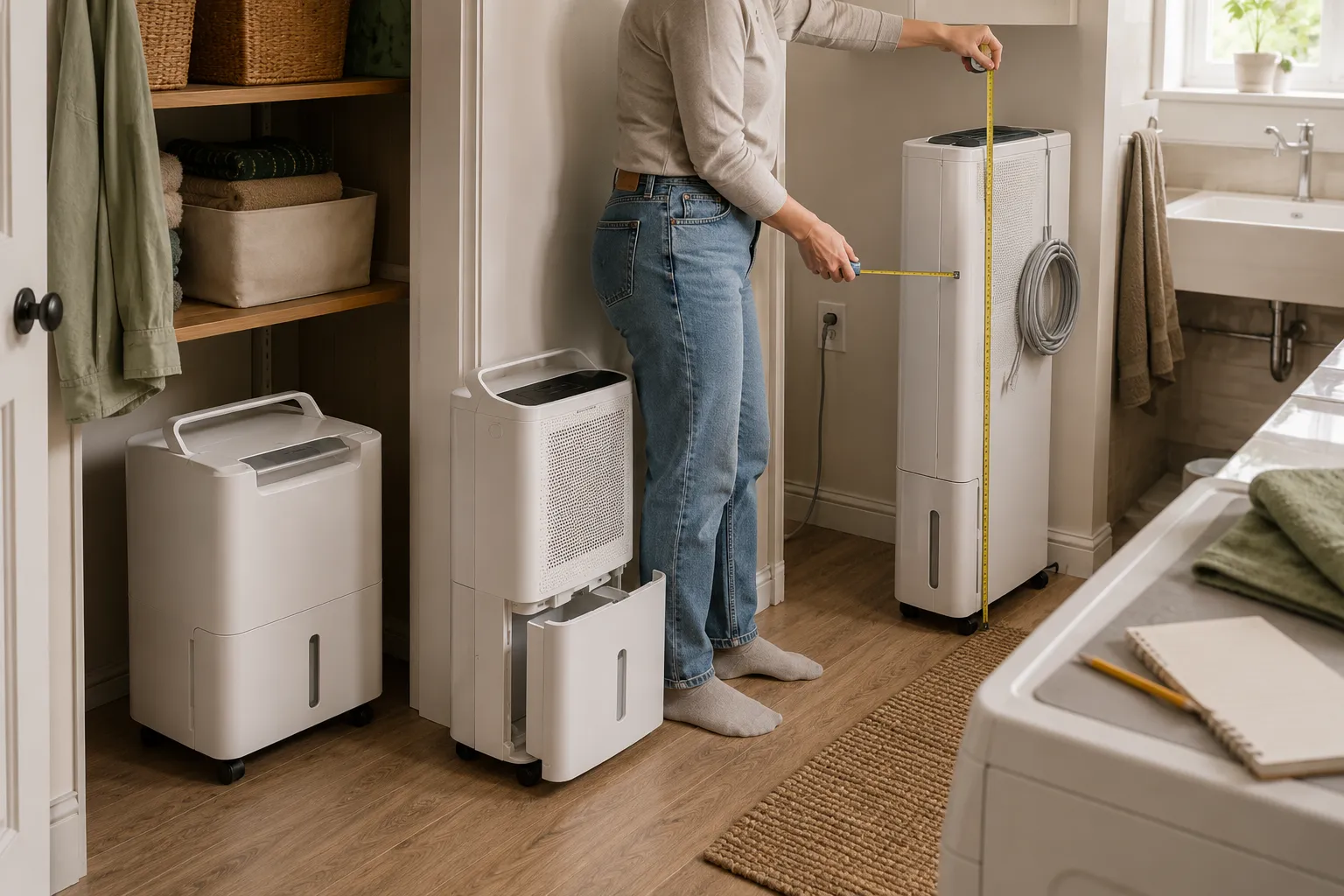
The compromise is height. At 24.1 in tall, this GE needs more room below upper cabinets and more clearance for handling than the Midea or Frigidaire. Its 11.4 in depth is still relatively shallow, but do not measure only the cabinet body: leave the manufacturer-required airflow clearance, room to remove the bucket, and space to inspect the hose connection.
Use this role when the pump path is your limiting problem and the 16 ft published distance meaningfully fits a secure route to an approved destination. Confirm the current owner manual for electrical requirements, hose setup, cleaning, and written-warranty terms before ordering.
Tank Backup and Maintenance Are Part of the Purchase
All three products need routine attention. The difference is which part is most visible:
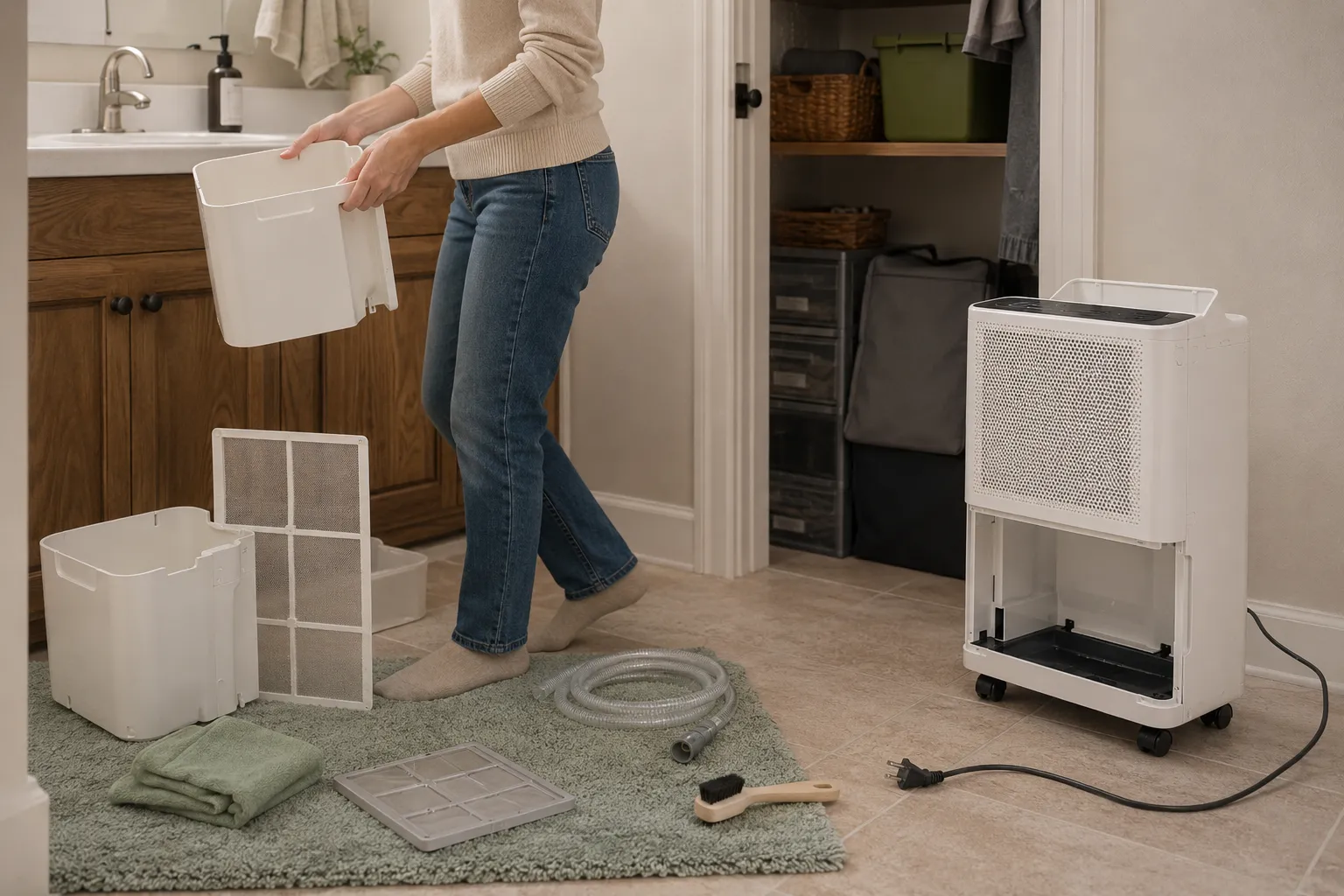
- Midea Cube: The current owner manual includes bucket-cleaning guidance. Keep the manual accessible for current filter and storage instructions.
- Frigidaire: The washable filter is a direct practical advantage, but it still needs cleaning and the bucket remains relevant if the drain route is not in use.
- GE: The filter reminder and empty-bucket alarm help make maintenance visible; they do not replace checking the filter, bucket, hose connection, and floor around the machine.
Before storage, follow the exact owner guide for emptying, cleaning, drying, and cord handling. Do not put a full bucket on a shelf or rolling cart to postpone a trip to the sink. Keep the machine level on the floor and inspect a continuous-drain route periodically for kinks, leaks, and movement.
Which Apartment Setup Fits?
| Your priority | Better starting point | Why |
|---|---|---|
| The machine must store compactly between humid periods | Midea Cube MAD50PS1QWT | Lift-and-twist body can nest down for storage |
| Shallow depth is the limiting measurement | Frigidaire FHDP5033Y1 | 9.9 in listed depth |
| You need a documented longer pump route | GE ADHE50PWF | Included hose and maker-listed drainage up to 16 ft away |
| You want an officially listed washable filter | Frigidaire FHDP5033Y1 | Washable filter listed on the current product page |
| You want a fixed published bucket number | GE ADHE50PWF | 15 pint bucket capacity listed |
| You have no safe, permitted drainage destination | None as a pump-first purchase | Use a tank-first routine or reconsider the room and placement |
Before You Buy
- Match the full model number:
MAD50PS1QWT,FHDP5033Y1, orADHE50PWF. - Confirm the drain destination and your lease or building rules before buying a pump feature.
- Measure body dimensions, airflow clearance, bucket access, hose path, outlet reach, and walking space.
- Read the live owner manual for the exact model’s pump limits, connection procedure, electrical requirements, cleaning, and storage instructions.
- Plan to empty the bucket safely even when continuous drainage is your normal workflow.
- Confirm availability, included items, replacement parts, and current warranty terms with the seller.
FAQ
Do I need a built-in pump for an apartment dehumidifier?
Only when you have a permitted drainage destination that cannot be reached by a downhill gravity hose. A pump is useful for a compatible upward route to a sink or other approved point. It is not useful when there is nowhere safe for the water to go.
Can I run a pump dehumidifier hose out a window?
Some current product pages describe a window route, including the Midea Cube and Frigidaire models in this guide. You still need to check the exact owner guide and rental rules, secure the hose, account for weather and window operation, and avoid an unsafe or leaking discharge location.
Which model is smallest for apartment storage?
The Midea Cube is the storage-first option because its lift-and-twist body can nest down between humid periods. The Frigidaire is shallower front to back, while the GE is tallest. Measure the actual constraint in your apartment rather than choosing from a single dimension.
Will a pump dehumidifier eliminate bucket emptying?
No. It can support continuous drainage only while the hose route is safely installed and working. The bucket remains the fallback for a blocked hose, a move to another room, or a setup that cannot use continuous drainage.
Bottom Line
The Midea Cube MAD50PS1QWT is the strongest starting point when nested seasonal storage is the real problem. The Frigidaire FHDP5033Y1 fits a renter who needs a shallow upright body, a washable filter, and a conventional bucket layout. The GE ADHE50PWF is the most relevant option when its documented 16 ft pump route solves a specific drainage constraint and the tall body fits the room.
The right apartment pump dehumidifier is not simply the one with the largest coverage claim or the most hands-off label. It is the one that fits the floor, has a secure and permitted water destination, keeps the hose out of the way, and still leaves you with a practical bucket-emptying plan.