For most one-person apartments and light daily loads, start with a countertop dishwasher if you can spare the measured counter space. Choose a rolling portable dishwasher when a small rack would be repeatedly insufficient and you have floor storage, a compatible faucet, and a clear route to the sink.
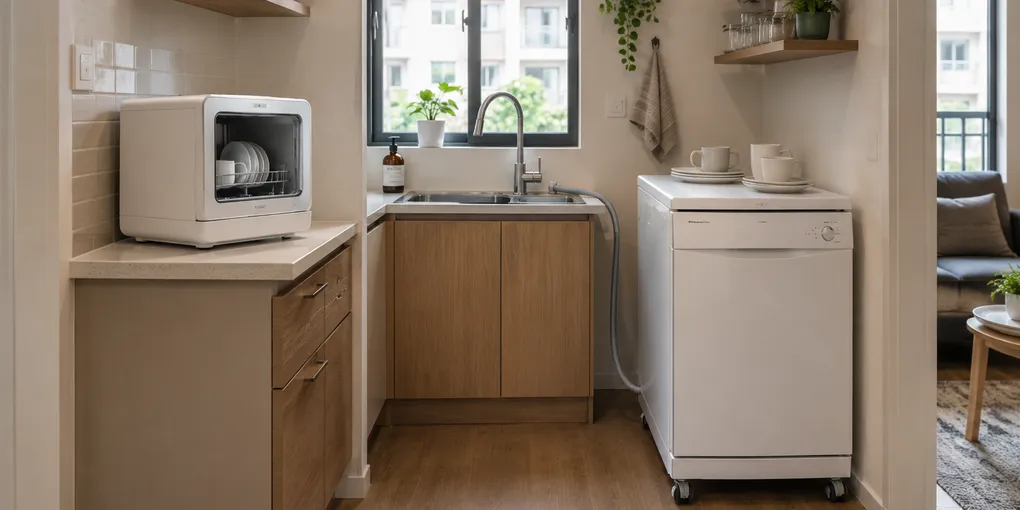
The word portable is used loosely in shopping results. In this comparison, a countertop dishwasher sits on the counter, while a portable dishwasher means a floor-standing machine on casters. Both avoid a conventional built-in installation, but they make very different demands on the kitchen.
The useful question is not which category is universally better. It is whether your limiting factor is counter space, dish volume, faucet compatibility, or the path between the machine and the sink. This guide compares current manufacturer specifications for representative models. It does not claim hands-on testing, guaranteed faucet compatibility, or that any setup is permitted by every lease.
If you are comparing countertop, rolling portable, and 18-inch built-in formats, start with the apartment-size dishwasher types and dimensions guide. This page answers the narrower purchase question: whether a countertop or rolling portable machine is the better non-built-in fit.
If your first question is whether a countertop dishwasher needs a plumbing hookup, read what a no-hookup countertop dishwasher actually requires. If you already know a countertop unit is your category, see our countertop dishwasher picks for small apartments.
If a floor-standing option would need to connect to a pull-down or pull-out faucet, check portable dishwasher pull-down faucet compatibility before you compare capacity or price.
For the narrower floor-standing category, see what to check before buying an 18-inch portable dishwasher for an apartment. It covers the floor footprint, faucet connection, storage, and current model availability separately from countertop choices.
Countertop vs Portable Dishwasher: Which Should You Buy?
| Your real constraint | Better starting category | Why |
|---|---|---|
| You live alone, have a light daily load, and cannot rely on a compatible faucet | Countertop model with a built-in tank | It can be filled manually, while still draining through its hose to a suitable nearby destination. |
| You have usable counter space and a conventional, compatible kitchen faucet | Faucet-connected countertop dishwasher | It avoids filling a tank by hand without taking floor space. |
| You regularly fill a six-place countertop machine or need room for larger meal loads | Full-size portable dishwasher on wheels | A 24-inch portable model offers much more interior capacity, but needs floor storage, faucet access, and a clear route to the sink. |
| You have no stable counter, no sensible drain route, or no lease approval | Pause the purchase | Neither category fixes an unsuitable kitchen layout or a prohibited setup. |
For many one-person apartments, a countertop machine is the realistic first category. A larger portable dishwasher earns its floor space only when the dish load is genuinely too large for a smaller unit or the counter cannot host one.
Countertop vs Portable: The Difference That Matters
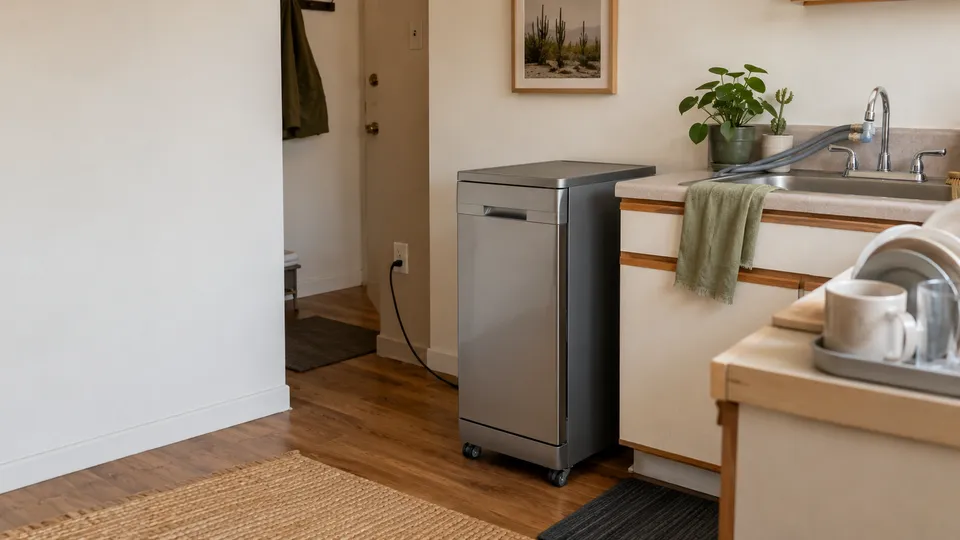
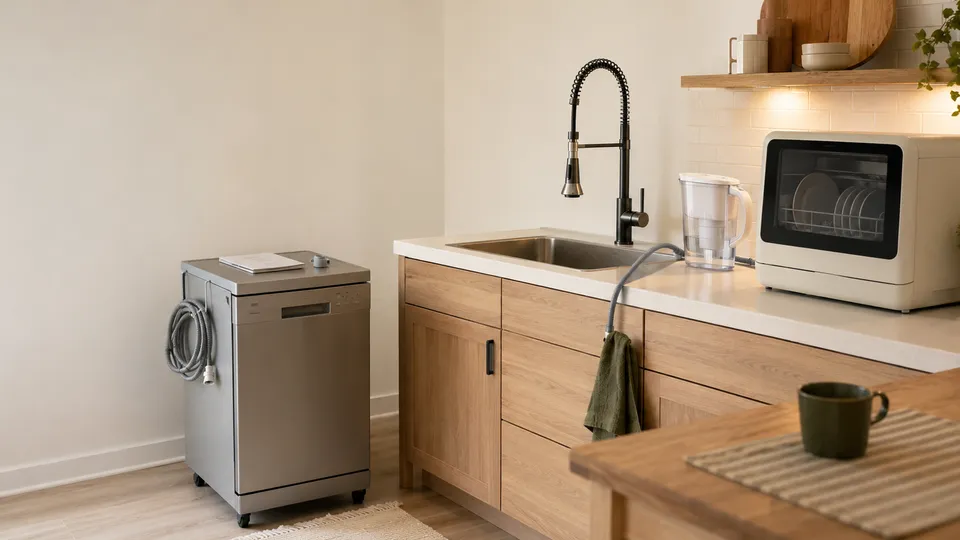
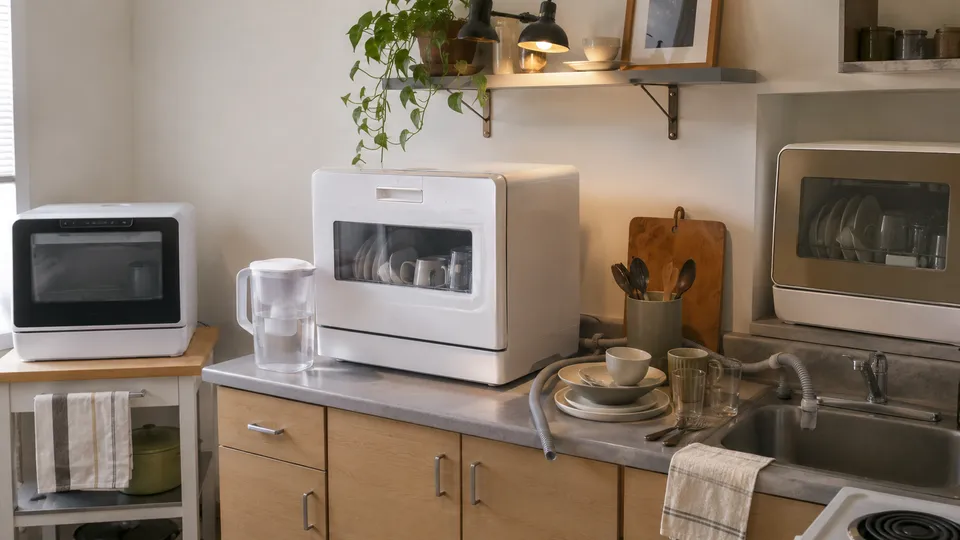
The labels are easy to confuse. In this guide, a countertop dishwasher sits on a counter and is commonly sized for a smaller daily load. A portable dishwasher is a floor-standing appliance, usually on casters, that is rolled near the sink when used. It is not a countertop model with a handle.
| Category | Representative model | Documented size and capacity | Water and drainage setup | Apartment tradeoff |
|---|---|---|---|---|
| Faucet-connected countertop | Danby DDW631SDB | 21.65 W x 20.65 D x 17.25 H in; six place settings | Danby lists a quick-connect feature compatible with most kitchen faucets; the machine uses the sink connection for its water setup. | Preserves floor space but occupies a wide, deep section of counter. |
| Built-in-tank countertop | HAVA R01 | 16.86 x 16.75 x 18.05 in; HAVA documents a light dish load rather than a place-setting figure | Built-in 5 L tank can be filled with its pitcher or an inlet hose; outlet hose drains to a sink or bucket. | Avoids depending on a faucet inlet, but manual filling is part of every cycle. |
| Full-size portable on wheels | GE GPT225SGLWW | 23.625 W x 25.375 D x 36 H in; 12 place settings | GE documents fill and drain hoses that connect to the kitchen faucet. | Much larger capacity, but it needs floor parking and a short, workable sink route. |
These are category examples, not a promise that a particular faucet, counter, floor, or lease will work with a specific model. Confirm the exact model number, current manual, available fittings, and building rules before ordering.
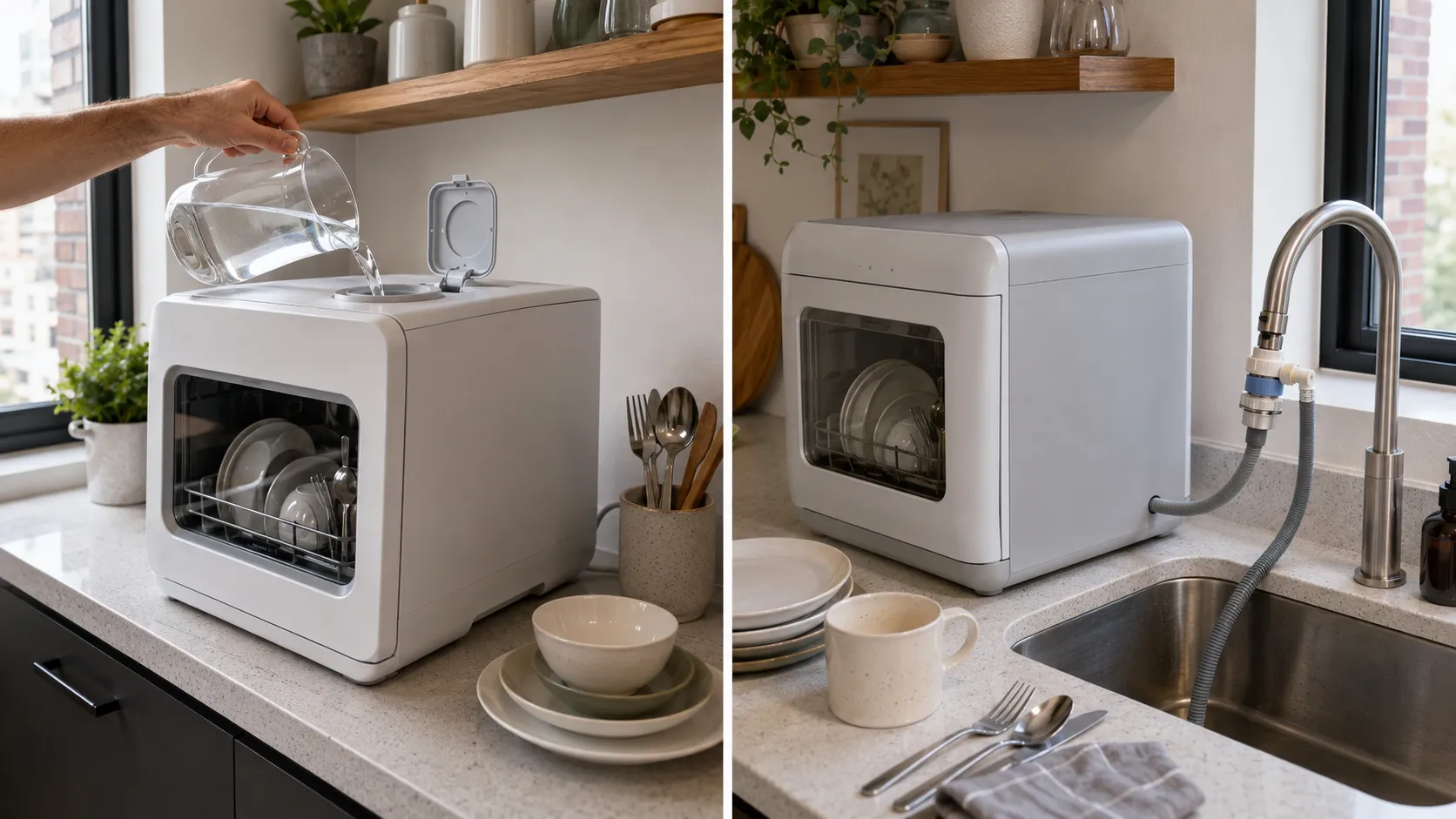
Best for a Small, Faucet-Friendly Counter: Danby DDW631SDB
The Danby DDW631SDB represents the conventional faucet-connected countertop route. Danby lists six place settings, a stated quick-connect feature compatible with most kitchen faucets, and dimensions of 21.65 W x 20.65 D x 17.25 H in. Its normal cycle is listed at up to 3.1 gallons of water.
This category works when the counter is actually available. A 21.65-inch-wide body is not a small accessory; it needs a stable surface, space to open the door, room to move dishes between the sink and rack, and clearance under upper cabinets. It also needs a faucet whose aerator and shape work with the supplied connector. “Most kitchen faucets” is not the same as every pull-down, pull-out, spray, or specialty faucet.
Choose this type when manual tank filling would become a daily irritation and you can leave a measured section of counter close to the sink. It is not the better choice merely because it carries more than a tank model. A counter that becomes unusable for food preparation is still a poor apartment outcome.
Best When the Faucet Is the Constraint: HAVA R01
The HAVA R01 is the clearer example of why a built-in water tank is a separate category. HAVA lists the unit at 16.86 x 16.75 x 18.05 in, with a built-in 5 L tank. The company says the tank can be filled with the supplied pitcher or through the faucet inlet, while its outlet hose can drain to a sink or bucket.
That flexibility is valuable for a one-person apartment where the kitchen has an incompatible faucet or the renter does not want to attach a connector for each cycle. It does not make the appliance independent of the sink. You still need to carry water to the machine, guide wastewater through the drain hose, and keep the unit near an accessible outlet.
HAVA’s documented rack guidance is a light everyday collection of plates, bowls, cups, and cutlery. That is a realistic fit for one person running regular smaller loads. Large frying pans, cutting boards, and oversized cookware are the point where a compact countertop interior becomes restrictive. For a product-specific tank comparison, see countertop dishwashers with built-in water tanks for apartments.
Best When Capacity Is the Actual Problem: GE GPT225SGLWW
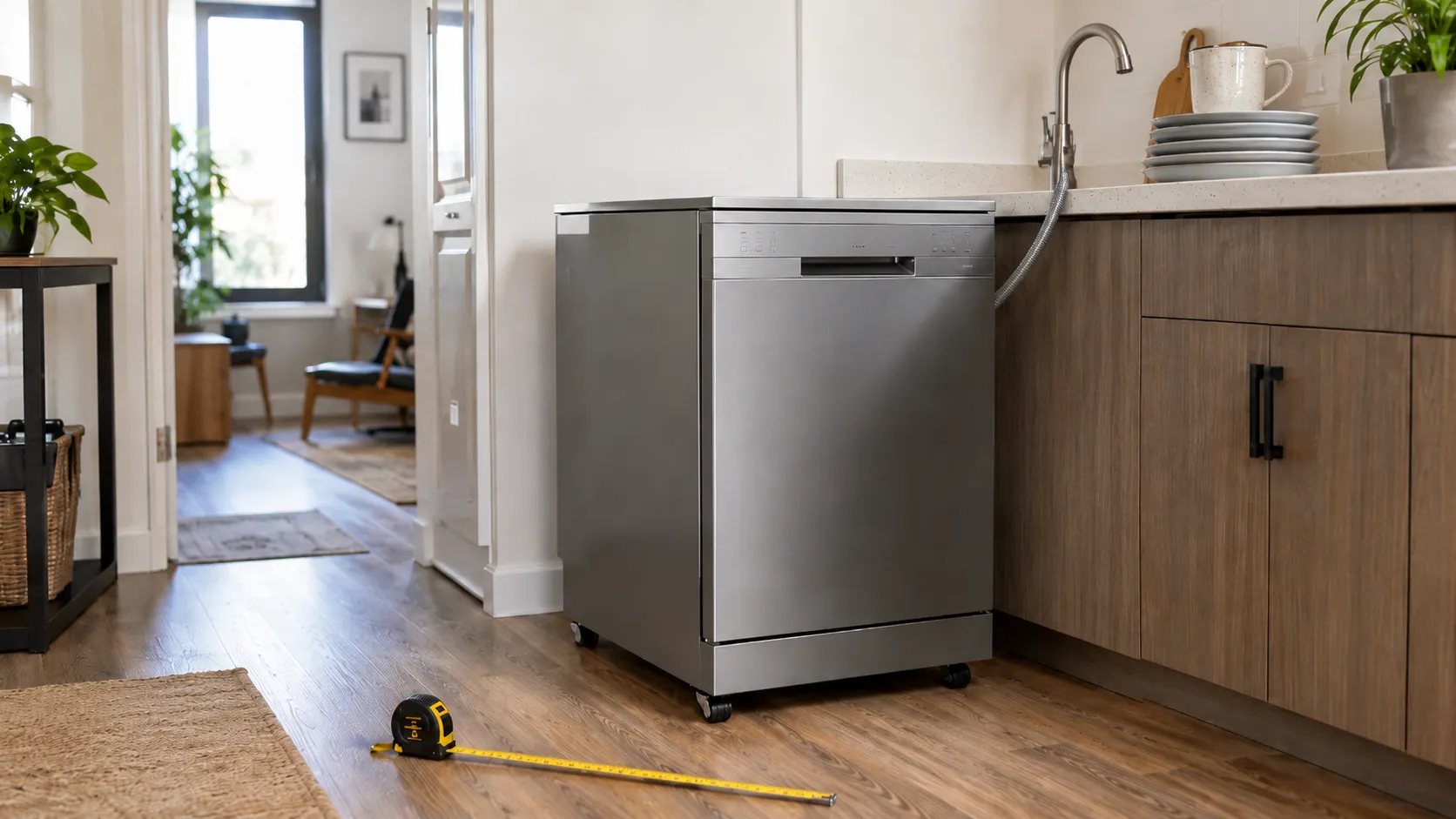
The GE GPT225SGLWW shows what changes when you move up to a full-size portable dishwasher. GE lists it as a 24-inch portable model with 12 place settings and dimensions of 23.625 W x 25.375 D x 36 H in. That is a very different apartment commitment from a counter unit: it takes nearly 26 inches of floor depth wherever it is stored.
It is still not a no-water solution. GE documents fill and drain hoses that extend about 35 inches to connect to the kitchen faucet. In practical terms, that means the portable machine must roll close enough to the sink, the faucet must accept its connection, and the hose route must stay controlled while the machine operates. Casters make storage and positioning easier; they do not remove those supply and drainage requirements.
This category makes sense when you consistently create enough dishes that a smaller machine would run too often, or when a full counter cannot be sacrificed. For a one-person household with a light daily load, the added floor footprint can be disproportionate. For two people who cook often, or one person who batches several meals and dishes before washing, the larger capacity can be the more workable tradeoff.
The One-Person Apartment Test
“One person” is a useful decision factor, but it is not a product category or a keyword that needs its own article. Two one-person homes can create radically different dish loads.
Start with your last three ordinary days rather than the maximum number of dishes that could fit in a rack:
- A mug, bowl, plate, glass, and cutlery each day: a compact tank model may be enough, provided the fill-and-drain routine is acceptable.
- Regular cooking with several plates, pans, and meal-prep containers: a faucet-connected countertop model may reduce the number of cycles, but only if the counter and faucet work.
- Several days of dishes, frequent guests, or a routine that regularly fills a six-place machine: a portable model becomes worth measuring for, not automatically worth buying.
Do not choose the largest appliance as insurance against an occasional heavy week. The machine has to fit and operate comfortably every day. A smaller dishwasher used frequently is more useful than a larger one that blocks a kitchen path or cannot be connected safely.
Rental and Setup Checks Before You Buy
Both categories are easier than a built-in installation, but neither should be treated as plug-and-play. Check these points against the exact manual and your rental rules:
| Check | Countertop model | Full-size portable model |
|---|---|---|
| Working location | Stable, level counter with room for the body, door, and dish transfer | Level floor space plus a storage location when not in use |
| Water supply | Built-in tank or a faucet connector, depending on the model | Usually a faucet connection; wheels do not replace it |
| Drainage | Hose must reach the sink or another manufacturer-approved destination | Fill and drain hoses must reach the kitchen faucet/sink area without strain |
| Electrical access | Nearby suitable outlet, kept clear of water and hoses | Same requirement, plus a practical route from the parked location |
| Rental permission | Check lease and building rules before changing fittings or relying on a temporary setup | Check the same rules; the larger machine may also affect floor, storage, and access expectations |
Avoid improvising permanent plumbing, forcing an adapter, or routing a hose where it can kink, create a trip risk, or be knocked loose. A product listing cannot verify your counter construction, faucet style, lease, or the path through your own kitchen.
Which One Should You Choose?
Choose a built-in-tank countertop dishwasher when the faucet is the main problem and your normal load is modest. Choose a faucet-connected countertop dishwasher when the counter is available, the faucet is compatible, and you want to avoid filling water manually. Move to a full-size portable dishwasher only when capacity is the reason, you can store a 24-inch-deep appliance, and the sink connection works within the model’s stated hose reach.
Before comparing individual products, measure the counter or floor location, the cabinet clearance, the distance to the faucet, and the actual door-opening space. For a focused checklist on tank models and drainage, return to the no-hookup countertop dishwasher guide.
FAQ
Is a portable dishwasher better than a countertop dishwasher for an apartment?
Not automatically. A portable dishwasher offers much more capacity, but it takes floor space and typically still connects to the kitchen faucet. A countertop unit is better when floor space is scarce and the dish load is modest; a portable model is better when capacity outweighs its storage and connection demands.
Do portable dishwashers on wheels need a water hookup?
They generally avoid a permanent built-in installation, but the GE GPT225SGLWW example still uses fill and drain hoses that connect to the kitchen faucet. Check the exact manual for the model you are considering rather than assuming that wheels mean no connection is needed.
Is a countertop dishwasher enough for one person?
Often, yes, when the person has a light everyday dish load and accepts the size limits for pans and oversized items. The better decision comes from tracking your actual dish routine, counter space, and faucet or drainage options, not from the number of residents alone.