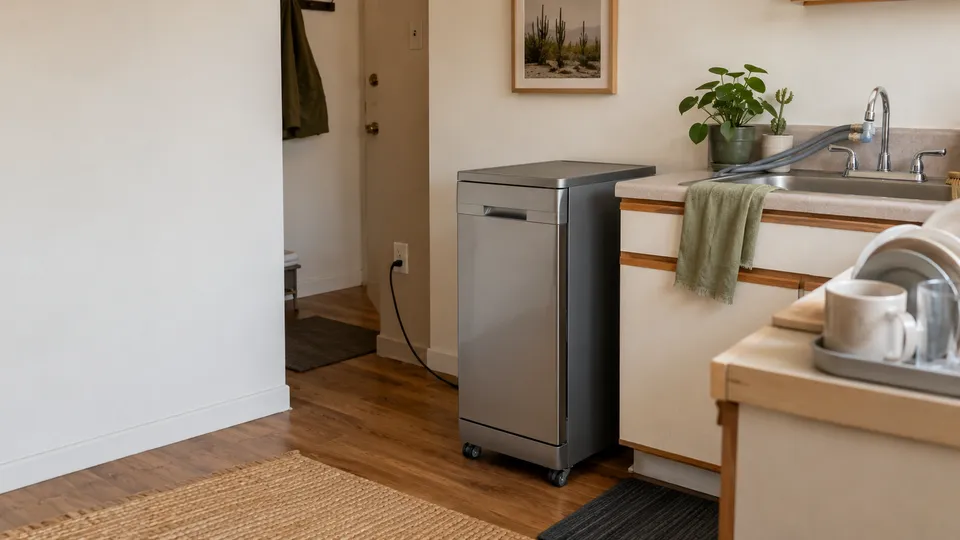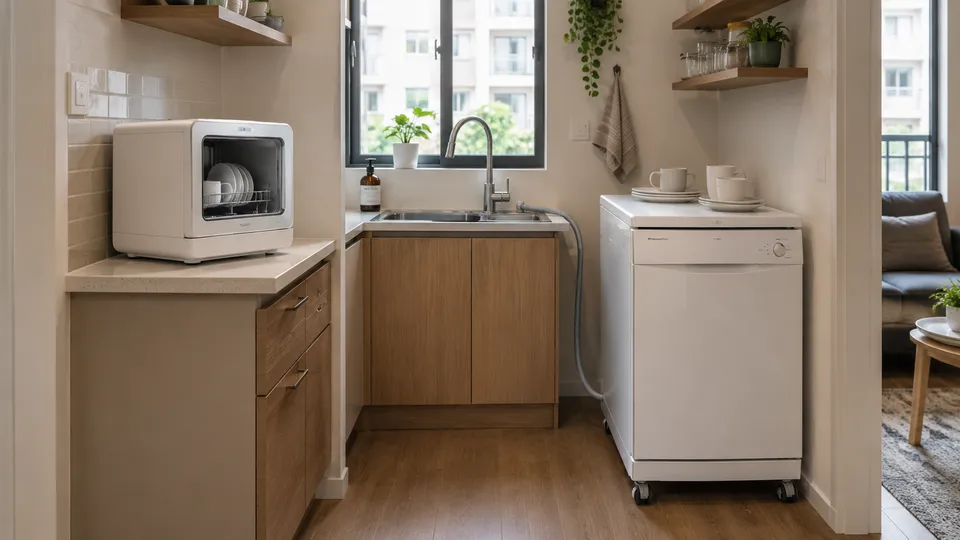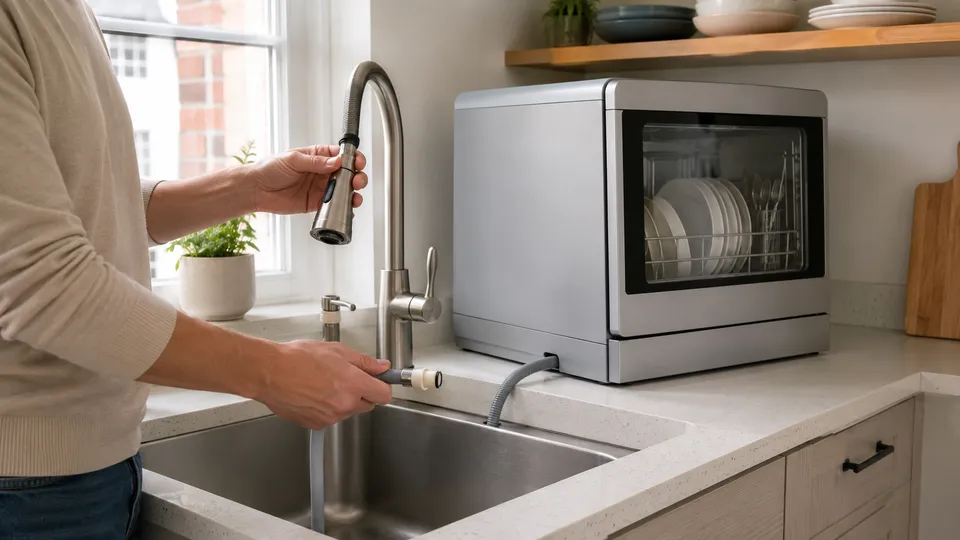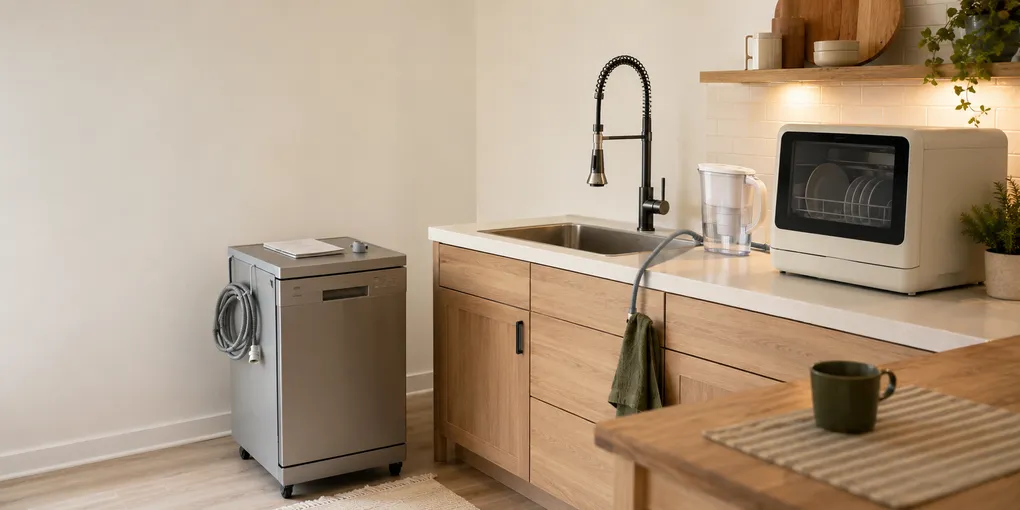
A floor-standing portable dishwasher can make sense when a countertop model is too small. But its temporary water connection is not automatically compatible with a pull-down or pull-out faucet.
That distinction matters before you buy. A product page may say a dishwasher has a quick-connect hose or works with most kitchen faucets. That is not the same as confirming that it works with your faucet, especially when the spray head pulls out on a hose.
This guide is about the compatibility decision, not a plumbing workaround. Check the manuals for both appliances before ordering, and do not treat a generic adapter listing as approval to connect them.
Quick Answer
Do not assume a portable dishwasher can connect to a pull-down faucet.
- A pull-down or pull-out faucet has a movable spray hose and a different connection arrangement from a fixed standard faucet.
- Delta’s published faucet guidance says that its pull-down and pull-out kitchen faucets should not be connected to a portable dishwasher because pressure changes during operation can rupture the hose.
- That is Delta-specific guidance, not a universal rule for every faucet brand. It is still a clear reason to verify the exact dishwasher and faucet documentation rather than relying on an adapter’s product title.
- A built-in-water-tank countertop dishwasher avoids the faucet inlet question, but it still needs a safe drainage route and enough space for manual filling.
If your faucet documentation does not clearly support the connection, treat that as a no for now. A dishwasher that needs an uncertain connection is not a renter-friendly purchase.
Why a Portable Dishwasher Is Different From a Water-Tank Countertop Model
The word “portable” covers two very different apartment setups.
| Type | Where it sits | How it gets water | What pull-down faucets change |
|---|---|---|---|
| Countertop dishwasher with a built-in tank | On the counter | You fill its internal tank manually | It does not need a faucet inlet, though it still drains to a sink or other approved drain point. |
| Faucet-connected countertop dishwasher | On the counter | A hose connects temporarily to a faucet | The faucet and adapter must be compatible. |
| Floor-standing portable dishwasher | Rolls beside the sink | A hose usually connects temporarily to a faucet | The same compatibility question applies, with more floor space and door-clearance requirements. |
For a broader comparison of counter space, capacity, and apartment routines, see countertop vs portable dishwashers for apartments. The decision here is narrower: whether the faucet connection itself is documented as suitable.
An 18-inch-wide floor-standing portable model has the same connection question; its narrower width only changes floor space and capacity. See the 18-inch portable dishwasher apartment guide for the measured-space checks that come after faucet compatibility.
What the Manufacturer Language Actually Tells You
Two phrases are easy to overread: “quick connect” and “most kitchen faucets.”
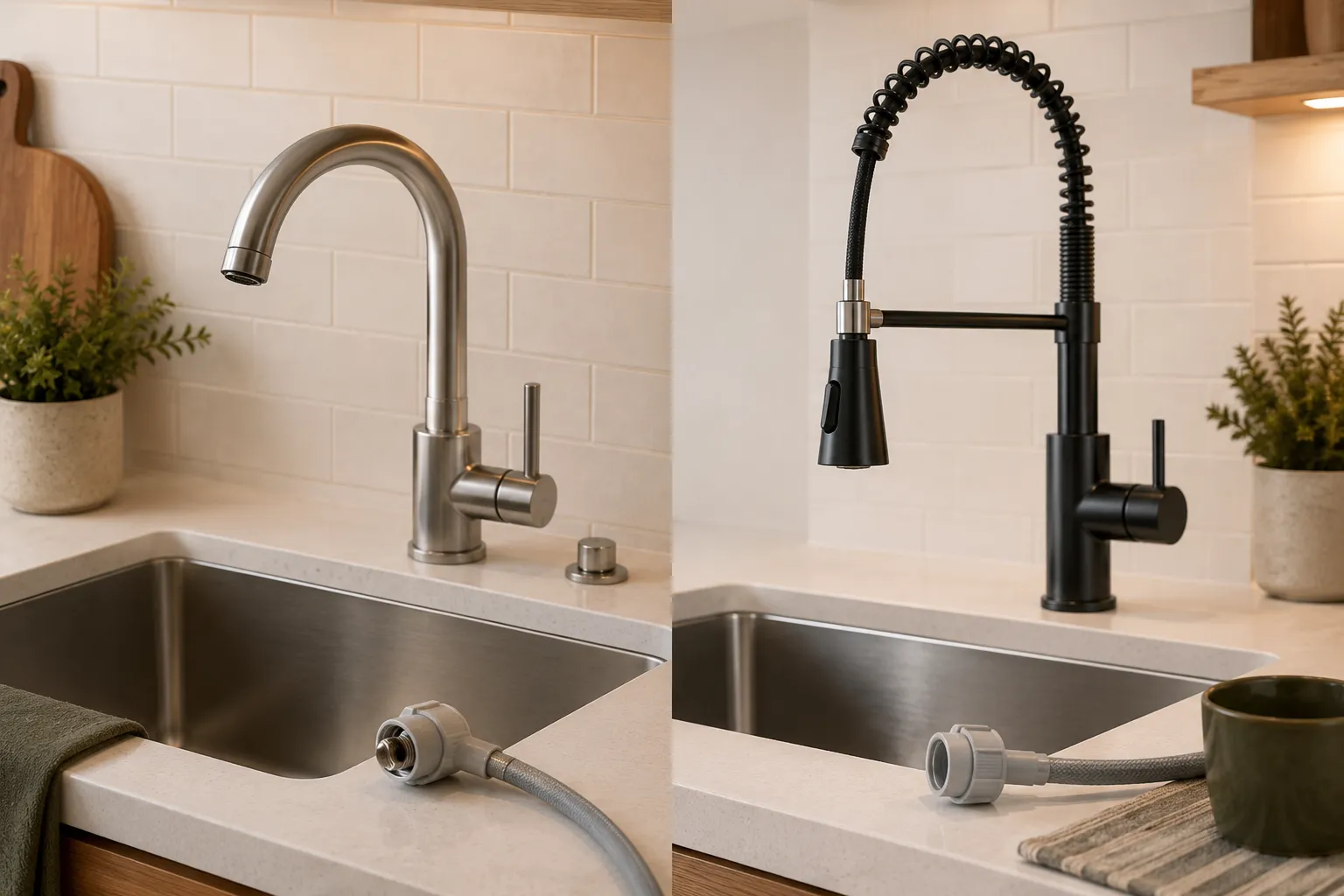
For example, Danby’s DDW1805EWP product page describes its quick-connect feature as compatible with most kitchen faucets. Its support guidance also says its dishwasher faucet adapters are designed for standard North American faucets.
That can be useful when you have a conventional fixed faucet with the required connection. It does not confirm compatibility with a pull-down or pull-out design. A pull-down faucet’s hose, spray head, aerator setup, and pressure limits are separate questions.
Delta is unusually direct on this point: its own guidance warns against connecting a portable dishwasher to its pull-down or pull-out faucets. The practical lesson is not that every brand has the exact same rule. It is that a dishwasher manual’s broad quick-connect claim cannot override the faucet maker’s instructions.
Four Checks to Make Before Buying
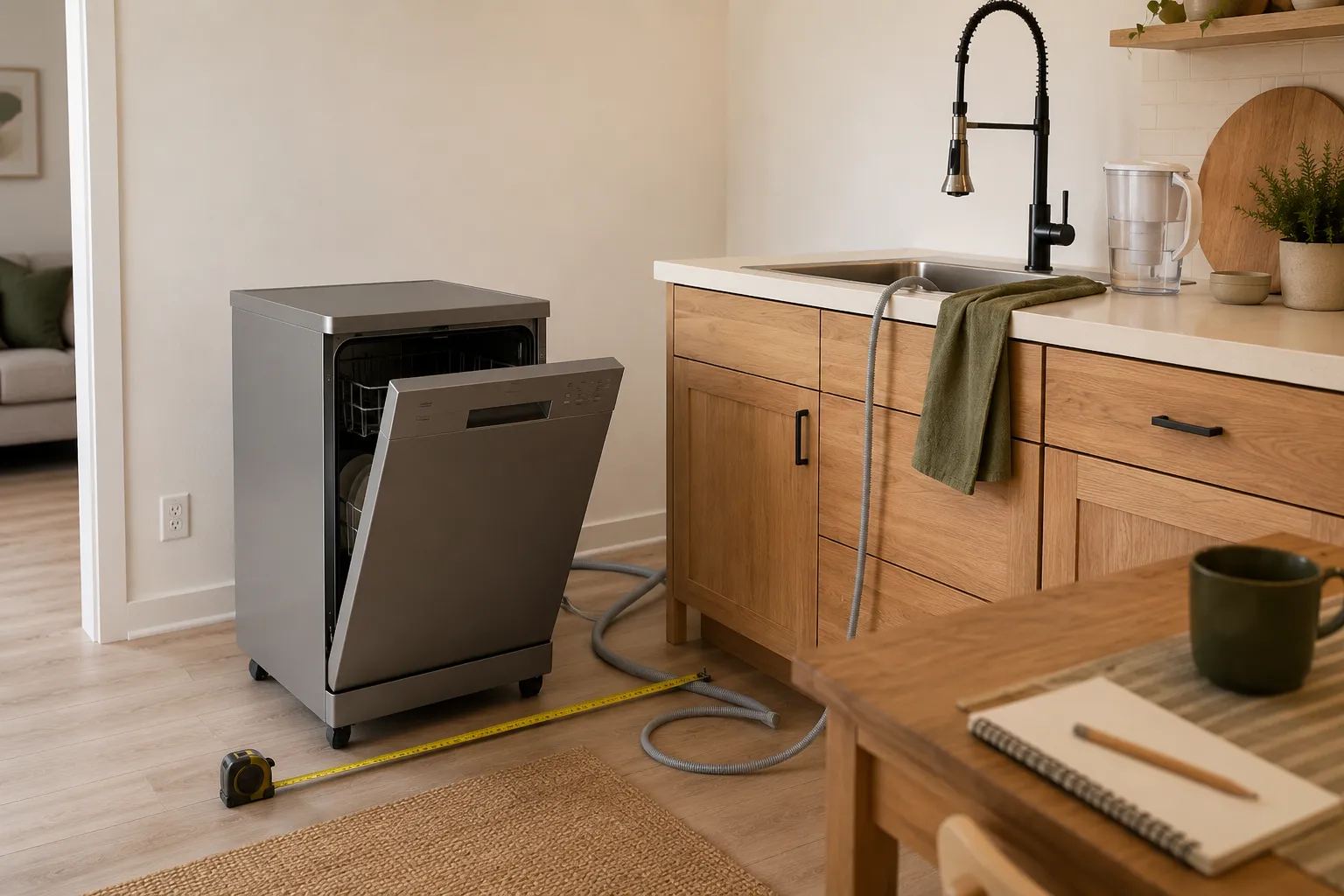
1. Find the exact dishwasher manual, not just a retailer listing
Look for the model’s installation or use-and-care manual. Confirm whether the machine requires a temporary faucet connection, what type of faucet connection it describes, and whether the manufacturer lists restrictions.
Do not make a decision from a listing photo that happens to show an adapter. Retailer pages can be incomplete, and a connector pictured with one faucet does not establish compatibility with another.
2. Check the faucet manufacturer’s documentation
Search the faucet brand and exact model number together with terms such as “portable dishwasher,” “pull-down,” and “appliance connection.” If the faucet maker says the appliance should not be connected, that is the answer to follow.
This is especially important when your faucet has a retractable spray head, a hidden aerator, a touch control, or a proprietary hose assembly. Those features may be convenient for washing dishes by hand but can make temporary appliance connections unsuitable.
3. Treat an adapter as a part, not proof
An adapter can only solve a limited mechanical fit question. It does not establish that the faucet can handle the operating conditions or that the hose arrangement is approved.
Avoid buying a “universal” adapter before you have both manuals in hand. Do not force a fitting, alter the faucet, or improvise a connection. Those approaches can damage equipment, create leaks, and be a poor fit for a rental.
4. Confirm the rest of the kitchen setup too
Even an approved faucet connection is only one part of the decision. Check:
- Floor space beside the sink, including the machine’s door swing.
- A clear route for the inlet and drain hoses without pinching or sharp bends.
- Whether the sink can remain usable during the wash cycle.
- A properly located electrical outlet. Do not plan around an extension cord when the appliance instructions say not to use one.
- Rental rules and who is responsible if a hose or connection leaks.
For an overview of these countertop and drainage constraints, read do countertop dishwashers need a water hookup?.
Why “It Fits” Is Not Enough
It is tempting to test only whether an adapter screws onto the faucet. That is not a complete compatibility check.
A portable dishwasher uses water under operating pressure and needs a stable connection for a full wash cycle. Pull-down and pull-out faucets are designed around a moving hose and spray head. A connection that seems secure for a moment may still be unsupported by the faucet manufacturer or poorly suited to the appliance’s use.
This is also why online comments are not a reliable approval process. Another renter’s faucet may be a different brand, model, aerator style, or age. Their setup may work temporarily while still falling outside the documentation for yours.
When a Water-Tank Countertop Dishwasher Is the Better Choice
If you want dishwasher help but cannot document faucet compatibility, a water-tank model is often the cleaner apartment decision.
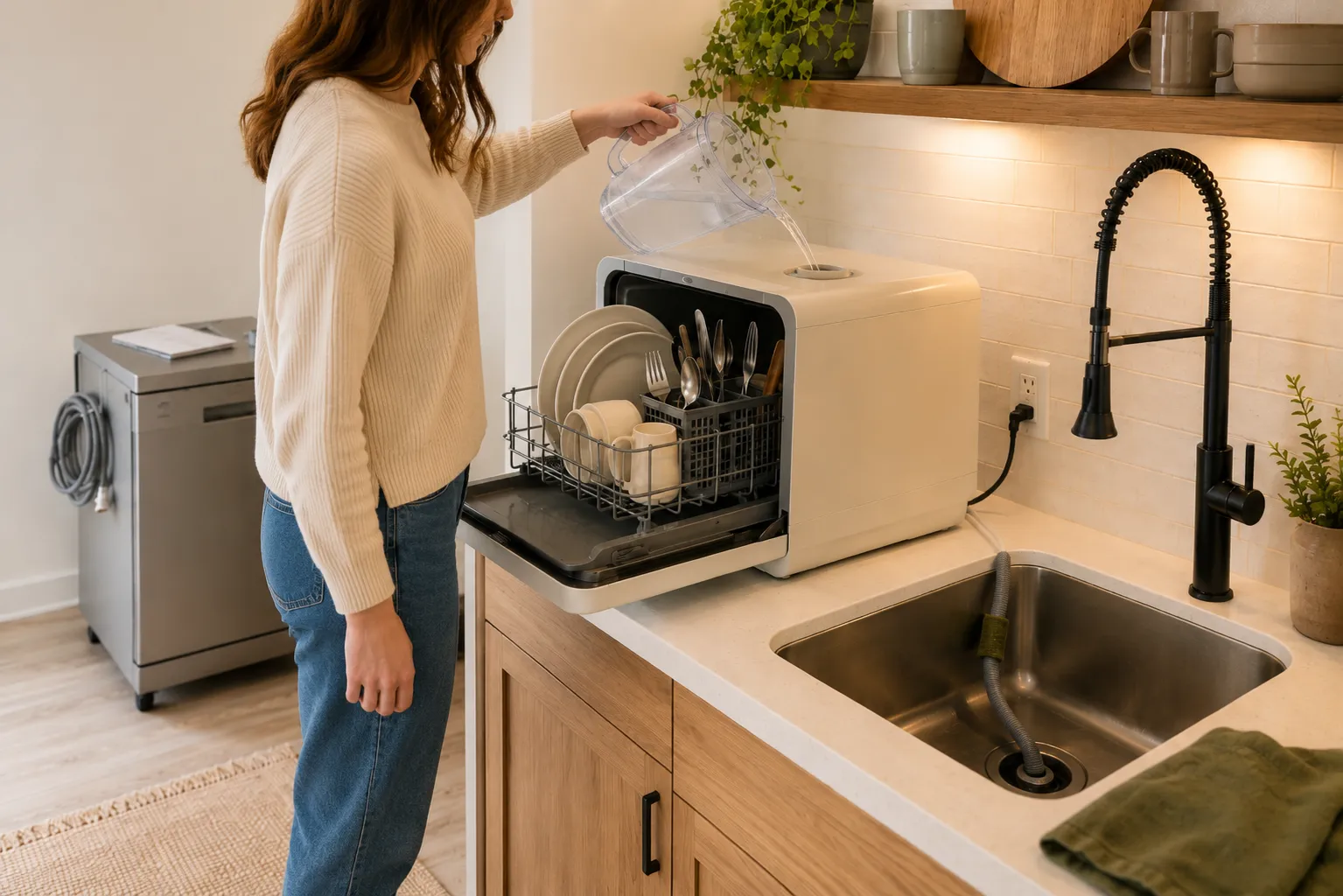
You manually add water to the machine’s internal reservoir, so the machine does not need to attach to the faucet for its water supply. It still needs a proper drain-hose route and realistic counter space, but it avoids the uncertain pull-down-faucet connection.
Start with the best countertop dishwashers with built-in water tanks for apartments if that setup sounds closer to your kitchen. These models are generally better for a one-person routine with plates, cups, cutlery, and smaller cookware than for large pans or a full family’s dishes.
If the issue is simply that your current faucet does not work, buying a larger portable dishwasher is not automatically the solution. It may increase capacity, but it does not remove the need to verify the inlet connection.
A Practical Decision Path for Renters
| Your situation | Sensible next step |
|---|---|
| You have a fixed faucet and both manuals clearly support the connection | Confirm space, drainage, outlet location, and rental rules before choosing a portable model. |
| You have a pull-down or pull-out faucet and documentation says no | Do not look for a workaround. Compare water-tank countertop models instead. |
| You have a pull-down faucet but cannot find an explicit answer | Treat compatibility as unconfirmed. Ask the faucet or dishwasher manufacturer before buying, or choose a no-faucet-inlet alternative. |
| You need more capacity than a countertop model offers | Solve the faucet compatibility and floor-space questions first; capacity alone does not make a portable model suitable. |
| You are considering a permanent plumbing change in a rental | Pause and get written landlord approval and advice from a qualified installer. This is not a temporary-appliance setup to improvise. |
The point is to avoid turning a dishwasher purchase into a sink-fixture project. A smaller machine that fits your actual kitchen routine is better than a larger one that starts with an unsupported connection.
Frequently Asked Questions
Can I use a portable dishwasher with a pull-down faucet?
Only if the exact dishwasher and faucet documentation supports it. Do not assume it will work. Delta, for example, says its pull-down and pull-out faucets should not be connected to a portable dishwasher. Other brands may have different documentation, so check the exact models.
Will a dishwasher faucet adapter make a pull-down faucet compatible?
Not by itself. An adapter may address thread fit, but it does not override the faucet maker’s restrictions or confirm that the moving hose and spray-head assembly are suitable for dishwasher use.
Does an 18-inch portable dishwasher avoid this issue?
No. The physical size changes capacity and floor-space needs, not the water-connection requirement. For instance, Danby’s 18-inch DDW1805EWP uses a quick-connect approach for most kitchen faucets, which still requires you to confirm your particular faucet is an appropriate standard-faucet match.
Does a portable dishwasher mean no hookup is needed?
Not usually. A floor-standing portable dishwasher is movable, but it generally still needs temporary water and drain connections for each cycle. A built-in-water-tank countertop dishwasher is the category to consider when you want to avoid a faucet inlet.
What should I do if I rent and the faucet is incompatible?
Choose a water-tank countertop option, wait until you have a compatible kitchen, or get clear written approval before considering permanent changes. Do not force a temporary connection that the manufacturer does not support.
The Bottom Line
A pull-down faucet is not a detail to sort out after buying a portable dishwasher. It is a purchase constraint.
Read the exact dishwasher and faucet documentation first. If either side does not support the connection, skip the adapter hunt and compare a small-apartment countertop dishwasher or a built-in-water-tank model instead. That keeps the decision focused on a setup you can safely use and realistically maintain.