The best countertop dishwasher with a water tank depends on the routine you want to repeat. The HAVA R01 is the clearest starting point for most manual-fill setups, the HAVA R09 adds a water softener and more cycle options, and the Midea MDC17P0ABB is a shorter but heavier alternative whose current availability needs to be confirmed.
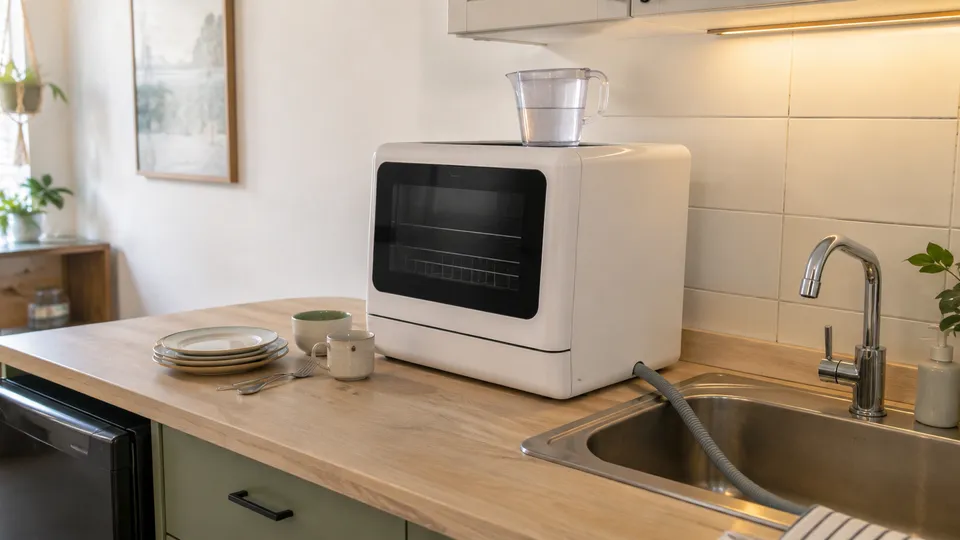
These portable countertop dishwashers let you fill their built-in tanks instead of connecting an inlet hose for every cycle. That can solve an incompatible apartment faucet, but it does not make the appliance sink-free. Every model still needs a secure drain-hose route, a stable counter near an outlet, and enough working clearance to fill the tank and load dishes.
The models below were selected for their documented built-in tank, current manufacturer specifications, and a clear role in a small apartment. This is not hands-on testing, a medical or safety certification, or a promise that every faucet, counter, lease, or dish load will work the same way.
Which Water-Tank Countertop Dishwasher Should You Buy?
| Need | Pick | Why it fits |
|---|---|---|
| Best starting point for a manual-fill setup | HAVA R01 Compact Countertop Dishwasher | Built-in 5 L tank, supplied pitcher, optional faucet inlet, and a compact documented footprint |
| Best for hard-water features and more cycle options | HAVA R09 Compact Countertop Dishwasher | Built-in 5 L tank, integrated water softener, seven cycles, and an optional faucet inlet |
| Documented compact alternative, subject to current availability | Midea MDC17P0ABB | Built-in 5 L tank, pitcher and hoses included, and listed dimensions under 18 in in each direction |
For most renters, the R01 is the simplest place to start because its role is easy to understand: fill the tank, secure the drain hose, and run smaller daily loads. Choose the R09 only when its softener or additional programs solve a real need. Treat the Midea as a specification-backed alternative rather than an automatic recommendation until the exact model is available from a seller you trust.
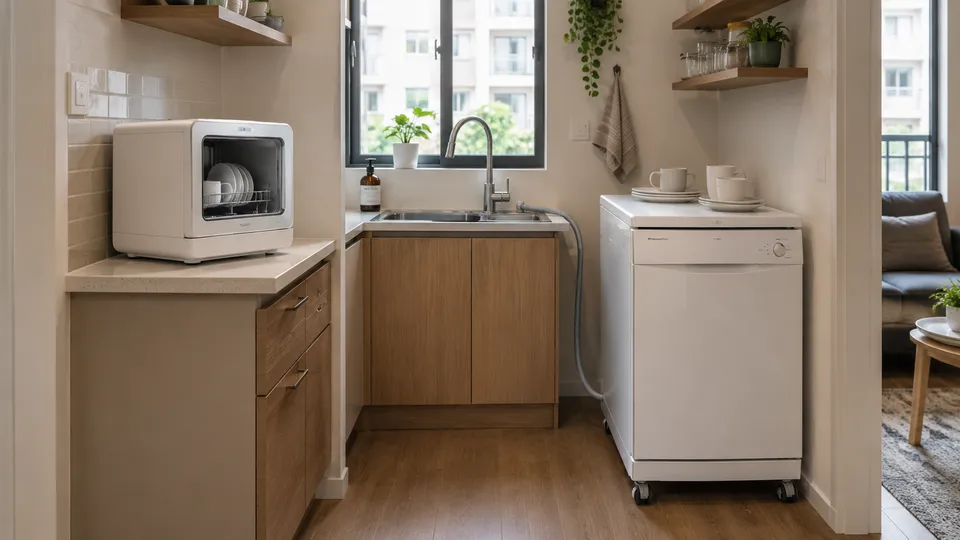
For the wider choice between this counter format, an 18-inch portable dishwasher, and an 18-inch built-in machine, see how apartment-size dishwasher formats differ. Before buying any manual-fill model, also review what a no-hookup countertop dishwasher actually requires. Those guides cover category and installation questions; this page focuses on choosing among documented water-tank models.
Product availability, model revisions, regional versions, and included fittings can change. Check the exact model number, current manual, seller, and rental rules before buying. A water tank avoids a faucet inlet connection; it does not remove the drainage requirement.
Who Should Choose a Built-In Water Tank?
Choose this category when the biggest constraint is the water inlet, not the entire kitchen. A tank model can make sense when:
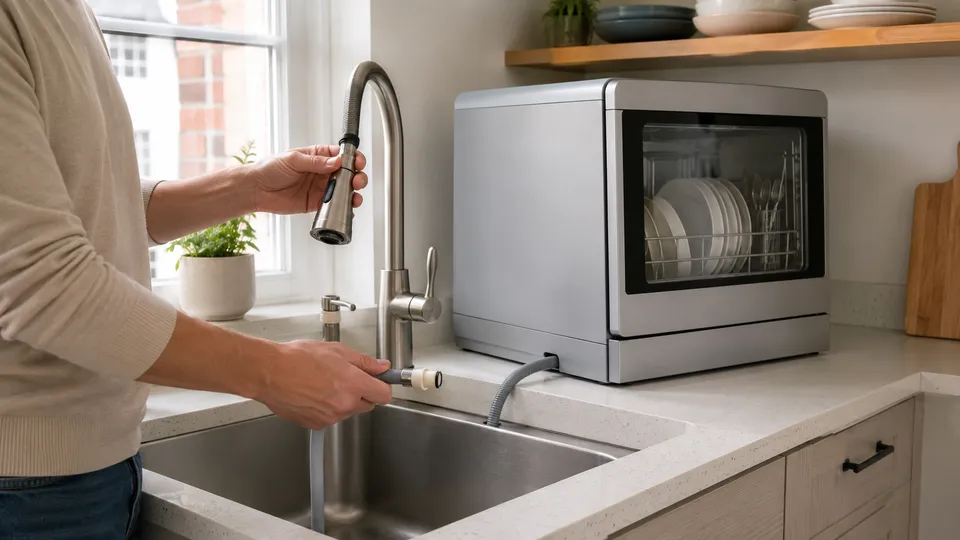
- Your faucet has a pull-down, pull-out, spray, or unusual aerator that may not accept a quick-connect adapter.
- You want to fill a stated amount of water with a pitcher instead of connecting the faucet for every cycle.
- You have a measured counter location near a usable sink and an accessible outlet.
- Your normal load is everyday plates, bowls, mugs, glasses, and utensils rather than oversized cookware.
If a pull-down or pull-out faucet is the reason you are considering this category, first read how to check countertop dishwasher faucet compatibility. A generic adapter listing does not confirm that your exact faucet and dishwasher connector will work together.
For the separate question of a floor-standing portable dishwasher, see whether a portable dishwasher can work with a pull-down faucet. The water connection, hose arrangement, and floor-space requirements are different from a countertop water-tank setup.
Skip the category when there is no reliable drain route, no stable counter, or no room for an open door and dish transfer. A 5 L tank does not make a dishwasher portable in the sense of using it anywhere in the apartment. Dirty water still needs a destination permitted by the manufacturer.
What Matters More Than the Tank Size
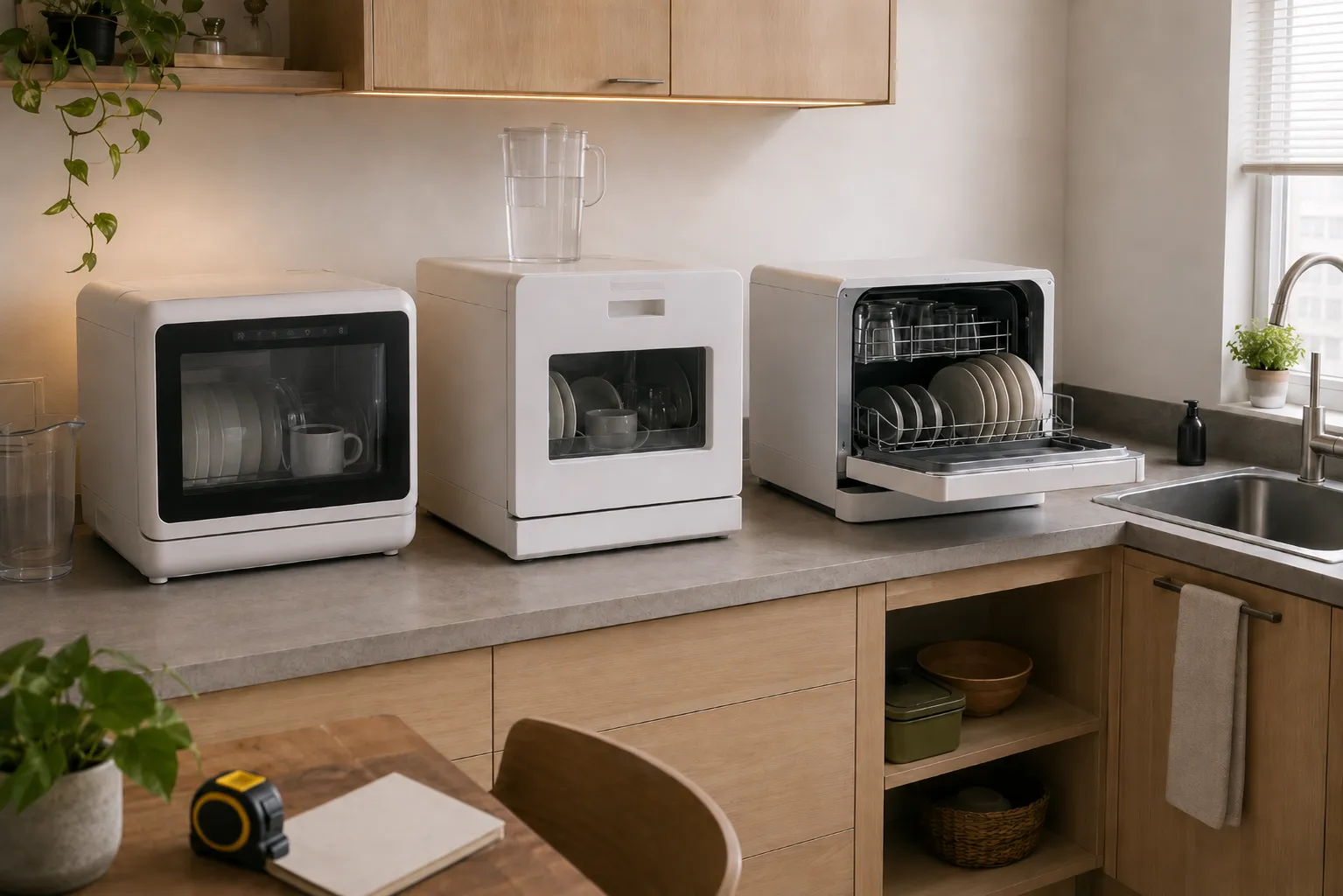
Most of the products in this category use a 5 L tank. That number alone does not decide which one fits your kitchen. Compare the complete working setup instead.
| Check | Why it matters |
|---|---|
| External width, depth, and height | The unit must sit fully on the counter and clear upper cabinets. |
| Empty weight plus water and dishes | The counter supports more than the empty appliance weight. |
| Fill method | A top opening, supplied pitcher, or optional faucet inlet changes the daily routine. |
| Drain-hose route | The hose needs to reach a sink or another manufacturer-approved destination without kinks or a walkway hazard. |
| Rack and dish guidance | Plate diameter, bowl shape, and cookware often matter more than a place-setting label. |
| Current availability | A fully documented model is not a useful immediate purchase option if the exact version is not currently available. |
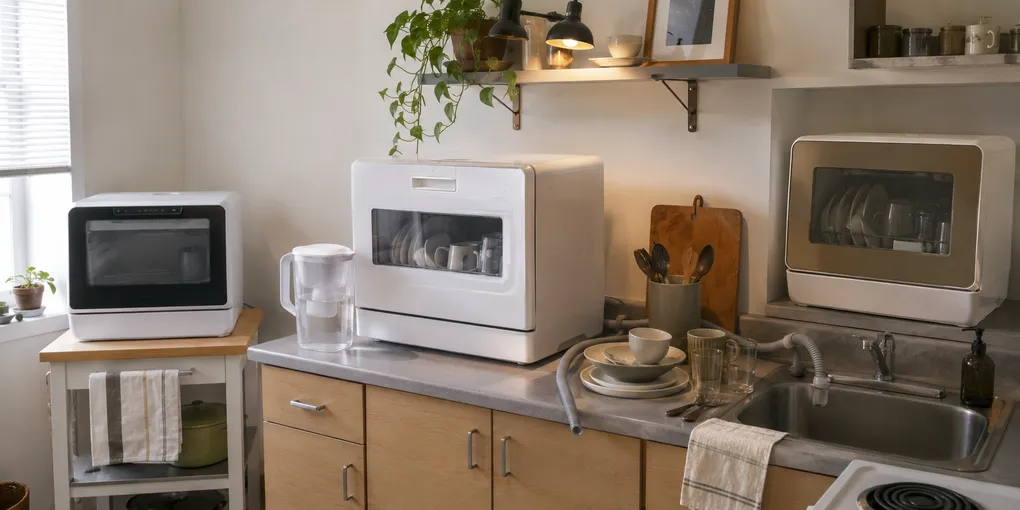
For a wider comparison that includes faucet-connected countertop machines and a floor-standing portable alternative, see the best countertop dishwashers for small apartments.
Best Starting Point for a Manual-Fill Setup: HAVA R01
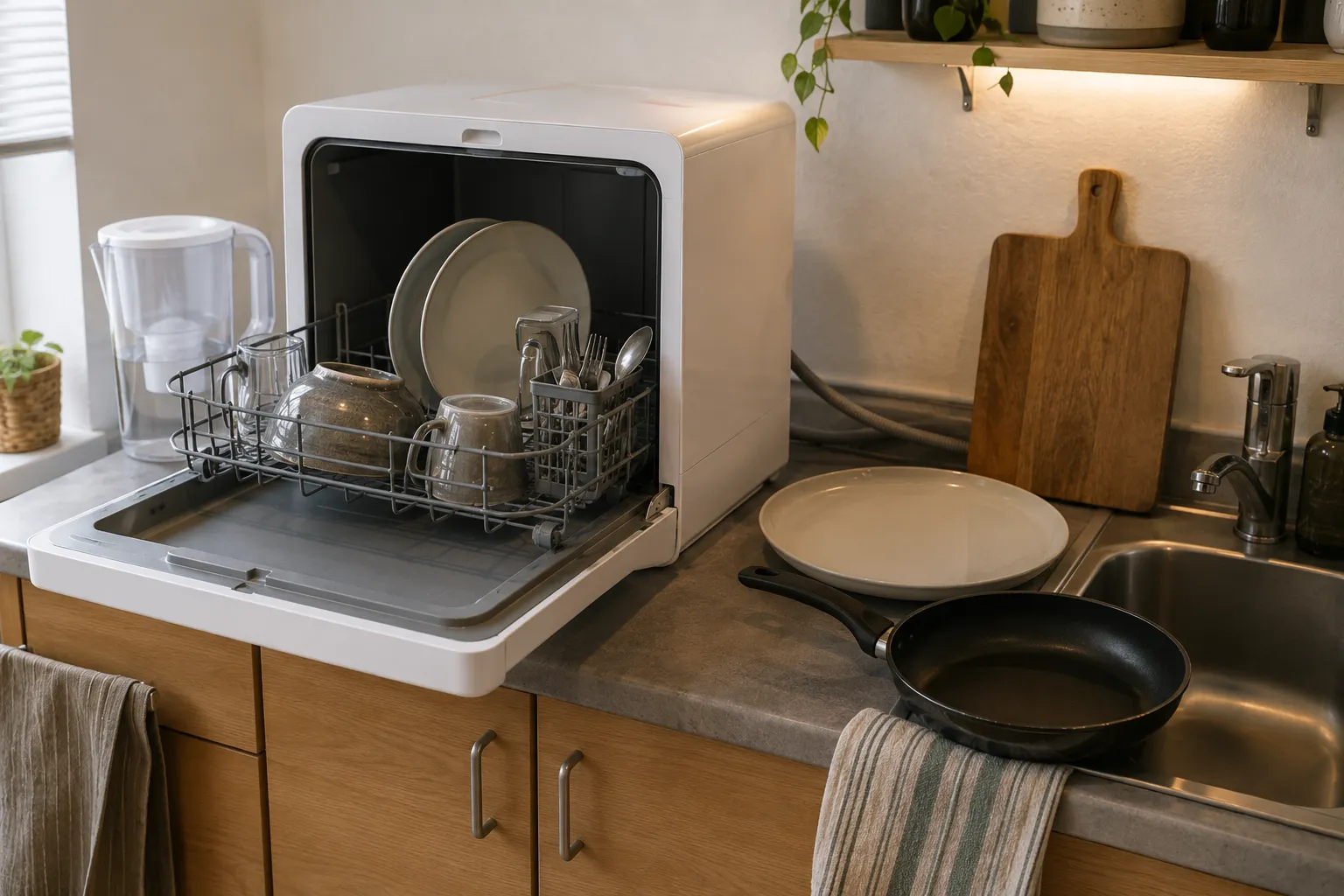
The HAVA R01 is the straightforward choice when the priority is a compact, clearly documented water-tank setup. HAVA lists a built-in 5 L tank that can be filled with the included pitcher, while also allowing a faucet connection through its inlet hose. The brand states that the outlet hose can drain to a sink or bucket, so the practical setup is flexible without requiring permanent plumbing changes.
HAVA lists the R01 at 16.86 x 16.75 x 18.05 in and 28.7 lb before water and dishes. Those dimensions are useful for a narrow counter, but they are not the whole footprint. Leave room above the unit to fill the tank, in front of it to open the door, and beside it to transfer dishes without blocking the sink.
The official rack guidance covers a light daily load of bowls, cups, small plates, dinner plates, and utensils. That makes the R01 more realistic for one person or a couple running frequent smaller loads than for a kitchen that produces large pans and several full meals between cycles.
What to verify before choosing it:
- The drain hose can reach your sink or another destination HAVA permits.
- Your counter has clearance for the
18.05 inheight and the tank-filling routine. - Your usual plates and bowls match the stated rack guidance.
- You are comfortable filling the tank for each manual-fill cycle.
The R01 is not a recommendation to ignore faucet compatibility or drainage. Its value is giving you two documented water-supply options when the faucet is uncertain.
Best Water-Tank Upgrade for Hard Water: HAVA R09
The HAVA R09 occupies a different role from the R01 even though the outer dimensions are the same. HAVA lists a 5 L built-in tank, an optional faucet inlet, and a drain hose in the package. It also lists three place settings, seven wash cycles, an integrated water softener, and delayed start.
The water-softener feature is the reason to consider this model rather than treating it as a cosmetic upgrade. Hard-water conditions can make scale management a relevant ownership concern, but local water conditions and the product instructions should determine whether that feature matters enough to you. Do not assume that a softener removes routine cleaning or maintenance requirements.
HAVA lists the R09 at 16.86 x 16.75 x 18.05 in and 31.5 lb before water and dishes. Its stated capacity is slightly larger than the R01’s role, but it remains a compact countertop appliance. It does not change the limits around oversized cookware, counter support, drain routing, or rental approval.
What to verify before choosing it:
- Your water conditions and the current manual make the softener feature relevant.
- You have room for the same
18.05 inheight and a full manual-fill workflow. - You need the additional cycles or delayed-start function rather than simply a larger rack.
- The drain hose and outlet can be kept clear of water and foot traffic.
This is the higher-feature option for a measured tank setup, not a replacement for measuring or a guarantee of more usable capacity for every kind of dish.
A Documented Compact Alternative: Midea MDC17P0ABB
Midea lists the MDC17P0ABB with a 5 L built-in water tank, a water pitcher, a quick-connect inlet hose with adapter, and a drain hose. It is a useful comparison point because the manufacturer publishes a compact outer size of 17.1 in wide, 16.5 in deep, and 17.2 in high, along with an empty weight of 36.6 lb. Midea also states that its adjustable interior can hold more than 30 items and dishes up to 9.5 inches.
The dimensions make it easier to reject or shortlist before ordering. It is shorter than the two HAVA models but heavier, so the counter-support question remains important. A lower height is helpful only if the machine also has enough clearance for filling, loading, and the route from counter to sink.
At the time of fact checking, Midea’s official page showed a notification option rather than a direct purchase option. Treat this model as a specification benchmark and confirm current seller availability before making it part of an actual buying decision. Do not assume that an old retailer listing, a different color, or a similarly named version has the same included hoses or tank setup.
What to verify before choosing it:
- The exact
MDC17P0ABBversion is available from a seller you trust. - Included components still list the pitcher, inlet hose, and drain hose.
- Your largest everyday plate fits within the stated 9.5-inch guidance.
- The 36.6 lb empty weight works for the proposed counter before water and dishes are added.
Tank Filling vs. Faucet Connection: Use Both Only When They Help
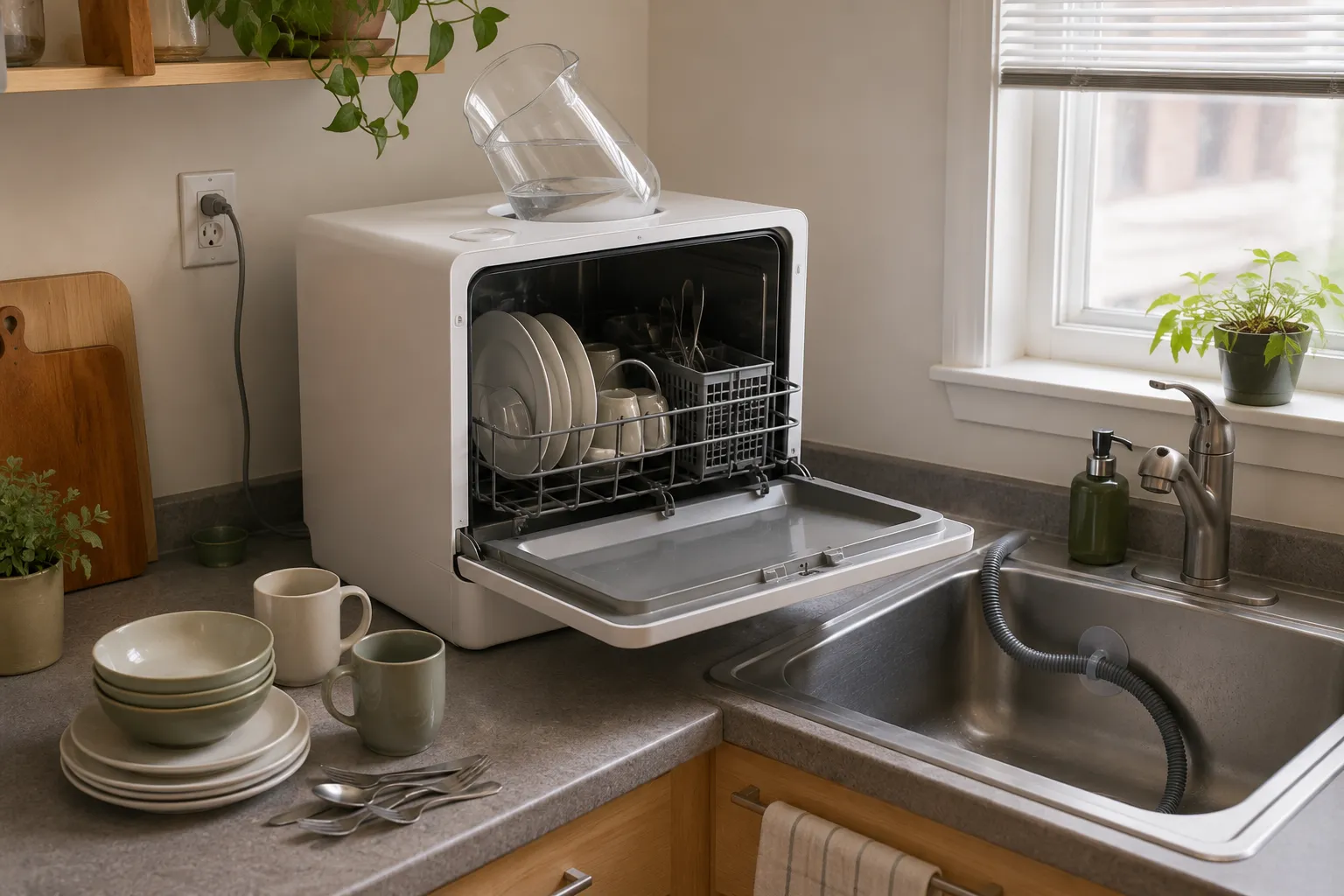
All three models document a built-in tank and an optional faucet inlet. That does not mean you need to use both methods or that a faucet connection is always more convenient.
| Situation | More practical approach |
|---|---|
| Incompatible or inconvenient faucet | Fill the built-in tank manually and keep the drain hose planned. |
| Compatible faucet and frequent washing | Use the documented inlet connection if it simplifies your routine. |
| No safe drain path | Do not buy a tank model until you have solved the drainage issue. |
| Counter is the only food-prep area | Reconsider the appliance category instead of treating the tank as a space solution. |
Manual filling is not a drawback when it removes the exact obstacle that kept you from using a countertop dishwasher. It becomes a drawback when it adds a repeated task to a household with large, frequent dish loads. Be honest about which of those descriptions matches your routine.
A Practical Apartment Setup Check
Before ordering any water-tank dishwasher, stand at the intended counter and check the full sequence:
- Measure counter width, depth, and clearance below upper cabinets.
- Confirm the appliance body has a level, supported surface and a safe, accessible outlet.
- Trace the drain-hose path to the sink without sharp bends, a trip risk, or a route that prevents normal sink use.
- Leave room for the pitcher and for opening the dishwasher door.
- Compare your everyday plates, bowls, mugs, and cookware with the manufacturer’s rack guidance.
- Read the lease or building rules for water-using appliances and seek approval when required.
This check is more valuable than choosing by wash-cycle count alone. A product can have the right water tank and still be impractical because its open door blocks the walkway or its drain hose cannot stay secure.
FAQ
Do built-in water-tank dishwashers still need a sink?
Usually, yes. A water tank removes the need for a faucet to supply the wash water, but the machine still produces wastewater. Follow the current manual for the exact model and use only its permitted drainage arrangement.
Is a 5 L tank enough for an apartment dishwasher?
It can be enough for a compact, manual-fill dishwasher because that is the tank size stated for the models in this guide. Whether it suits you depends on your willingness to fill it each cycle, your dish load, and the machine’s documented capacity. It does not make the appliance suitable for every household or every cookware item.
Can I put a water-tank dishwasher anywhere on the counter?
No. It needs a stable surface, working clearance, a safe outlet, and a drain-hose route. It also needs to be close enough to the sink that daily loading and draining are practical.
Is a water-tank countertop dishwasher good for renters?
It can be a practical option when a faucet connection is the obstacle and the apartment has a safe drain route. Check the model manual, the proposed counter setup, and your lease or building rules before purchasing or operating one.
Bottom Line
The HAVA R01 is the clearest starting point when you want a compact 5 L water-tank dishwasher with a documented manual-fill and optional faucet setup. The HAVA R09 is the higher-feature alternative when an integrated water softener and additional cycles fit your needs. The Midea MDC17P0ABB offers a useful compact-size comparison, but current availability must be confirmed before it can be treated as a purchase option.
Choose a built-in tank because it solves a real faucet limitation, not because it eliminates water management. The right apartment dishwasher still requires a measured counter, secure drainage, a safe outlet, and a dish load that fits its rack.