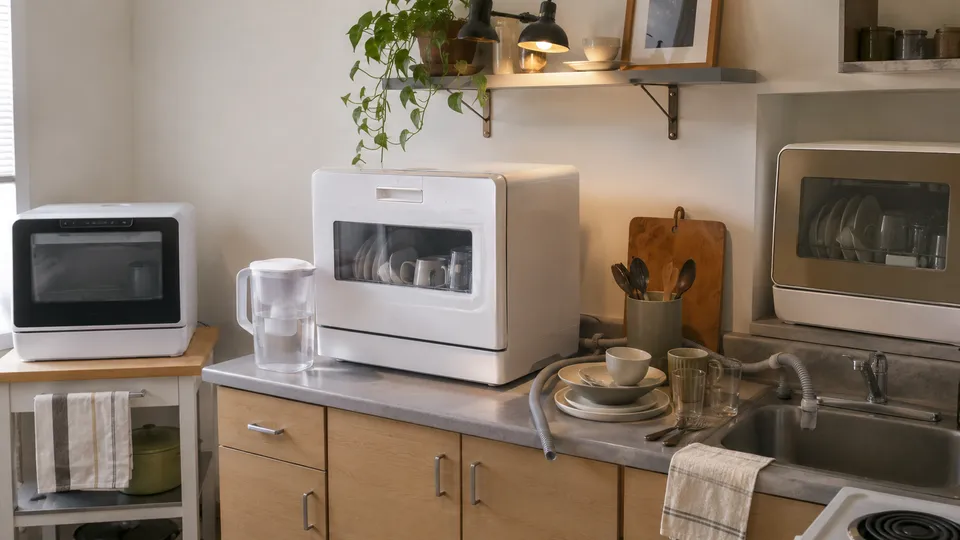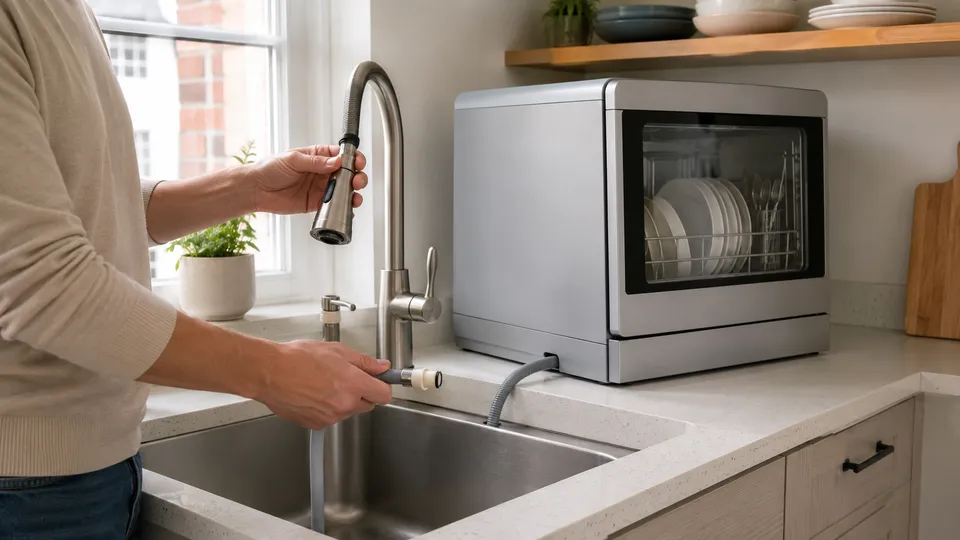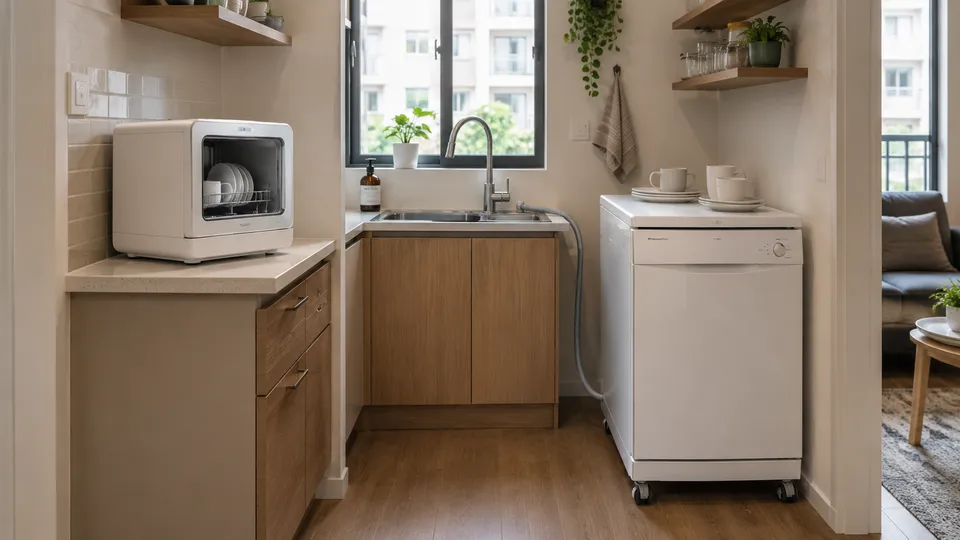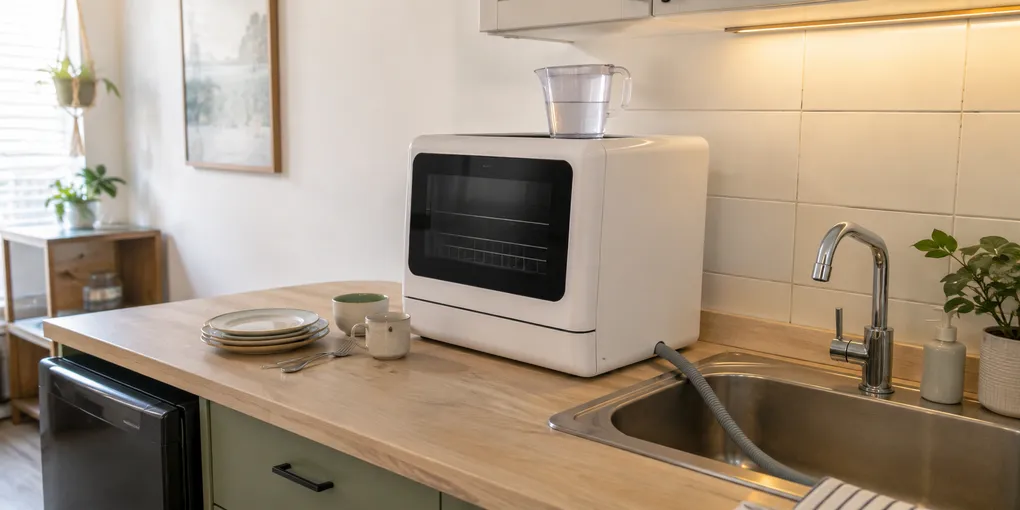
The short answer is no: some countertop dishwashers can run without connecting their water inlet to a kitchen faucet. Models with a built-in water tank can be filled manually. But “no hookup” does not mean “no setup.” You still need to fill the machine, give its drain hose a safe destination, place it on a suitable surface, and use an accessible outlet.
That distinction matters in an apartment. A water-tank dishwasher can solve the problem of an incompatible pull-down faucet or a rental where you do not want a faucet adapter attached every day. It does not solve a counter with no room, a sink that cannot accept the drain hose, or a lease that prohibits the intended setup. For the compatibility checks behind that decision, see whether a countertop dishwasher can work with a pull-down faucet.
If the appliance you are considering is a floor-standing portable model rather than a countertop machine, use the separate portable dishwasher pull-down faucet compatibility guide before treating an adapter as a solution.
This guide explains what a no-hookup countertop dishwasher actually requires. It is not a product ranking or an installation manual for every model. Check the current manual for the exact dishwasher, along with your lease and building rules, before buying or operating one.
For a broader product comparison by capacity and water setup, start with the best countertop dishwashers for small apartments.
Quick Answer: What Does “No Hookup” Mean?
For countertop dishwashers, the phrase can describe two different situations:
| Setup | What it avoids | What it still needs |
|---|---|---|
| Built-in water tank | A faucet inlet connection for the wash water | Manual filling, drain-hose routing, counter space, and an outlet |
| Faucet-connected countertop machine | Permanent plumbing changes | A compatible faucet adapter, drain-hose routing, counter space, and an outlet |
| Floor-standing portable dishwasher | Built-in installation in cabinetry | Floor space and the model’s documented supply and drain setup |
The first option is what most apartment shoppers mean by a no-hookup countertop dishwasher. You add water to an onboard tank instead of taking it from the faucet. Dirty water still has to leave the machine. Do not assume that a built-in tank means the dishwasher can operate away from any sensible drain location.
When capacity, floor space, and faucet access are the decision rather than the water tank alone, compare countertop and portable dishwashers for apartments.
Built-In Water Tank: The Practical Apartment Option
A built-in tank can be useful when a faucet connection is uncertain, inconvenient, or incompatible with the kitchen. The normal routine is simple in principle: load the dishwasher, add the stated amount of water, run the cycle, and keep the drain hose directed to the destination specified by the manufacturer.
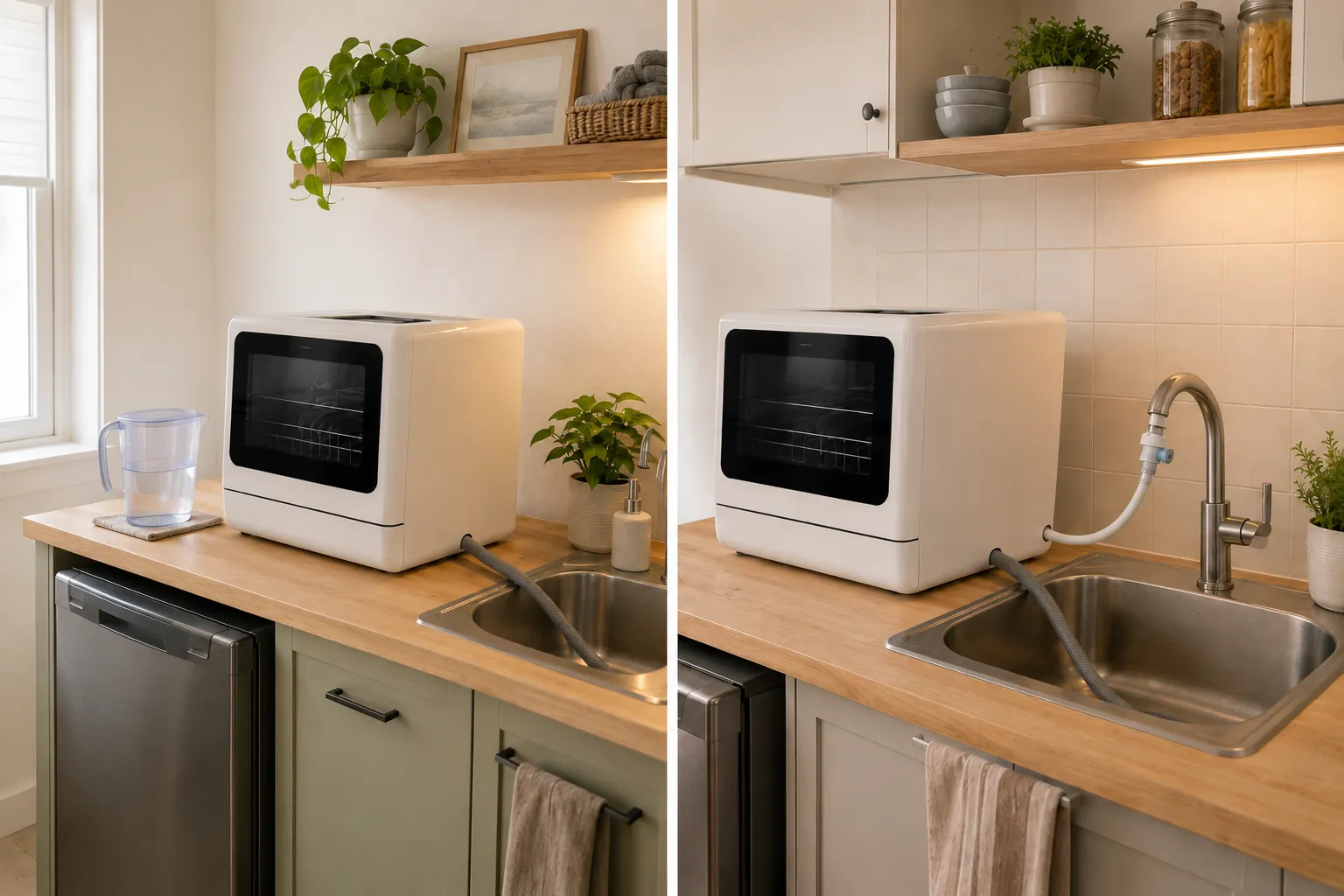
The tradeoff is manual work. Every cycle starts with filling the tank. The machine also tends to have a smaller interior than a larger faucet-connected countertop dishwasher. That is often reasonable for one person or a light daily dish load, but not necessarily for a household that cooks several full meals each day.
Two current examples show what to check:
| Model | Official water-tank and setup facts | Space facts to check |
|---|---|---|
| HAVA R01 | HAVA lists a built-in 5 L tank that can be filled with the included pitcher or through a faucet connection. The company says its outlet hose can drain to a sink or bucket. | 16.86 x 16.75 x 18.05 in; 28.7 lb before adding water and dishes |
| Midea MDC17P0ABB | Midea lists a 5 L built-in water tank. Its included components include a water pitcher and drain hose, as well as a quick-connect inlet hose. | 17.1 in wide, 16.5 in deep, 17.2 in high; 36.6 lb before adding water and dishes |
These are examples of how specifications can differ, not a claim that either model is right for every apartment. Product pages, manuals, included accessories, and regional versions can change. Confirm the exact model number and current instructions before ordering.
When your faucet limitation is already clear and you want to compare specific tank models, read our built-in water-tank countertop dishwasher picks for apartments.
A Water Tank Does Not Remove the Drainage Requirement
This is the most common point of confusion. A dishwasher with a tank does not need a faucet to supply wash water, but it still produces wastewater. Its drain hose needs a safe route to a sink or another destination the manufacturer explicitly permits.
Before buying, stand in the exact place where you expect the appliance to live and answer these questions:
- Can the drain hose reach the sink without being stretched, sharply bent, or routed across a walkway?
- Will loading the dishwasher or using the sink knock the hose out of place?
- Is there a safe way to keep the outlet and power cord clear of water?
- Can you monitor the first few cycles rather than treating the setup as unattended?
Do not invent a permanent plumbing arrangement, alter a pipe, or force a hose adapter because an online listing calls a product “portable.” Follow the current manual and ask your landlord or building manager when the lease requires approval.
Built-In Tank vs. Faucet Connection
Neither water method is automatically better. The right choice depends on what limits your kitchen.
Choose a built-in tank when
- Your kitchen faucet has a pull-down, pull-out, spray, or unusual aerator that may not work with a quick-connect adapter
- You want to avoid using the faucet as part of every wash cycle
- You can fill the tank comfortably and have a reliable drainage path
- Your daily dish load is small enough for a compact rack
Choose a faucet-connected countertop machine when
- Your faucet is documented as compatible with the model’s connector
- You prefer not to manually fill the water tank each time
- You need the larger capacity common to six-place-setting countertop machines
- You can spare the sink while the hose is connected and keep the hose route clear
Skip both options when
- You do not have a stable, measured counter location near a sink and outlet
- Your only clear counter area is needed for food preparation
- You regularly need to wash cookware that will not fit in a compact rack
- You cannot make a safe, approved drainage plan
For the product-level tradeoffs between a tank model and a larger quick-connect model, see our countertop dishwasher comparison for small apartments.
Measure the Whole Setup, Not Just the Machine Body
A dishwasher may fit inside a counter’s width and depth but fail as a daily appliance. The useful footprint includes the machine, open-door access, water pitcher, drain-hose route, dish transfer space, and nearby outlet.
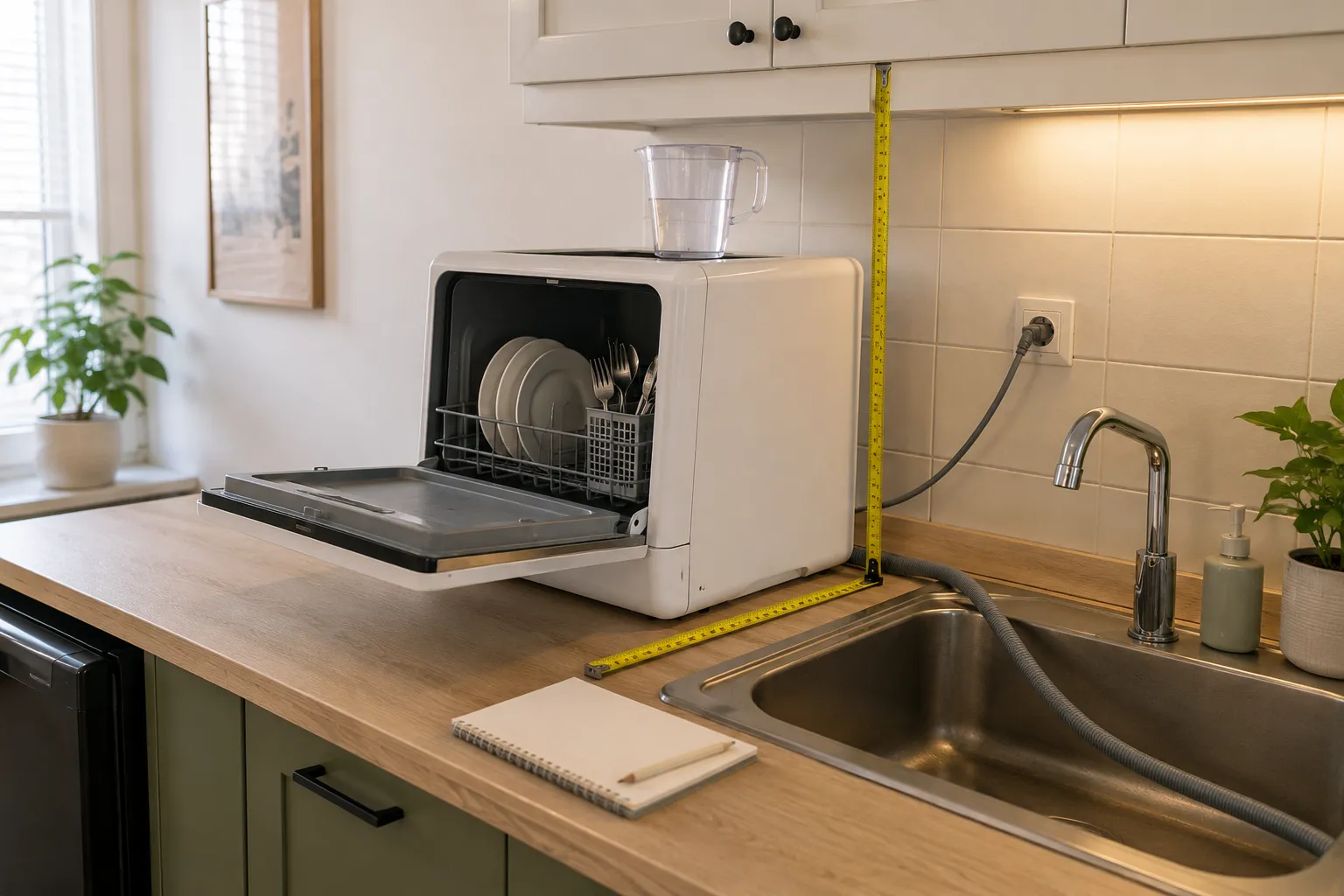
| Measurement or check | Why it matters |
|---|---|
| Counter width and depth | Confirms that the body sits fully on a level, supported surface |
| Clearance below upper cabinets | Lets you access controls and any fill opening without scraping a cabinet |
| Counter load and stability | Water, dishes, and the appliance together are heavier than the empty-unit listing weight |
| Sink-to-counter path | Determines whether you can move dishes and manage the drain hose without a daily obstacle |
| Outlet location | Keeps the cord accessible and away from sink splashes or a hose route |
Avoid using a casual extension lead or overloaded power strip as the solution to a missing outlet. A heat-producing kitchen appliance needs a safe, accessible power arrangement that follows its instructions.
Is a No-Hookup Dishwasher Better for Renters?
It can be a better fit when the alternative is attaching an adapter to a faucet that may be incompatible or when you want to avoid permanent plumbing changes. But renter-friendly does not mean rule-free.
Read the lease and building rules before you buy. Some properties limit water-using appliances, require approval, or set conditions for hose use and water damage. A landlord may also care about where the machine sits and whether the counter can handle its weight. Keep the manufacturer’s documentation available and ask for written clarification when the rule is not clear.
A Realistic One-Person Routine
For a one-person apartment, a tank dishwasher can be most practical when it is treated as a small daily-load appliance rather than a place to store dishes all week.
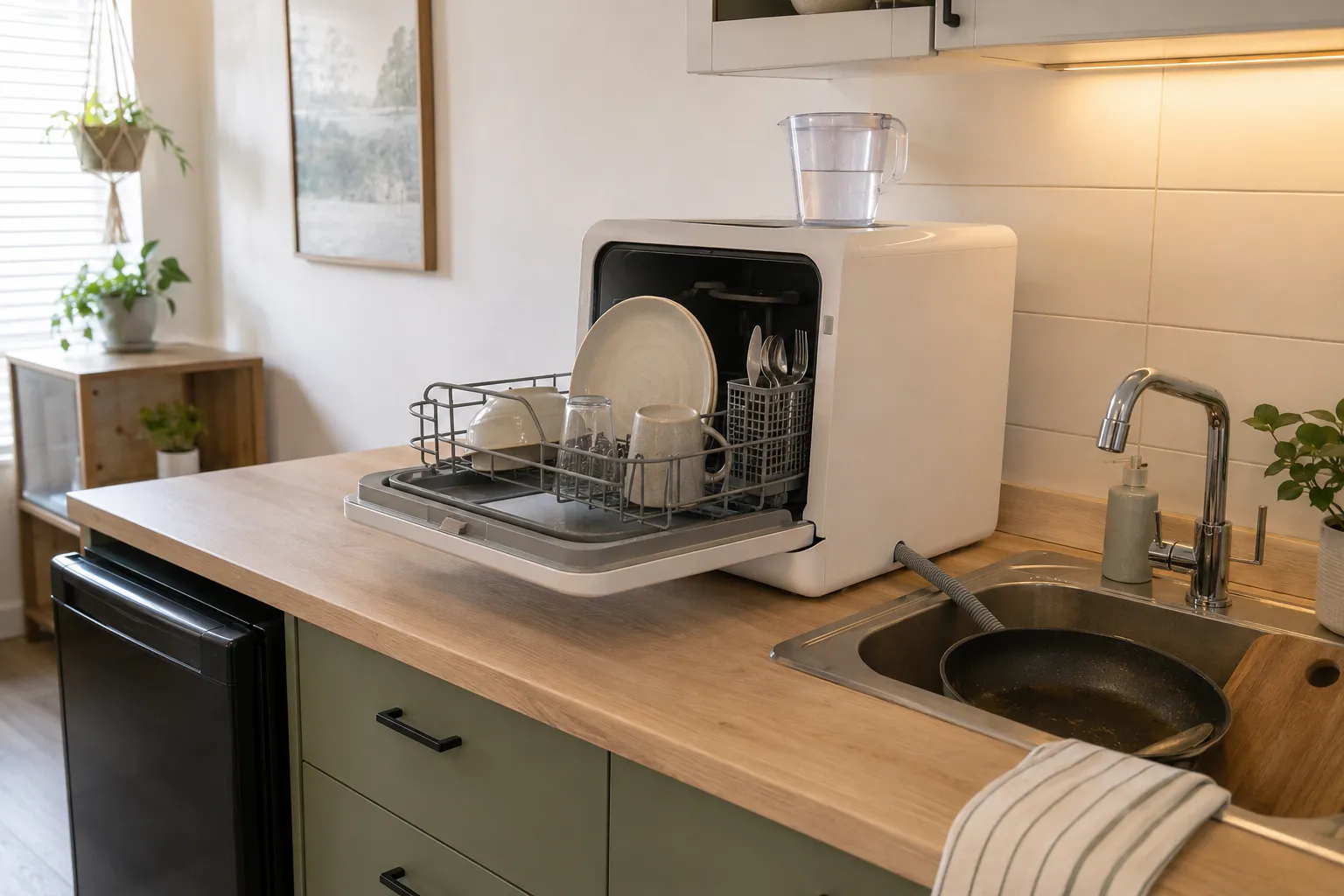
- Keep the machine near the sink with the hose route planned before loading it.
- Load the everyday plates, bowl, mug, glass, and utensils that fit according to the manual.
- Fill the tank to the model’s stated requirement if you are not using the faucet inlet.
- Confirm the drain hose position before starting a cycle.
- Run the machine when you can check the first setup cycles and unload it after the cycle finishes.
- Hand-wash oversized pans, cutting boards, and other items that do not fit the rack safely.
This routine is not a promise of capacity or water use for every dishwasher. It is a way to decide whether manual filling and compact loading suit the way you actually cook.
FAQ
Do all countertop dishwashers need a faucet hookup?
No. Some models have a built-in tank that you fill manually. Other countertop dishwashers use a quick-connect inlet hose for a compatible kitchen faucet. Check the exact model rather than assuming every compact dishwasher includes both options.
Can I use a countertop dishwasher without a sink?
Not automatically. A built-in tank can remove the need for a faucet water inlet, but wastewater still needs an approved drainage route. Check the manufacturer’s current instructions before considering any setup that is not next to a usable sink.
Do no-hookup dishwashers still need a drain hose?
Usually, yes. The HAVA R01 and Midea MDC17P0ABB both list a drain hose as part of the setup or included components. The final requirement is the current manual for the specific model you buy.
Are water-tank dishwashers good for a small apartment?
They can be, particularly for a one-person or light daily dish load where faucet compatibility is the problem. They still need counter space, manual filling, drainage, an outlet, and a rack size that fits your dishes.
Can I put a countertop dishwasher under a cabinet?
Only when the measured height and operating clearance work. Check the product dimensions, the fill opening or lid access, and the room needed to load and unload dishes. A machine that only barely fits under a cabinet is often inconvenient to use.
Bottom Line
Some countertop dishwashers can run without a faucet hookup because they use an onboard water tank. That makes them a useful option for renters and small apartments with an incompatible faucet, but it does not make them independent of water management. You still need a place to fill the tank, a secure drainage route, a stable counter, a safe outlet, and permission where required.
Choose a water-tank model when manual filling is easier than a faucet connection. Choose a faucet-connected model when the connector is compatible and a larger load matters more. In either case, measure the whole working setup before buying, not only the appliance body.