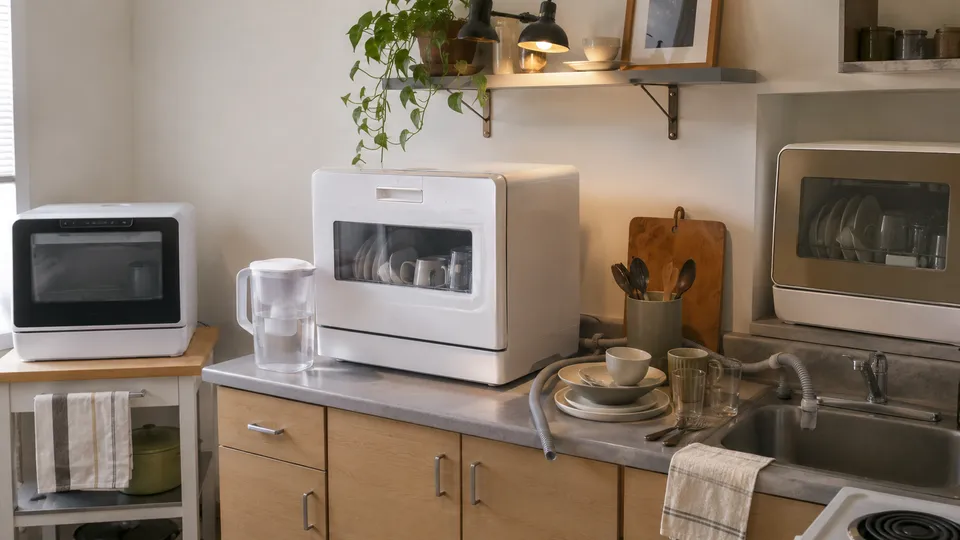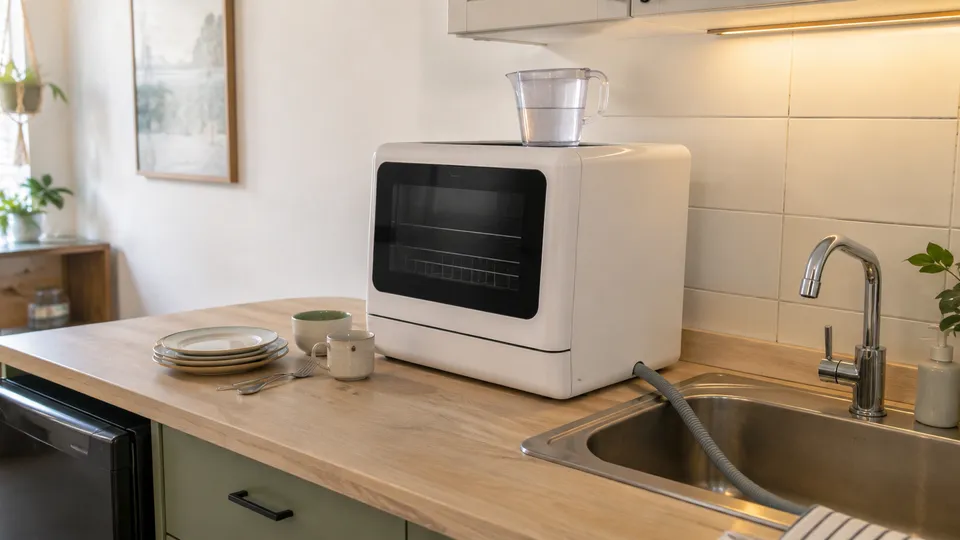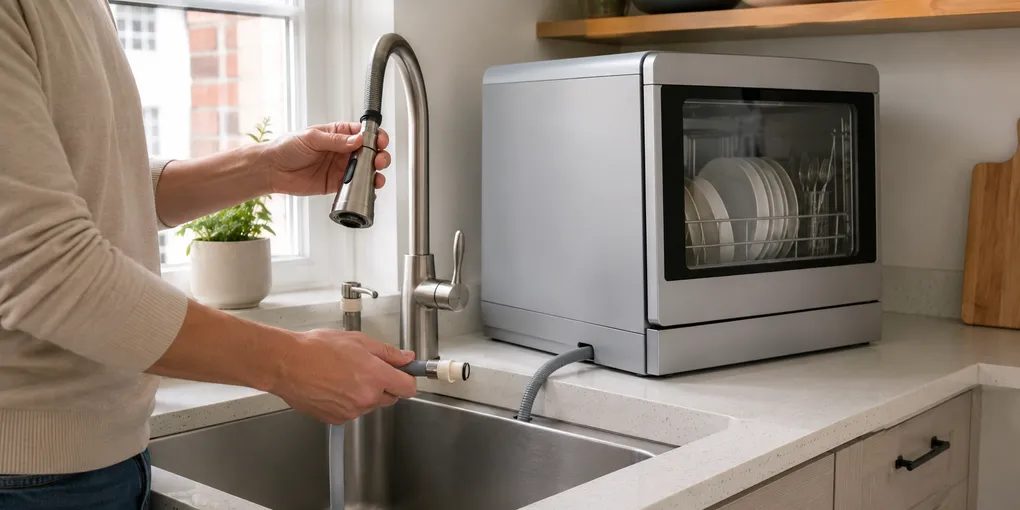
A countertop dishwasher can be convenient in a small apartment, but a pull-down faucet changes the buying decision. Many countertop models use a quick-connect hose at the faucet aerator. A pull-down or pull-out spout may have no suitable fixed threaded end, may move while the hose is attached, or may not match the connector the dishwasher manufacturer specifies.
That does not mean every pull-down faucet is impossible. It does mean that an online listing for a “universal” faucet adapter is not proof that your kitchen and dishwasher will work together. Check the exact appliance instructions and your faucet before you order either one.
This guide explains the decision process. It is not a plumbing modification guide, a promise that a particular adapter will fit, or a substitute for the current manual and rental rules. If you are still deciding between water setups, start with what a no-hookup countertop dishwasher actually requires.
Quick Answer
You may be able to use a countertop dishwasher with a pull-down faucet only when the dishwasher manufacturer documents a compatible connection and your exact faucet can accept it safely. Do not assume that removing the aerator or buying an adapter makes a pull-down faucet compatible.
For many renters, the simpler answer is a countertop dishwasher with a built-in water tank. You fill its tank manually instead of connecting the inlet hose to the faucet. That avoids the water-inlet compatibility question, though it still requires a safe drain-hose route, counter space, and an accessible outlet.
| Your situation | Better next step |
|---|---|
| You have a fixed faucet with a standard exposed aerator and the dishwasher manual documents compatibility | Confirm the exact connector before buying the faucet-connected model. |
| You have a pull-down, pull-out, spray, or unusual faucet | Treat compatibility as unconfirmed until the appliance maker confirms it for your exact setup. |
| You do not want to depend on a faucet connection for each cycle | Compare a built-in water-tank countertop dishwasher. |
| You have no safe drain route, stable counter, or usable outlet | Pause the purchase rather than trying to solve the problem with an adapter. |
Why a Pull-Down Faucet Is Different
A conventional fixed kitchen faucet often has an aerator at the end of a rigid spout. Some countertop dishwashers use that location for a temporary quick-connect fitting. The exact thread, aerator design, and connector still matter, but the spout itself does not move.
A pull-down faucet has a flexible hose inside the spout. A pull-out faucet uses a similar moving-head arrangement. These designs can create several separate questions:
- Does the faucet have a removable aerator with a documented thread that matches the dishwasher connector?
- Does the appliance maker permit connection to this faucet type, rather than merely saying it works with “most” kitchen faucets?
- Can the moving spray head and hose remain stable while the dishwasher is filling and draining?
- Will using an adapter interfere with the faucet’s normal function, warranty, or rental rules?
The important word is documented. A visual resemblance to a standard faucet, a video using another brand, or a product review with a different adapter cannot confirm your own installation.
What the Dishwasher Connector Claim Really Means
Faucet-connected countertop models are not all designed around the same fitting. The Danby DDW631SDB is a useful example because Danby describes its quick-connect feature as compatible with most kitchen faucets. Its FAQ adds that the units are designed for standard North American faucets.
That is helpful category information, but it is not a guarantee for a pull-down faucet. The wording leaves room for faucets with an unusual aerator, concealed threads, a spray head, a nonstandard shape, or a different regional fitting. It is also why this article does not recommend a generic adapter as a universal answer.
Before purchasing a faucet-connected dishwasher, keep the exact model number and consult its current manual. Look for the stated faucet or connector requirement, included parts, installation limits, and any exclusions. Then compare that requirement with the faucet you actually use, not the faucet shown in a retailer photo.
Four Checks Before You Buy an Adapter or Dishwasher
1. Identify the faucet type
Check whether your faucet is fixed, pull-down, pull-out, side-spray, or another specialty design. A fixed faucet with an exposed aerator is a different starting point from a pull-down sprayer head. Take the faucet model information from its documentation when possible instead of trying to identify a thread size by sight.
2. Read the dishwasher instructions first
Find the exact dishwasher’s current manual before comparing adapters. Confirm whether it uses a quick-connect fitting, what faucet type it expects, and whether the inlet and drain use one combined assembly or separate hoses. A retailer question-and-answer section is not a replacement for the manufacturer instructions.
3. Plan for drainage, not only water supply
A faucet-compatible inlet does not remove the drainage question. The drain hose must reach a sink or another destination the manufacturer specifically permits, without being stretched, sharply bent, crossing a walkway, or sitting where it can be knocked loose.
This matters just as much for a manual-fill unit. A built-in tank avoids a faucet inlet connection, but it does not make the appliance sink-free. For a fuller planning checklist, read our no-hookup apartment dishwasher guide.
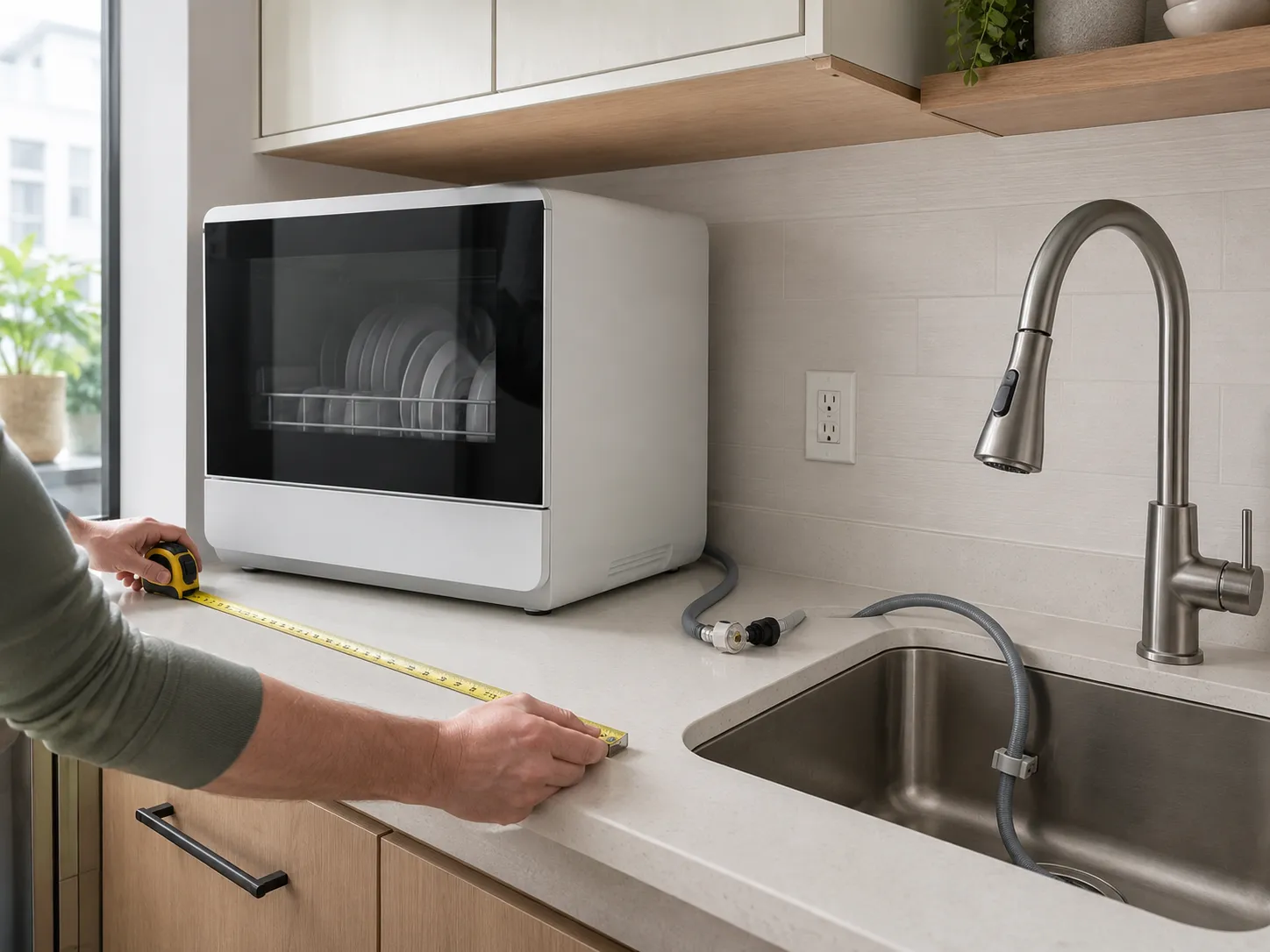
4. Check the real working footprint
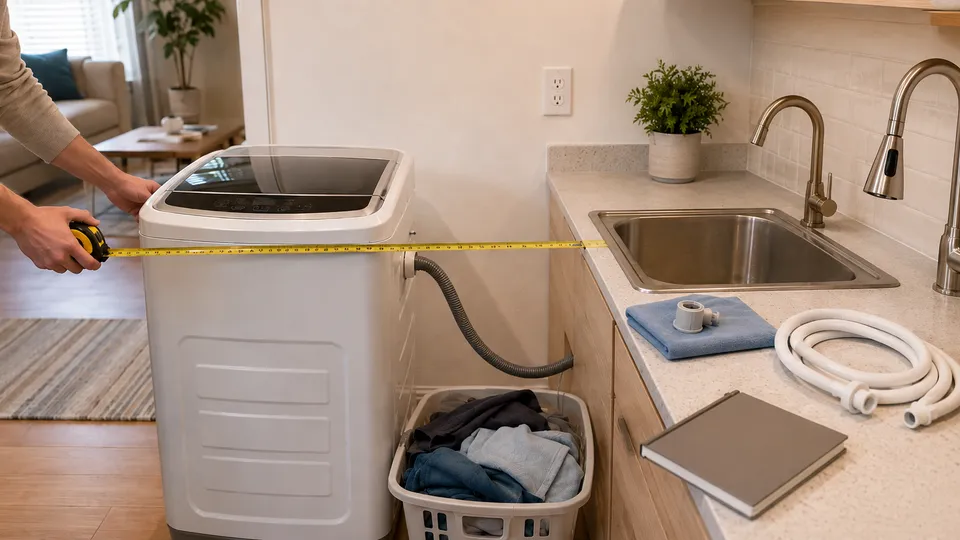
Measure more than the appliance body. You need a stable, level counter; clearance for the door; space to transfer dishes; an accessible outlet kept clear of water; and a sensible hose path to the sink. Also check the lease or building rules before relying on a temporary fitting or placing a heavy appliance on a counter.
What a Faucet Adapter Can and Cannot Solve
An adapter can sometimes bridge two compatible, documented fittings. It cannot turn every faucet into a safe dishwasher connection.
It does not prove that:
- a pull-down spray head can support the connection while operating;
- the dishwasher manufacturer approves your faucet type;
- the faucet’s aerator threads, seals, and water path match the adapter;
- the faucet will still function correctly after the adapter is installed; or
- the rental agreement allows the intended setup.
Avoid forcing a connection, modifying plumbing, or treating a leak-free test at the sink as a complete safety check. When the manual does not clearly support the arrangement, a water-tank machine is usually the lower-friction category to compare.
A Better Alternative When the Faucet Is Uncertain: Built-In Water Tanks
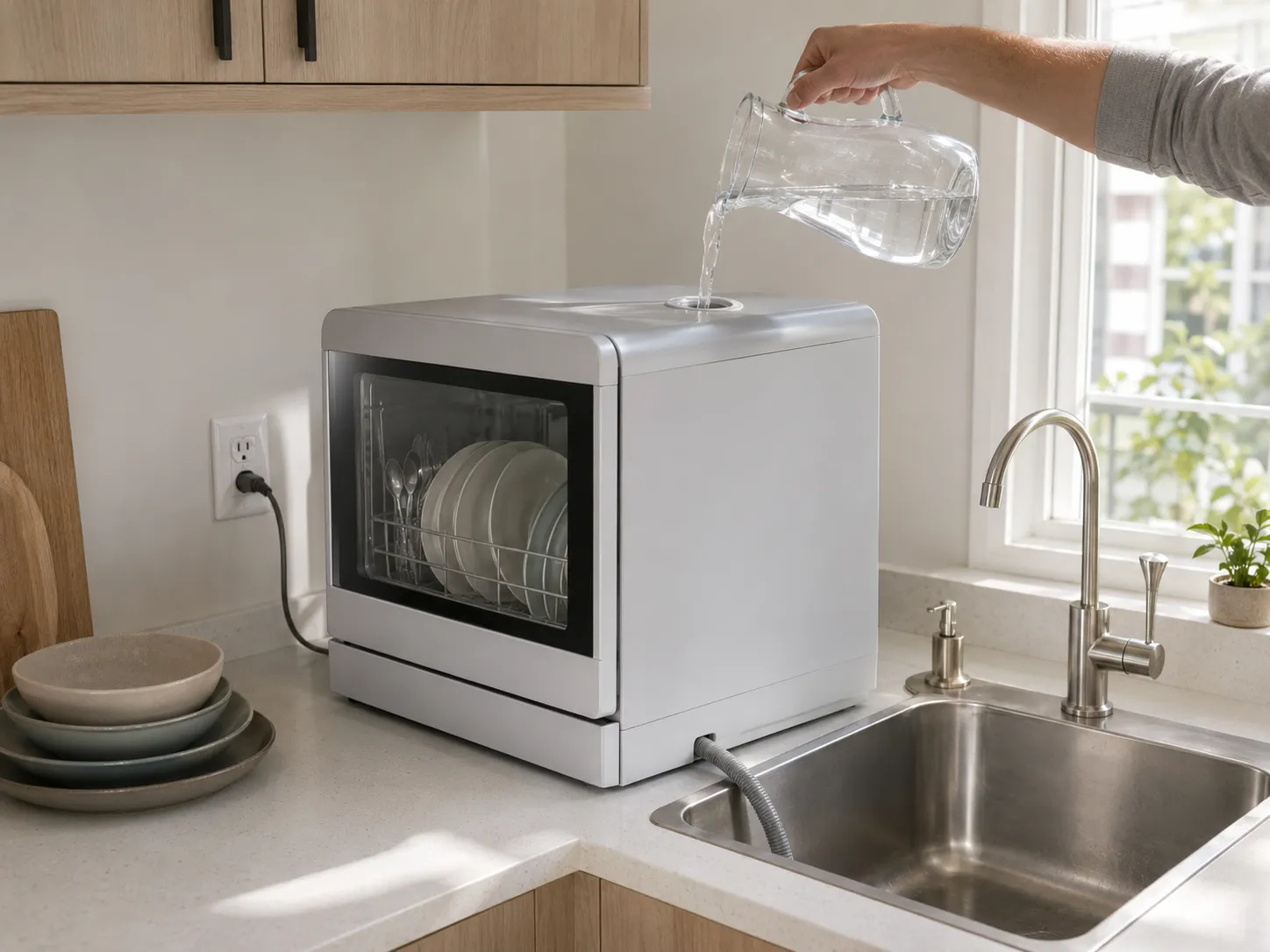
A countertop dishwasher with a built-in tank can be the practical alternative when a pull-down faucet is the main obstacle. You add the wash water manually, commonly with a supplied pitcher, rather than connecting the inlet to the faucet every cycle.
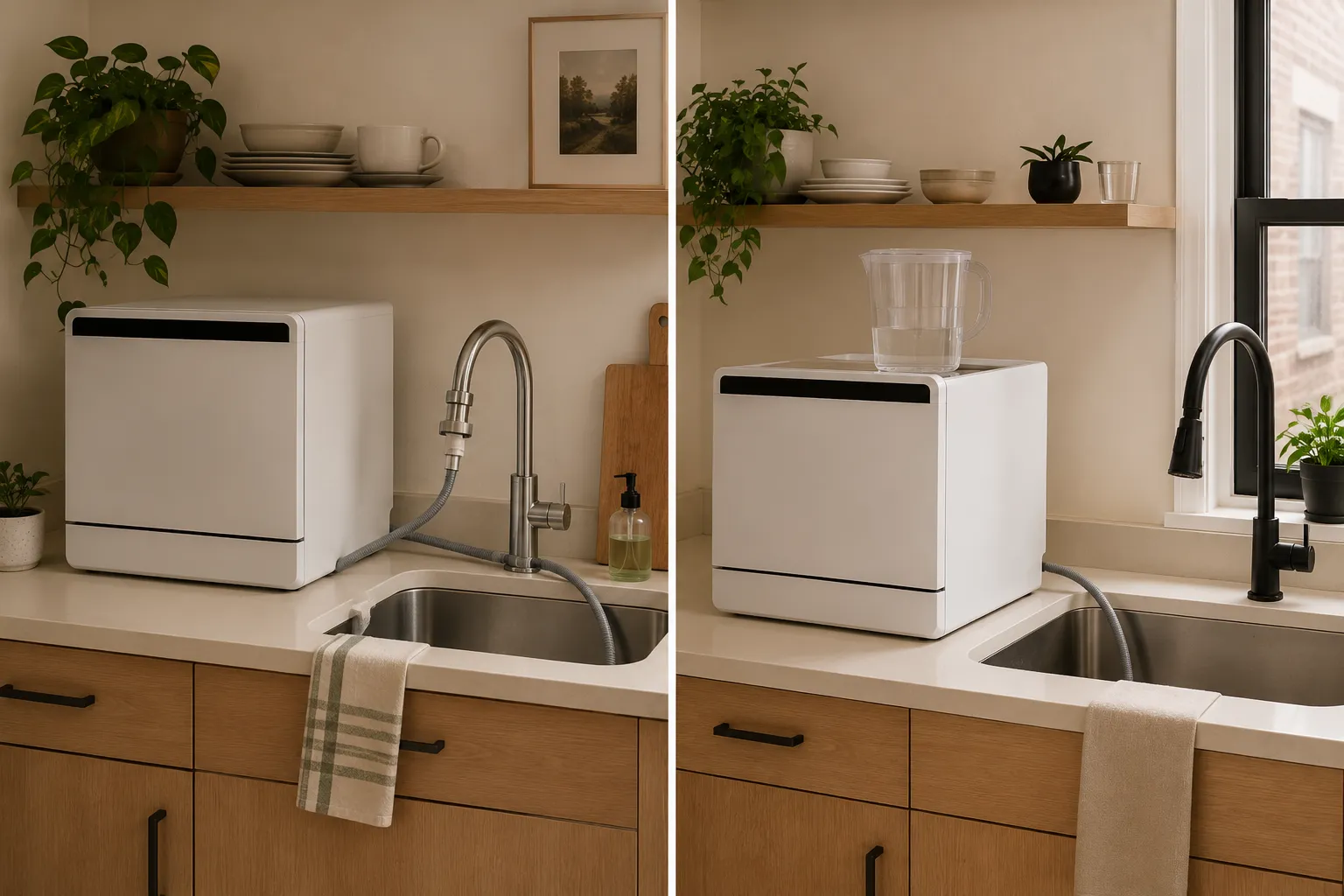
The HAVA R01 illustrates the category. HAVA lists a built-in 5 L water tank that can be filled with the provided pitcher or through a faucet inlet. The company also states that its drain hose can lead to a sink or a bucket. Its body measures 16.86 x 16.75 x 18.05 in, so the fill opening, drain path, and door clearance still need to be measured around the appliance.
That combination makes a tank model useful when you can handle a manual fill routine and have a safe nearby drainage plan. It is not an invitation to place a dishwasher anywhere in the apartment. The empty machine, water, dishes, cord, and drain hose all need a stable, practical setup.
For current tank-model options and their product-level differences, compare countertop dishwashers with built-in water tanks for apartments.
Should You Choose a Larger Portable Dishwasher Instead?
Usually not just because the kitchen has a pull-down faucet. A full-size portable dishwasher on wheels may solve a capacity or counter-space problem, but it commonly still relies on the kitchen faucet for its supply and drainage arrangement. It is not automatically compatible with a pull-down faucet.
If you are considering a floor-standing model specifically, read whether a portable dishwasher can work with a pull-down faucet. The connector question is similar, but the machine category, hose arrangement, and floor-space tradeoff are different.
Choose that category only when you need the added capacity and have floor space to store it. First check the exact model’s hose reach, faucet requirement, path to the sink, and whether the appliance can be moved without blocking the kitchen. Our countertop vs. portable dishwasher comparison explains those space and capacity tradeoffs.
Decision Table: Connect, Use a Tank, or Skip the Setup
| Decision | When it is reasonable | What you still need to verify |
|---|---|---|
| Use a faucet-connected countertop dishwasher | The manual supports your fixed, standard faucet and the counter is close to the sink | Exact fitting, drain route, counter clearance, outlet, and rental rules |
| Choose a built-in water-tank countertop dishwasher | The faucet is uncertain or inconvenient, and the daily load is light enough for a compact rack | Fill routine, tank capacity, drain route, counter load, and door clearance |
| Consider a full-size portable dishwasher | Capacity is the genuine problem and you have suitable floor storage | Faucet compatibility, hose reach, floor route, storage space, and lease rules |
| Skip or delay the purchase | There is no safe counter or floor location, no workable drainage path, or no approval | A better kitchen layout or permission, rather than a more elaborate adapter |
Before You Order: A Short Compatibility Checklist
- Write down the exact dishwasher model number, not only its product title.
- Read the current manufacturer manual for its faucet and hose requirements.
- Identify your faucet type and retrieve its model documentation when available.
- Measure counter width, depth, cabinet clearance, and open-door space.
- Trace the drain-hose path all the way to its permitted destination.
- Confirm that the outlet is accessible and clear of sink splashes and hose routing.
- Check your lease or building rules before attaching fittings or operating the appliance.
When the faucet is fixed and documented as compatible, a faucet-connected countertop machine can be a convenient way to avoid filling a tank. When the faucet is pull-down or otherwise uncertain, choose certainty over an optimistic adapter purchase. A built-in tank is often the cleaner path, provided the drain and counter setup are genuinely workable.
For a broader comparison of compact models by capacity, water method, and small-kitchen fit, see the best countertop dishwashers for small apartments.
FAQ
Can a pull-down faucet connect to a countertop dishwasher?
Sometimes, but only when the dishwasher manufacturer documents compatibility with your faucet type and connector arrangement. A pull-down head, concealed aerator, or nonstandard fitting makes the answer uncertain. Do not assume a generic adapter makes it compatible.
Do countertop dishwasher faucet adapters work with every kitchen faucet?
No. An adapter can only help when the faucet and dishwasher connections are documented as compatible. It does not override a manufacturer limitation, change the faucet’s design, or create a safe drain route.
Is a water-tank countertop dishwasher really no-hookup?
It can avoid a faucet inlet connection because you fill the onboard tank manually. It still needs an outlet, a stable counter, and a drain hose leading to a manufacturer-approved destination. See what no-hookup countertop dishwashers actually need before choosing one.
Will a portable dishwasher on wheels solve a pull-down faucet problem?
Not necessarily. Portable models may provide more capacity and avoid taking counter space, but many still connect their supply and drain hoses to the kitchen faucet. Verify the current manual before treating one as an alternative.